We read your photo as:

Calculate the current across the 8 ohm resistor

Physics

ScanSolve AI Answer

Answer

224169 A\frac{224}{169} \, \text{A}

Step-by-step solution

3 steps
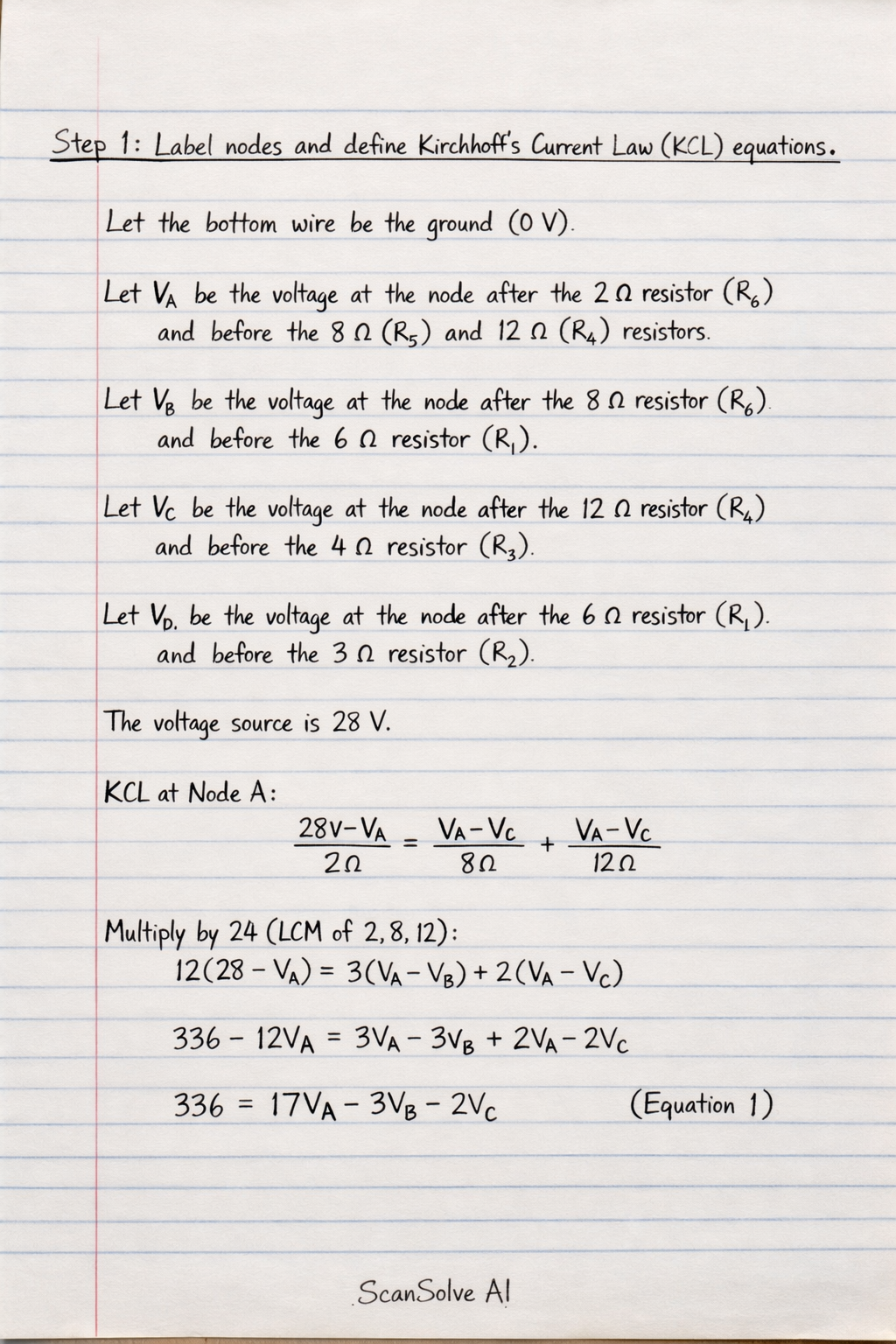
  1. Label nodes and define Kirchhoff's Current Law (KCL) equations.

    Let the bottom wire be the ground (0 V0 \, V).
    Let VAV_A be the voltage at the node after the 2 Ω2 \, \Omega resistor (R6R_6) and before the 8 Ω8 \, \Omega (R5R_5) and 12 Ω12 \, \Omega (R4R_4) resistors.
    Let VBV_B be the voltage at the node after the 8 Ω8 \, \Omega resistor (R5R_5) and before the 6 Ω6 \, \Omega resistor (R1R_1).
    Let VCV_C be the voltage at the node after the 12 Ω12 \, \Omega resistor (R4R_4) and before the 4 Ω4 \, \Omega resistor (R3R_3).
    Let VDV_D be the voltage at the node after the 6 Ω6 \, \Omega resistor (R1R_1) and before the 3 Ω3 \, \Omega resistor (R2R_2).
    The voltage source is 28 V28 \, V.

    KCL at Node A:

    28 V−VA2 Ω=VA−VB8 Ω+VA−VC12 Ω\frac{28 \, V - V_A}{2 \, \Omega} = \frac{V_A - V_B}{8 \, \Omega} + \frac{V_A - V_C}{12 \, \Omega}

    Multiply by 24 (LCM of 2, 8, 12):

    12(28−VA)=3(VA−VB)+2(VA−VC)12(28 - V_A) = 3(V_A - V_B) + 2(V_A - V_C) 336−12VA=3VA−3VB+2VA−2VC336 - 12V_A = 3V_A - 3V_B + 2V_A - 2V_C 336=17VA−3VB−2VC(Equation 1)336 = 17V_A - 3V_B - 2V_C \quad (\text{Equation 1})

    KCL at Node B:

    VA−VB8 Ω=VB−VD6 Ω\frac{V_A - V_B}{8 \, \Omega} = \frac{V_B - V_D}{6 \, \Omega}

    Multiply by 24:

    3(VA−VB)=4(VB−VD)3(V_A - V_B) = 4(V_B - V_D) 3VA−3VB=4VB−4VD3V_A - 3V_B = 4V_B - 4V_D 3VA=7VB−4VD(Equation 2)3V_A = 7V_B - 4V_D \quad (\text{Equation 2})

    KCL at Node C:

    VA−VC12 Ω=VC−0 V4 Ω\frac{V_A - V_C}{12 \, \Omega} = \frac{V_C - 0 \, V}{4 \, \Omega}

    Multiply by 12:

    VA−VC=3VCV_A - V_C = 3V_C VA=4VC(Equation 3)V_A = 4V_C \quad (\text{Equation 3})

    KCL at Node D:

    VB−VD6 Ω=VD−0 V3 Ω\frac{V_B - V_D}{6 \, \Omega} = \frac{V_D - 0 \, V}{3 \, \Omega}

    Multiply by 6:

    VB−VD=2VDV_B - V_D = 2V_D VB=3VD(Equation 4)V_B = 3V_D \quad (\text{Equation 4})
  2. Solve the system of equations for node voltages.

    From Equation 3, VC=14VAV_C = \frac{1}{4}V_A.
    From Equation 4, VD=13VBV_D = \frac{1}{3}V_B.

    Substitute VDV_D into Equation 2:

    3VA=7VB−4(13VB)3V_A = 7V_B - 4\left(\frac{1}{3}V_B\right) 3VA=7VB−43VB3V_A = 7V_B - \frac{4}{3}V_B 3VA=21VB−4VB33V_A = \frac{21V_B - 4V_B}{3} 3VA=173VB3V_A = \frac{17}{3}V_B 9VA=17VB  ⟹  VB=917VA(Equation 5)9V_A = 17V_B \implies V_B = \frac{9}{17}V_A \quad (\text{Equation 5})

    Now substitute VCV_C and VBV_B (in terms of VAV_A) into Equation 1:

    336=17VA−3(917VA)−2(14VA)336 = 17V_A - 3\left(\frac{9}{17}V_A\right) - 2\left(\frac{1}{4}V_A\right) 336=17VA−2717VA−12VA336 = 17V_A - \frac{27}{17}V_A - \frac{1}{2}V_A

    Find a common denominator (34) for the coefficients of VAV_A:

    336=VA(17×3434−27×234−1×1734)336 = V_A \left(\frac{17 \times 34}{34} - \frac{27 \times 2}{34} - \frac{1 \times 17}{34}\right) 336=VA(578−54−1734)336 = V_A \left(\frac{578 - 54 - 17}{34}\right) 336=VA(50734)336 = V_A \left(\frac{507}{34}\right) VA=336×34507=11424507 VV_A = \frac{336 \times 34}{507} = \frac{11424}{507} \, V
  3. Calculate the current across the 8 Ω8 \, \Omega resistor.

    The current across the 8 Ω8 \, \Omega resistor (R5R_5) is IR5=VA−VB8 ΩI_{R5} = \frac{V_A - V_B}{8 \, \Omega}.
    First, find the voltage difference VA−VBV_A - V_B:

    VA−VB=VA−917VA=(1−917)VA=17−917VA=817VAV_A - V_B = V_A - \frac{9}{17}V_A = \left(1 - \frac{9}{17}\right)V_A = \frac{17 - 9}{17}V_A = \frac{8}{17}V_A

    Now substitute VAV_A:

    VA−VB=817×11424507=8×1142417×507=913928619 VV_A - V_B = \frac{8}{17} \times \frac{11424}{507} = \frac{8 \times 11424}{17 \times 507} = \frac{91392}{8619} \, V

    Finally, calculate the current IR5I_{R5}:

    IR5=VA−VB8=9139286198=913928×8619=114248619 AI_{R5} = \frac{V_A - V_B}{8} = \frac{\frac{91392}{8619}}{8} = \frac{91392}{8 \times 8619} = \frac{11424}{8619} \, A

    Simplify the fraction by dividing by common factors. Both numerator and denominator are divisible by 3:

    11424÷38619÷3=38082873\frac{11424 \div 3}{8619 \div 3} = \frac{3808}{2873}

    Both are divisible by 17:

    3808÷172873÷17=224169\frac{3808 \div 17}{2873 \div 17} = \frac{224}{169}

    The fraction cannot be simplified further as 169=132169 = 13^2 and 224 is not divisible by 13.

    The current across the 8 Ω8 \, \Omega resistor is 224169 A\boxed{\frac{224}{169} \, \text{A}}.

Was this helpful?

Try one yourself

A new problem that tests the same skill.

Still stuck on this one?

Ask a follow-up, and the answer starts from this question.

Got a different question?Ask your own question
Handwritten step-by-step solution preview

Handwritten Step-by-Step Solution

Get this as a handwritten image on WhatsApp — like a tutor wrote it for you.

Try on WhatsApp