
We read your photo as:
Determine the voltage across the 5 resistor.
ScanSolve AI Answer
Step-by-step solution
3 stepsHere's the solution to the problem:
Part i· 2 steps
the reading on the ammeter
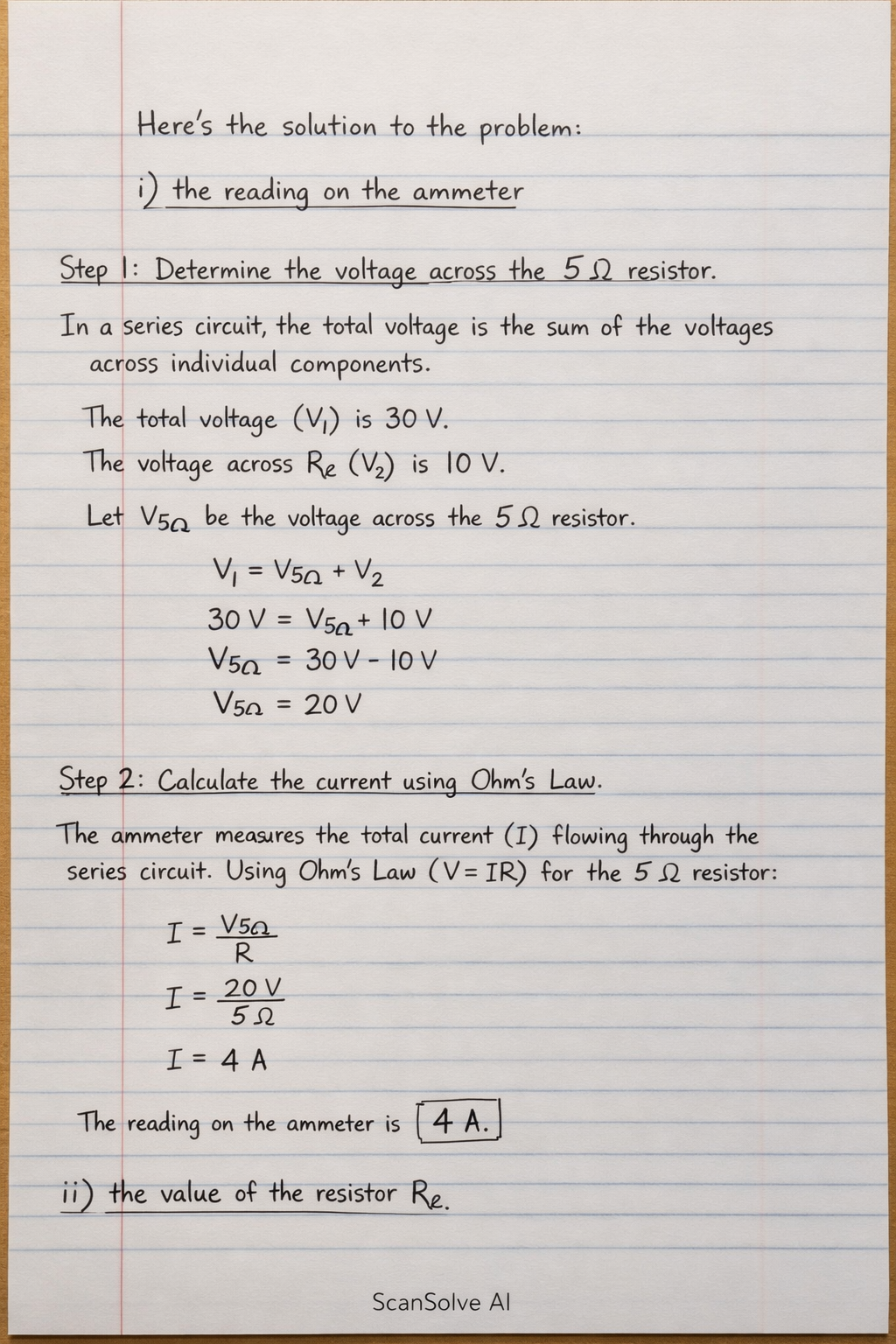
Determine the voltage across the resistor.
In a series circuit, the total voltage is the sum of the voltages across individual components.
The total voltage () is .
The voltage across () is .
Let be the voltage across the resistor.Calculate the current using Ohm's Law.
The ammeter measures the total current () flowing through the series circuit. Using Ohm's Law () for the resistor:
The reading on the ammeter is .
Part ii· 1 step
the value of the resistor
Calculate using Ohm's Law.
We know the voltage across () and the current flowing through it () from part (i).
The value of the resistor is .
Still stuck on this one?
Ask a follow-up, and the answer starts from this question.
More Physics Questions
Handwritten Step-by-Step Solution
Get this as a handwritten image on WhatsApp — like a tutor wrote it for you.
Try on WhatsApp