A local taxi association charges a fixed base fare of R12, plus an additional cost per kilometre. A passenger recorded the following amounts paid in a week: Day | Distance travelled (km) | Amount paid (R) | Monday | 5 | 22 | Tuesday | 9 | 30 | Wednesday | 14 | 40 | Thursday | ..... | ..... | Friday | ..... | ..... 1.1 Describe the pattern shown in the taxi fare table in terms of cost, distance, and the pattern that will be formed should a graph be drawn. 1.2 Determine the additional cost per kilometre. Show calculations. 1.3 Write a formula to calculate the taxi fare (C) for any distance travelled (d). 1.4 Use your formula (from Q1.3) to calculate the cost of travelling 43 miles, if 1 km = 0,62 miles.

Mathematics
A local taxi association charges a fixed base fare of R12, plus an additional cost per kilometre. A passenger recorded the following amounts paid in a week: Day | Distance travelled (km) | Amount paid (R) | Monday | 5 | 22 | Tuesday | 9 | 30 | Wednesday | 14 | 40 | Thursday | ..... | ..... | Friday | ..... | ..... 1.1 Describe the pattern shown in the taxi fare table in terms of cost, distance, and the pattern that will be formed should a graph be drawn. 1.2 Determine the additional cost per kilometre. Show calculations. 1.3 Write a formula to calculate the taxi fare (C) for any distance travelled (d). 1.4 Use your formula (from Q1.3) to calculate the cost of travelling 43 miles, if 1 km = 0,62 miles.

ScanSolve AI Answer

Answer

R2/km

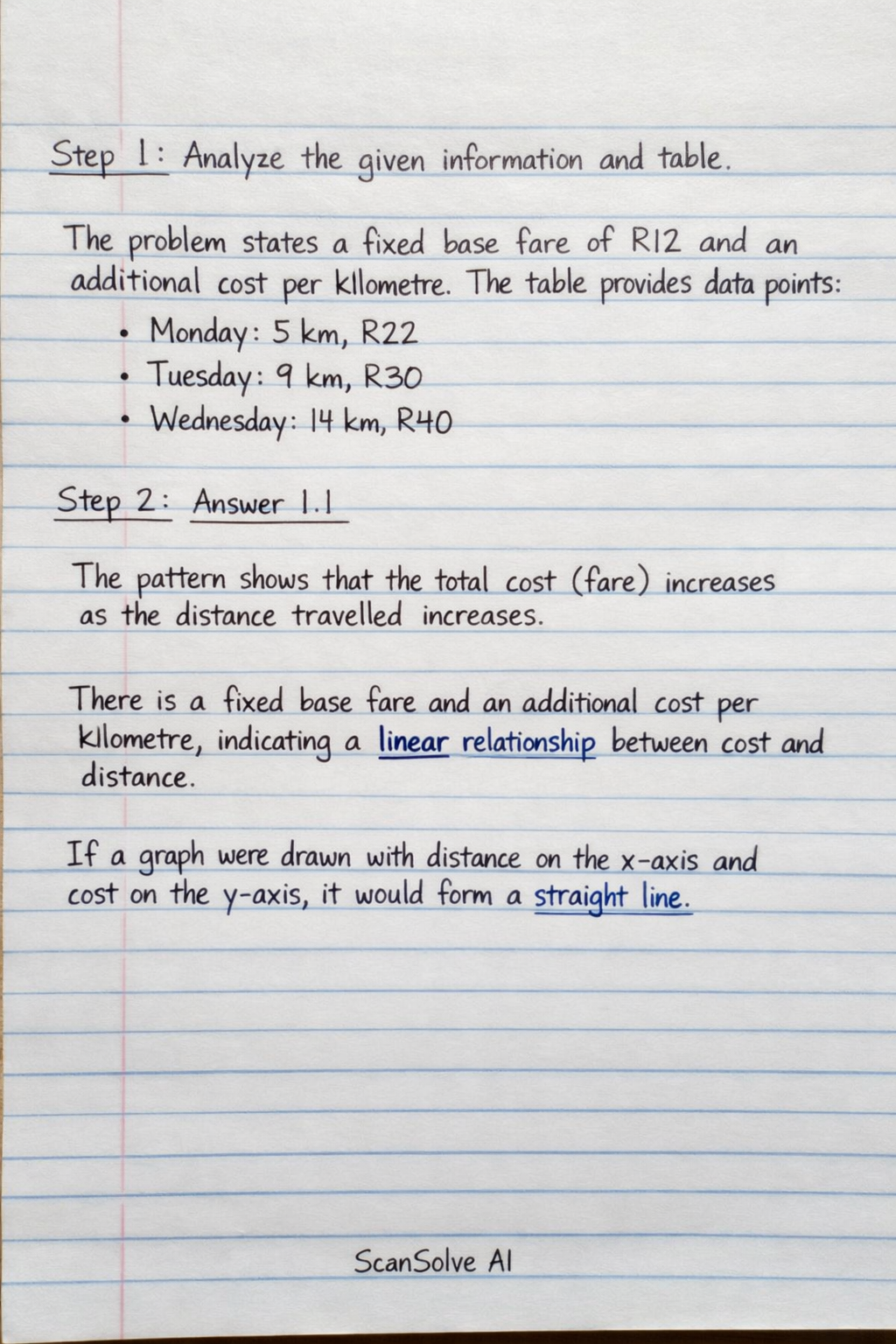
Step 1: Analyze the given information and table. The problem states a fixed base fare of R12 and an additional cost per kilometre. The table provides data points: • Monday: 5 km, R22 • Tuesday: 9 km, R30 • Wednesday: 14 km, R40

Step 2: Answer 1.1. The pattern shows that the total cost (fare) increases as the distance travelled increases. There is a fixed base fare and an additional cost per kilometre, indicating a linear relationship between cost and distance. If a graph were drawn with distance on the x-axis and cost on the y-axis, it would form a straight line.

Step 3: Answer 1.2 by determining the additional cost per kilometre. We can use any data point from the table and the given base fare of R12. Using Monday's data: Total cost = Base fare + (Additional cost per km ×\times Distance) 22=12+(Additionalcostperkm×5)22 = 12 + (Additional cost per km \times 5) Subtract the base fare from the total cost to find the variable cost: 2212=Additionalcostperkm×522 - 12 = Additional cost per km \times 5 10=Additionalcostperkm×510 = Additional cost per km \times 5 Divide by the distance to find the cost per kilometre: Additional cost per km=105\text{Additional cost per km} = \frac{10}{5} Additional cost per km=2 R/km\text{Additional cost per km} = 2 \text{ R/km} Using Tuesday's data as a check: 30=12+(Additionalcostperkm×9)30 = 12 + (Additional cost per km \times 9) 3012=Additionalcostperkm×930 - 12 = Additional cost per km \times 9 18=Additionalcostperkm×918 = Additional cost per km \times 9 Additional cost per km=189\text{Additional cost per km} = \frac{18}{9} Additional cost per km=2 R/km\text{Additional cost per km} = 2 \text{ R/km} The additional cost per kilometre is consistent. The additional cost per kilometre is R2/km\boxed{R2/km}.

Step 4: Answer 1.3 by writing the formula for taxi fare (C) for any distance travelled (d). Based on the fixed base fare of R12 and the additional cost of R2 per kilometre: C=BaseFare+(Costperkm×d)C = Base Fare + (Cost per km \times d) C=12+2dC = 12 + 2d The formula is C=12+2d\boxed{C = 12 + 2d}.

Step 5: Answer 1.4 by calculating the cost of travelling 43 miles. First, convert 43 miles to kilometres using the conversion factor 1 km = 0.62 miles. Distance in km=Distanceinmilesmilesperkm\text{Distance in km} = \frac{Distance in miles}{miles per km} Distance in km=43miles0.62miles/km\text{Distance in km} = \frac{43 miles}{0.62 miles/km} Distance in km69.3548 km\text{Distance in km} \approx 69.3548 \text{ km} Now, use the formula C=12+2dC = 12 + 2d with d=69.3548d = 69.3548 km. C=12+2(69.3548)C = 12 + 2(69.3548) C=12+138.7096C = 12 + 138.7096 C=150.7096C = 150.7096 Rounding to two decimal places for currency: C150.71C \approx 150.71 The cost of travelling 43 miles is R150.71\boxed{R150.71}.

Was this helpful?

Need help with your own homework?

Get instant step-by-step solutions to any question. Free to start.

Ask Your Question
Handwritten step-by-step solution preview

Handwritten Step-by-Step Solution

Get this as a handwritten image on WhatsApp — like a tutor wrote it for you.

Try on WhatsApp

Still have questions?

Quick Answer

Analyze the given information and table. The problem states a fixed base fare of R12 and an additional cost per kilometre.

A local taxi association charges a fixed base fare of R12, plus an additional cost per kilometre. A passenger recorded the following amounts paid in a week: Day | Distance travelled (km) | Amount paid (R) | Monday | 5 | 22 | Tuesday | 9 | 30 | Wednesday | 14 | 40 | Thursday | ..... | ..... | Friday | ..... | ..... 1.1 Describe the pattern shown in the taxi fare table in terms of cost, distance, and the pattern that will be formed should a graph be drawn. 1.2 Determine the additional cost per kilometre. Show calculations. 1.3 Write a formula to calculate the taxi fare (C) for any distance travelled (d). 1.4 Use your formula (from Q1.3) to calculate the cost of travelling 43 miles, if 1 km = 0,62 miles.
Mathematics

This mathematics problem involves applying core mathematical principles and formulas. Below you will find a complete step-by-step solution with detailed explanations for each step, helping you understand not just the answer but the method behind it.

ScanSolve AI Answer
Step 1: Analyze the given information and table. The problem states a fixed base fare of R12 and an additional cost per kilometre. The table provides data points: • Monday: 5 km, R22 • Tuesday: 9 km, R30 • Wednesday: 14 km, R40 Step 2: Answer 1.1. The pattern shows that the total cost (fare) increases as the distance travelled increases. There is a fixed base fare and an additional cost per kilometre, indicating a linear relationship between cost and distance. If a graph were drawn with distance on the x-axis and cost on the y-axis, it would form a straight line. Step 3: Answer 1.2 by determining the additional cost per kilometre. We can use any data point from the table and the given base fare of R12. Using Monday's data: Total cost = Base fare + (Additional cost per km × Distance) 22 = 12 + (Additional cost per km × 5) Subtract the base fare from the total cost to find the variable cost: 22 - 12 = Additional cost per km × 5 10 = Additional cost per km × 5 Divide by the distance to find the cost per kilometre: Additional cost per km = (10)/(5) Additional cost per km = 2 R/km Using Tuesday's data as a check: 30 = 12 + (Additional cost per km × 9) 30 - 12 = Additional cost per km × 9 18 = Additional cost per km × 9 Additional cost per km = (18)/(9) Additional cost per km = 2 R/km The additional cost per kilometre is consistent. The additional cost per kilometre is R2/km. Step 4: Answer 1.3 by writing the formula for taxi fare (C) for any distance travelled (d). Based on the fixed base fare of R12 and the additional cost of R2 per kilometre: C = Base Fare + (Cost per km × d) C = 12 + 2d The formula is C = 12 + 2d. Step 5: Answer 1.4 by calculating the cost of travelling 43 miles. First, convert 43 miles to kilometres using the conversion factor 1 km = 0.62 miles. Distance in km = Distance in milesmiles per km Distance in km = 43 miles0.62 miles/km Distance in km ≈ 69.3548 km Now, use the formula C = 12 + 2d with d = 69.3548 km. C = 12 + 2(69.3548) C = 12 + 138.7096 C = 150.7096 Rounding to two decimal places for currency: C ≈ 150.71 The cost of travelling 43 miles is R150.71.