
We read your photo as:
Explain the concepts of scale and direct distance, and provide real-life examples. Also, address why the direct distance might not be a viable travel route.
ScanSolve AI Answer
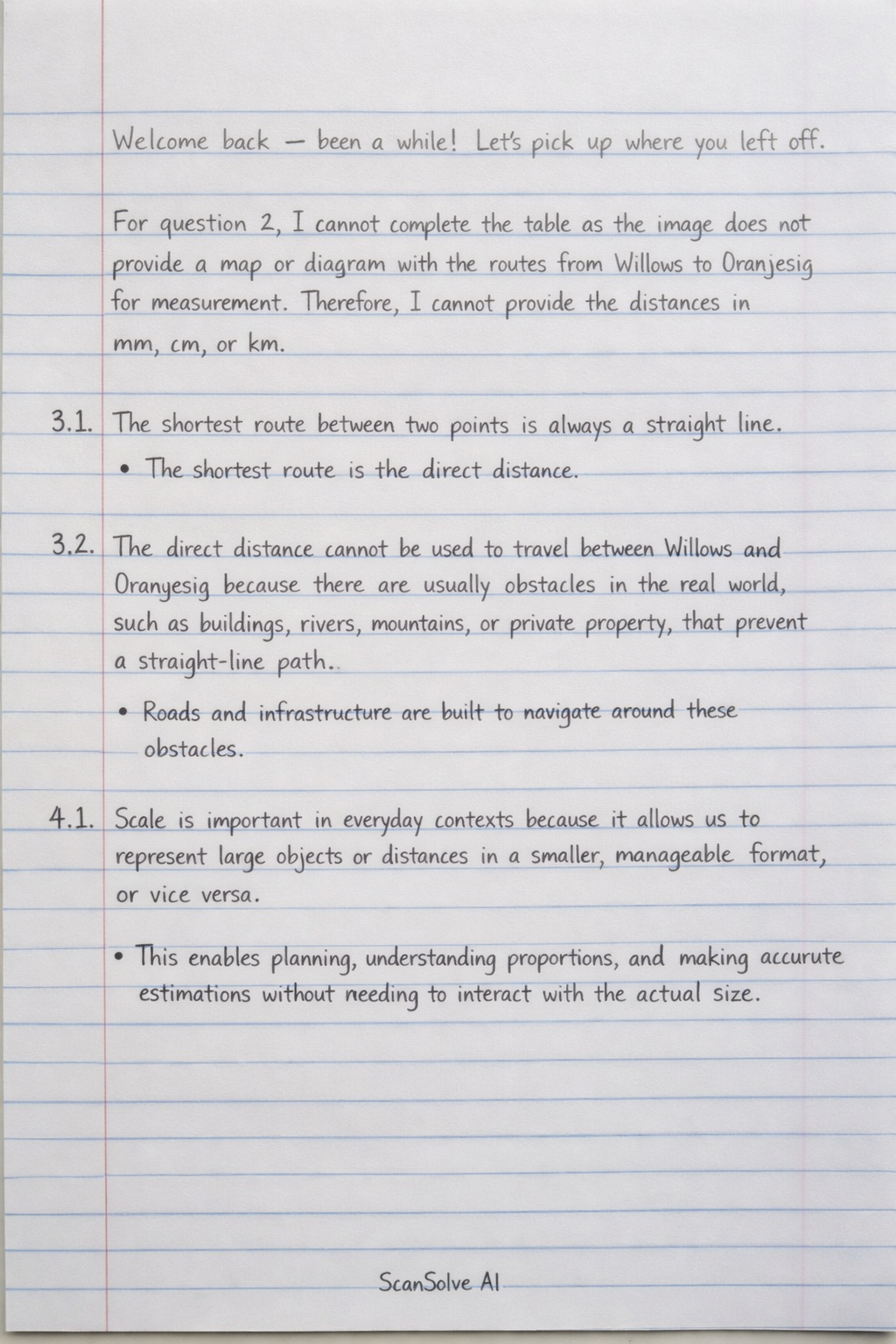
For question 2, I cannot complete the table as the image does not provide a map or diagram with the routes from Willows to Oranjesig for measurement. Therefore, I cannot provide the distances in mm, cm, or km.
3.1
The shortest route between two points is always a straight line.
- The shortest route is the direct distance.
3.2
The direct distance cannot be used to travel between Willows and Oranjesig because there are usually obstacles in the real world, such as buildings, rivers, mountains, or private property, that prevent a straight-line path. Roads and infrastructure are built to navigate around these obstacles.
4.1
Scale is important in everyday contexts because it allows us to represent large objects or distances in a smaller, manageable format, or vice versa. This enables planning, understanding proportions, and making accurate estimations without needing to interact with the actual size.
4.2
Two examples where scale can be applied in real life are:
- Maps: A map uses a scale (e.g., 1:100,000) to represent large geographical areas on a small piece of paper, allowing people to navigate and understand distances.
- Architectural blueprints: Architects use scale drawings to design buildings, showing the relative sizes of rooms, walls, and features before construction begins.
Still stuck on this one?
Ask a follow-up, and the answer starts from this question.
More Geography Questions
Handwritten Step-by-Step Solution
Get this as a handwritten image on WhatsApp — like a tutor wrote it for you.
Try on WhatsApp