

This geography problem is solved step by step below, with detailed explanations to help you understand the method and arrive at the correct answer.
ScanSolve AI Answer
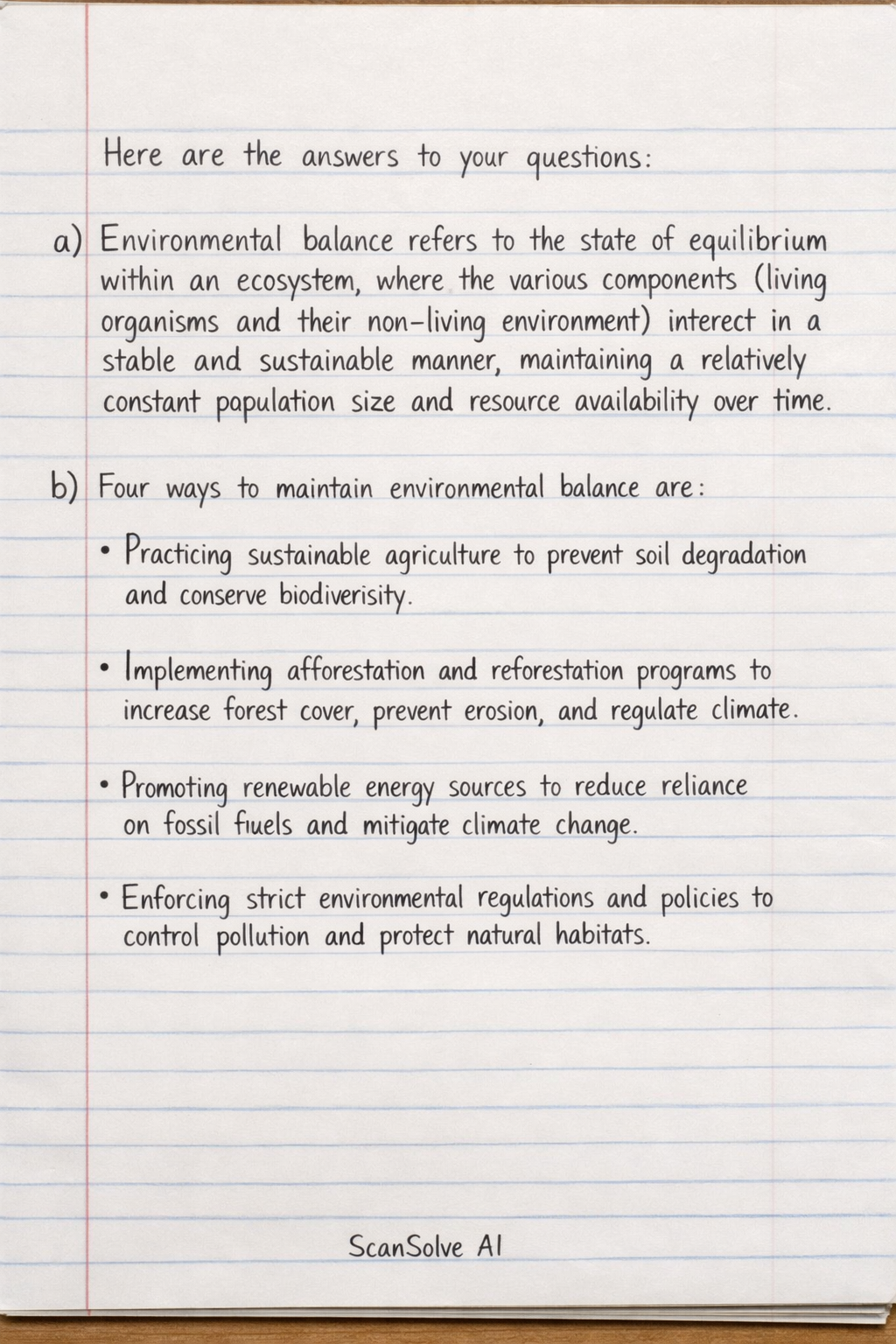
Here are the answers to your questions: *a) Environmental balance refers to the state of equilibrium within an ecosystem, where the various components (living organisms and their non-living environment) interact in a stable and sustainable manner, maintaining a relatively constant population size and resource availability over time. *b) Four ways to maintain environmental balance are: • Practicing sustainable agriculture to prevent soil degradation and conserve biodiversity. • Implementing afforestation and reforestation programs to increase forest cover, prevent erosion, and regulate climate. • Promoting renewable energy sources to reduce reliance on fossil fuels and mitigate climate change. • Enforcing strict environmental regulations and policies to control pollution and protect natural habitats. *c) Two negative effects of erosion in an ecosystem are: • Loss of fertile topsoil: Erosion removes the nutrient-rich topsoil, reducing agricultural productivity and making land unsuitable for plant growth. • Habitat destruction and biodiversity loss: Erosion can destroy natural habitats, leading to displacement or extinction of plant and animal species. *a) Four erosional features produced by wind in arid land are: • Deflation hollows (or blowouts) • Yardangs • Ventifacts • Mushroom rocks (or pedestal rocks) *b) I cannot provide annotated diagrams, but I can describe the mode of formation for each feature: i) Ox-bow lake: An ox-bow lake forms from a meander (a bend) in a river. Over time, erosion on the outer bank and deposition on the inner bank cause the meander to become more exaggerated. During floods, the river may cut across the narrow neck of the meander, taking a straighter, shorter course. Sediment is then deposited at the entrances of the old meander bend, eventually sealing it off from the main river channel. The isolated bend fills with water, forming a crescent-shaped lake known as an ox-bow lake. ii) Caldera lake: A caldera lake forms after a large volcanic eruption. When a volcano erupts violently, it expels a significant amount of magma from its underlying magma chamber. This rapid evacuation of magma can cause the ground above the chamber to collapse inward, forming a large, bowl-shaped depression called a caldera. Over time, this depression can fill with rainwater or meltwater, creating a caldera lake. *a) Four sources of Geographical Information System (GIS) data are: • Satellite imagery (e.g., from remote sensing satellites) • Aerial photographs (captured by aircraft) • GPS (Global Positioning System) data (field surveys and tracking) • Existing maps and cartographic data (digitized paper maps, topographic maps) *b) Three roles that GIS can play in combating insecurity in Nigeria are: • Crime mapping and analysis: GIS can be used to map crime hotspots, analyze crime patterns, and identify areas with high security risks, aiding in resource allocation and strategic planning for security forces. • Emergency response and disaster management: GIS helps in planning optimal routes for emergency services, locating affected areas, and coordinating relief efforts during security crises or natural disasters, improving response times and effectiveness. • Intelligence gathering and surveillance: GIS integrates data from various sources (e.g., satellite imagery, drone footage, sensor data) to provide real-time situational awareness, track movements of suspicious groups, and monitor critical infrastructure, enhancing intelligence operations. Send me the next one 📸