
We read your photo as:
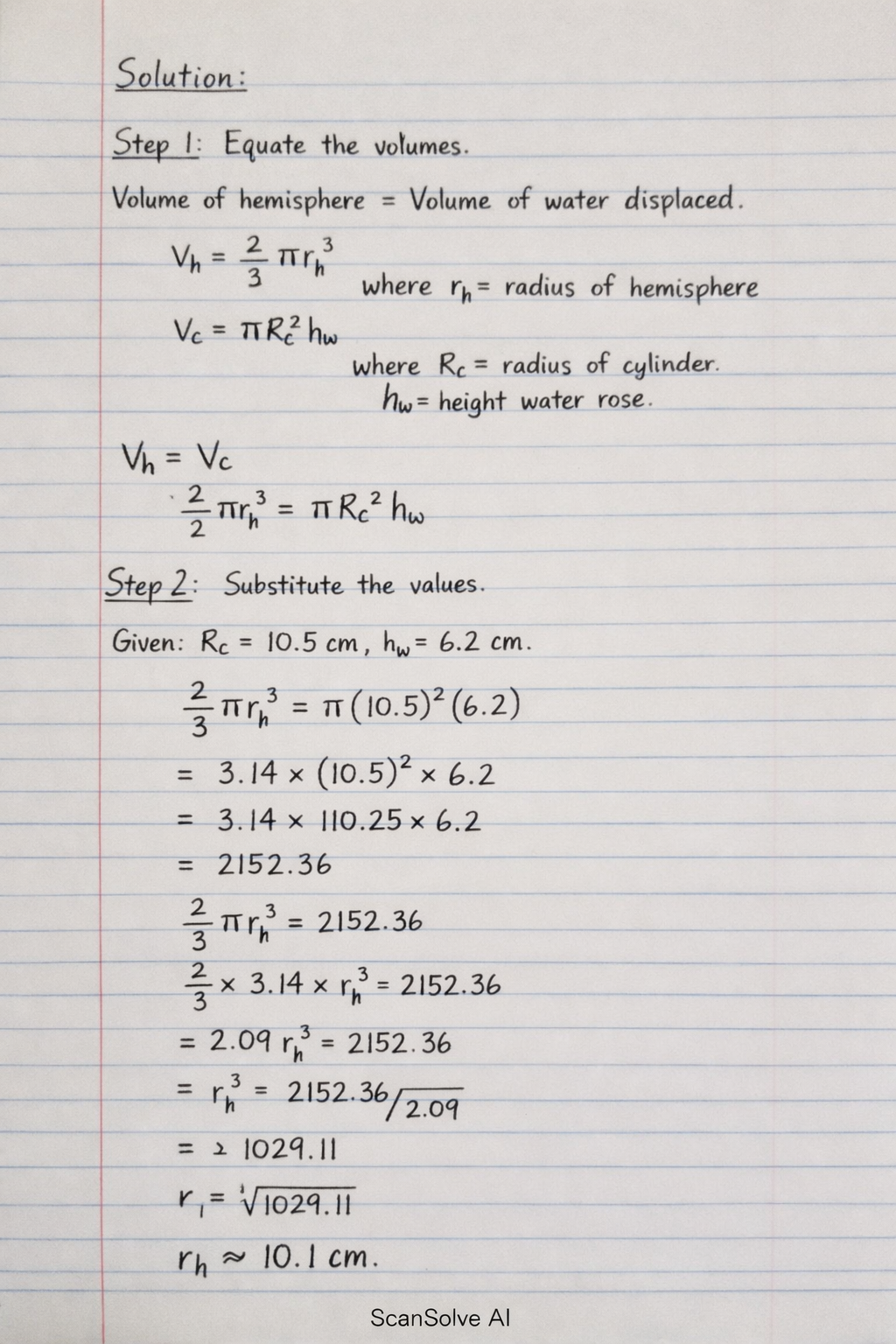
Equate the volume of the hemisphere to the volume of the water displaced in the cylinder.
ScanSolve AI Answer
Step-by-step solution
4 stepshere are the solutions to the problems.
15. A cylinder has a radius of 10.5cm. A hemispherical solid is fully immersed in the cylinder containing water and the level water rose by a height of 6.2cm. Calculate the radius of the hemisphere to 1 d.p.
Equate the volume of the hemisphere to the volume of the water displaced in the cylinder.
The volume of water displaced is equal to the volume of the hemisphere.
Volume of hemisphere () = , where is the radius of the hemisphere.
Volume of water displaced in cylinder () = , where is the radius of the cylinder and is the height the water level rose.Substitute the given values into the equation.
Given cm and cm.
Solve for .
Cancel from both sides:
Multiply both sides by :
Take the cube root of both sides:
Round the radius to 1 decimal place.
The radius of the hemisphere is .
16. Complete the figure below to show rotational order 3.
To complete the figure to show rotational order 3, the final shape must look identical after a rotation of about its center. The small dot in the figure indicates the center of rotation.
The given figure shows one "point" or "arm" of a three-pointed star. To complete it, you need to draw two more identical points, each rotated by from the previous one around the central dot.
The completed figure will be a three-pointed star, where each point is identical to the one shown and is positioned at intervals around the center.
Still stuck on this one?
Ask a follow-up, and the answer starts from this question.
More Geography Questions
Handwritten Step-by-Step Solution
Get this as a handwritten image on WhatsApp — like a tutor wrote it for you.
Try on WhatsApp