

This geography problem is solved step by step below, with detailed explanations to help you understand the method and arrive at the correct answer.
ScanSolve AI Answer
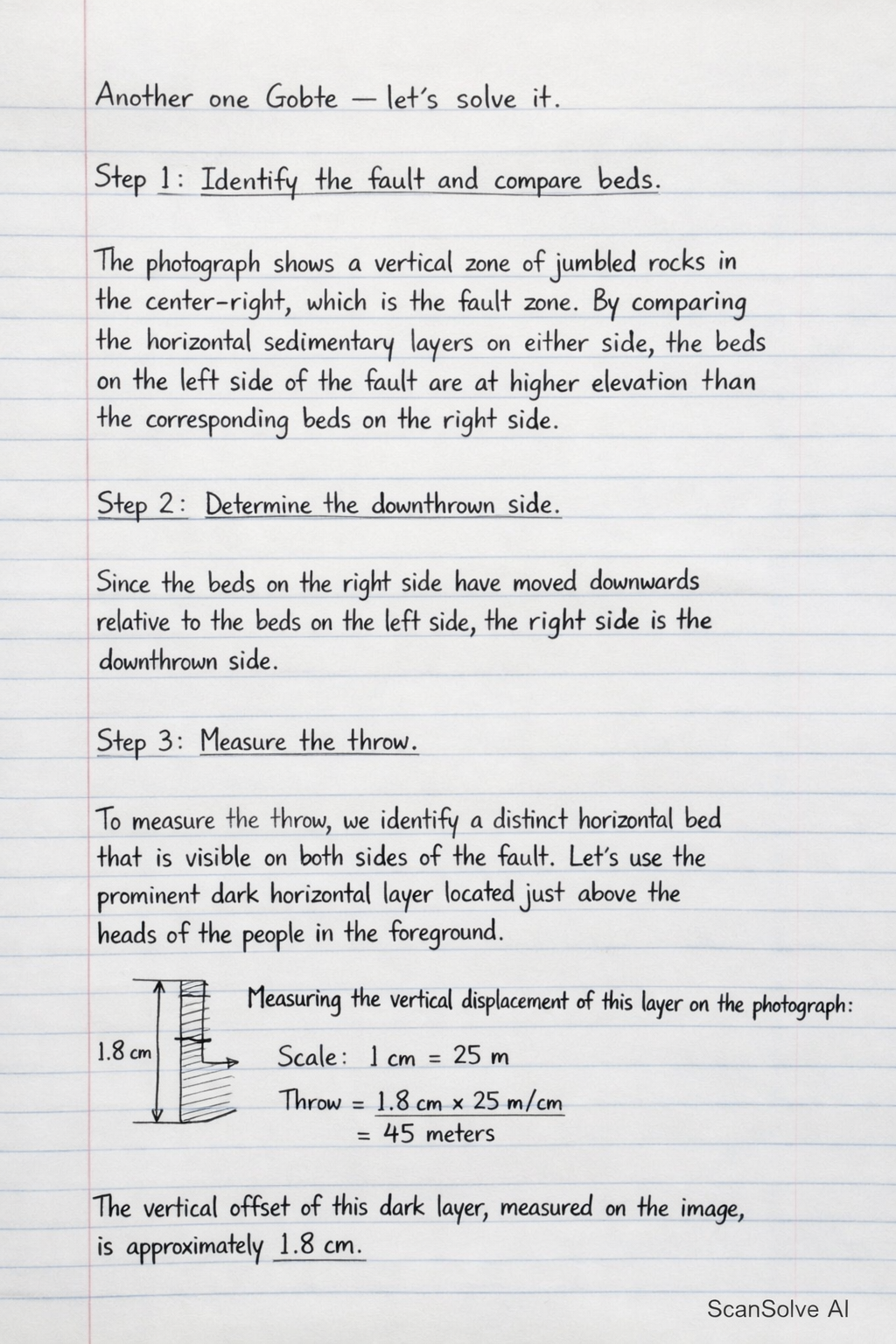
Another one Gobte — let's solve it. Step 1: Identify the fault and compare beds. The photograph shows a vertical zone of jumbled rocks in the center-right, which is the fault zone. By comparing the horizontal sedimentary layers on either side, the beds on the left side of the fault are at a higher elevation than the corresponding beds on the right side. Step 2: Determine the downthrown side. Since the beds on the right side have moved downwards relative to the beds on the left side, the right side is the downthrown side. Step 3: Measure the throw. To measure the throw, we identify a distinct horizontal bed that is visible on both sides of the fault. Let's use the prominent dark horizontal layer located just above the heads of the people in the foreground. Measuring the vertical displacement of this layer on the photograph: The vertical offset of this dark layer, measured on the image, is approximately 1.8 cm. Step 4: Calculate the throw in meters. Given that 1 cm on the photograph represents 1 m: Throw = 1.8 cm × 1 m1 cm = 1.8 m The downthrown side is the right side. The throw of the fault is 1.8 m. What's next? 📸