
We read your photo as:
A ball is thrown horizontally from the top of a vertical tower and strikes the ground 50m from the bottom. If the tower is 45m high, calculate the time taken to hit the ground.
ScanSolve AI Answer
Step-by-step solution
6 stepsHere are the solutions to your questions:
13. a) State the nature of the motion of the particle between:
-
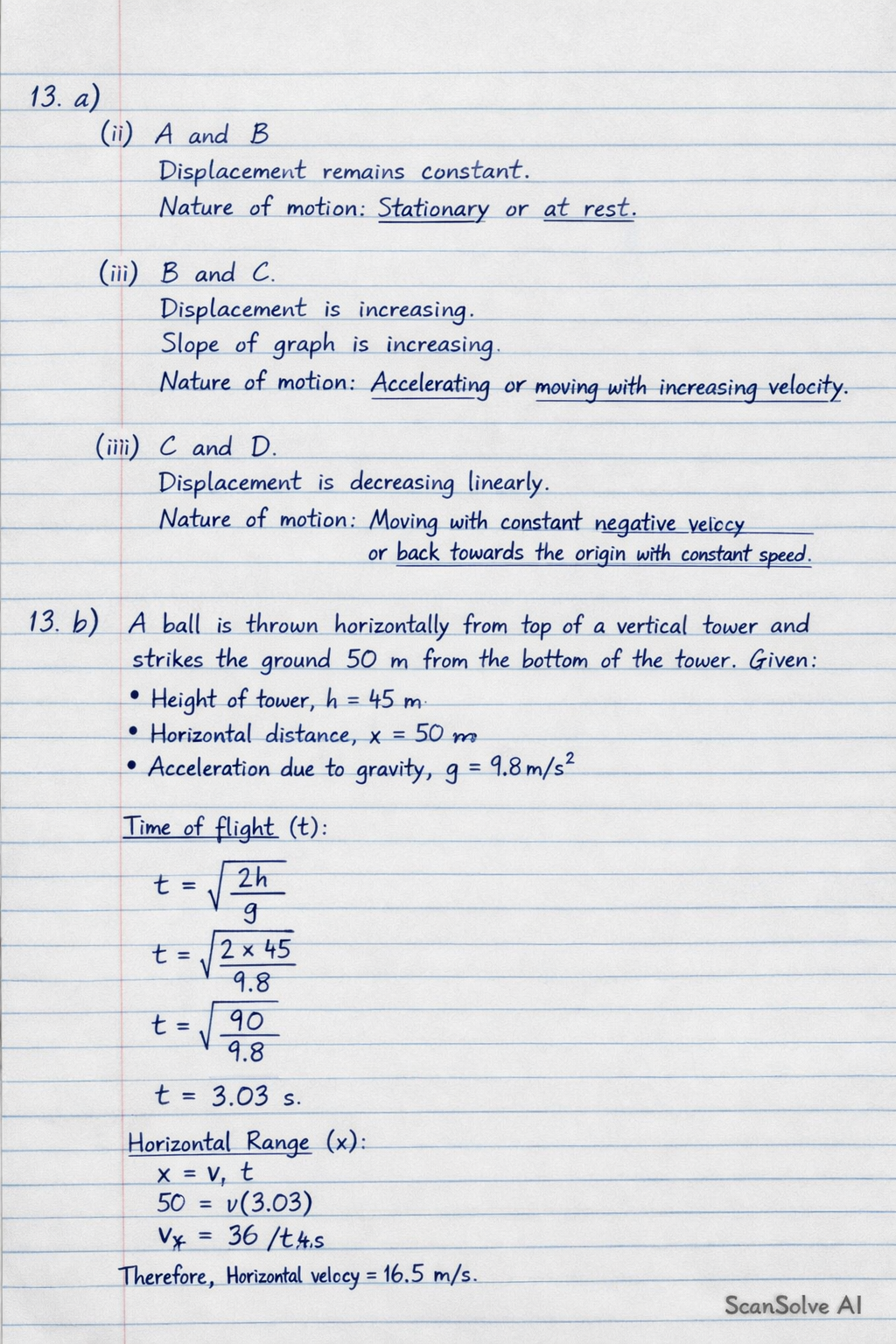
(i) A and B The displacement remains constant. Nature of motion: Stationary or at rest.
-
(ii) B and C The displacement is increasing, and the slope of the graph is increasing. Nature of motion: Accelerating or moving with increasing velocity.
-
(iii) C and D The displacement is decreasing linearly, indicating a constant negative slope. Nature of motion: Moving with constant negative velocity or moving back towards the origin with constant speed.
13. b) A ball is thrown horizontally from top of a vertical tower and strikes the ground at a point 50m from the bottom of the tower. Given that the height of the tower is 45m. Determine the:
Given:
Height of tower,
Horizontal distance,
Acceleration due to gravity,
- (i) Time taken by the ball to hit the ground.
Consider the vertical motion.
Initial vertical velocity, $u_y = 0 \text{ m/s}$ (since it's thrown horizontally). Vertical displacement, $s_y = h = 45 \text{ m}$. Use the kinematic equation: $s_y = u_y t + \frac{1}{2}gt^2$. $$ 45 \text{ m} = (0 \text{ m/s})t + \frac{1}{2}(9.8 \text{ m/s}^2)t^2 $$ $$ 45 = 4.9t^2 $$Solve for .
$$ t^2 = \frac{45}{4.9} $$ $$ t^2 \approx 9.18367 $$ $$ t = \sqrt{9.18367} $$ $$ t \approx 3.03 \text{ s} $$ The time taken by the ball to hit the ground is $\boxed{\text{3.03 s}}$.- (ii) Initial horizontal velocity of the ball.
Consider the horizontal motion.
Horizontal displacement, $s_x = 50 \text{ m}$. Time of flight, $t \approx 3.03 \text{ s}$ (from part i). Horizontal velocity, $u_x$, is constant. Use the equation: $s_x = u_x t$. $$ 50 \text{ m} = u_x (3.03 \text{ s}) $$Solve for .
$$ u_x = \frac{50 \text{ m}}{3.03 \text{ s}} $$ $$ u_x \approx 16.5 \text{ m/s} $$ The initial horizontal velocity of the ball is $\boxed{\text{16.5 m/s}}$.- (iii) Vertical velocity of the ball just before striking the ground.
Consider the vertical motion.
Initial vertical velocity, $u_y = 0 \text{ m/s}$. Time of flight, $t \approx 3.03 \text{ s}$. Acceleration, $g = 9.8 \text{ m/s}^2$. Use the kinematic equation: $v_y = u_y + gt$. $$ v_y = 0 \text{ m/s} + (9.8 \text{ m/s}^2)(3.03 \text{ s}) $$Solve for .
$$
v_y \approx 29.694 \text{ m/s}
$$
$$
v_y \approx 29.7 \text{ m/s}
$$
The vertical velocity of the ball just before striking the ground is $\boxed{\text{29.7 m/s}}$.
Still stuck on this one?
Ask a follow-up, and the answer starts from this question.
More Physics Questions
Handwritten Step-by-Step Solution
Get this as a handwritten image on WhatsApp — like a tutor wrote it for you.
Try on WhatsApp