
We read your photo as:
Provide a research paper outline on the Battle of Cuito Cuanavale's influence on Southern African political changes in the 1980s.
ScanSolve AI Answer
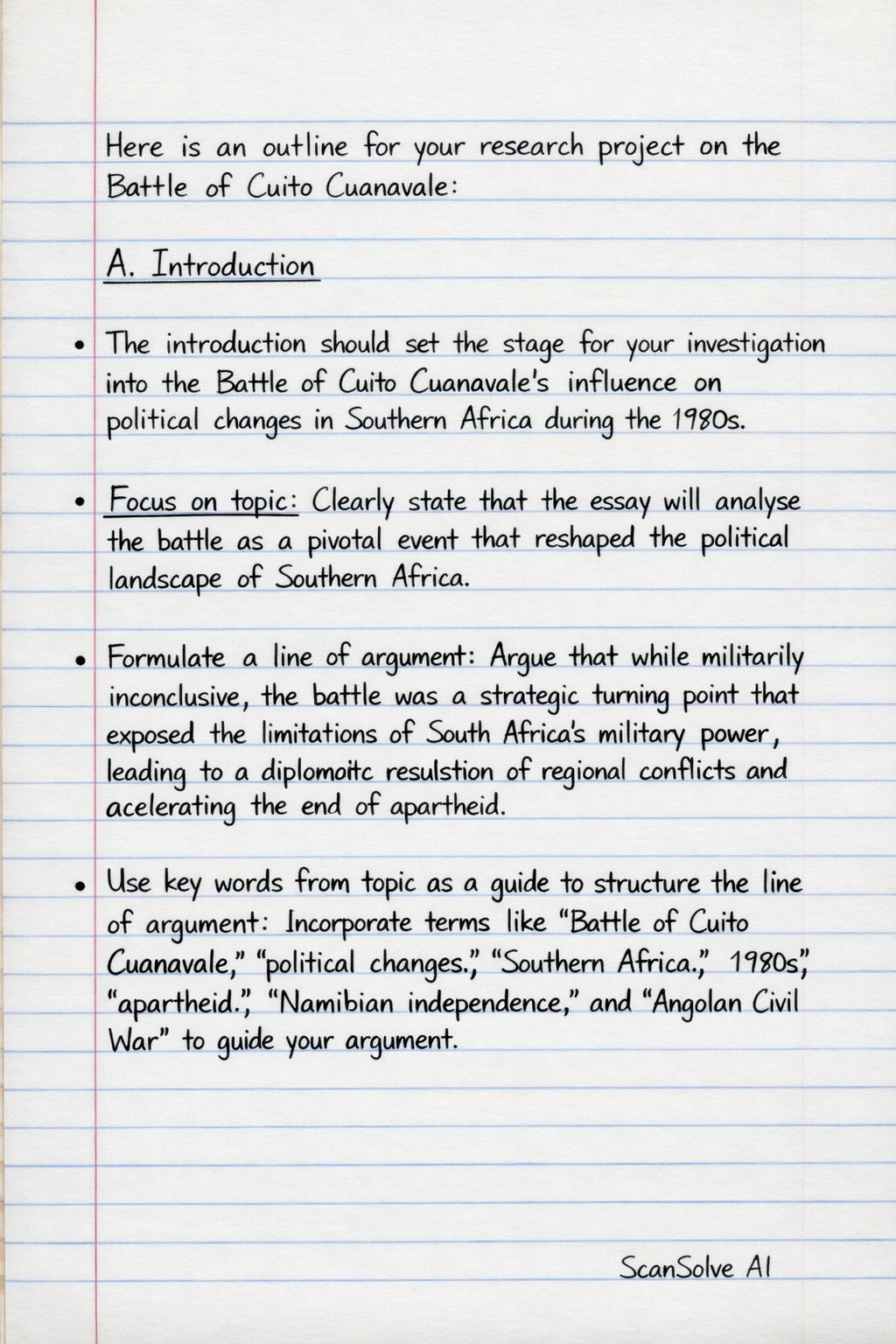
Here is an outline for your research project on the Battle of Cuito Cuanavale:
A. Introduction
The introduction should set the stage for your investigation into the Battle of Cuito Cuanavale's influence on political changes in Southern Africa during the 1980s.
- Focus on topic: Clearly state that the essay will analyze the battle as a pivotal event that reshaped the political landscape of Southern Africa.
- Formulate a line of argument: Argue that while militarily inconclusive, the battle was a strategic turning point that exposed the limitations of South Africa's military power, leading to a diplomatic resolution of regional conflicts and accelerating the end of apartheid.
- Use key words from topic as a guide to structure the line of argument: Incorporate terms like "Battle of Cuito Cuanavale," "political changes," "Southern Africa," "1980s," "apartheid," "Namibian independence," and "Angolan Civil War" to guide your argument.
B. Body
This section will delve into the specific aspects of the conflict and its regional impact.
- Independence of Angola: Discuss Angola's independence from Portugal in 1975 and the immediate power vacuum that led to civil war.
- Outbreak of the Civil war in Angola: Explain the origins of the Angolan Civil War between the MPLA, UNITA, and FNLA, and the ideological divisions that fueled it.
- Involvement of foreign powers in the Angolan civil war: Detail the significant roles of external actors, including Cuba (supporting MPLA), South Africa (supporting UNITA), and the United States (covertly supporting UNITA), highlighting the Cold War context.
- Battle of Cuito Cuanavale and its results: Describe the battle itself (1987-1988) as a major confrontation between Angolan-Cuban forces and South African-UNITA forces. Explain that while no clear military victor emerged, it resulted in a costly stalemate for South Africa, forcing them to seek a diplomatic exit.
- Impact of the battle of Cuito on Namibia: Explain how the battle directly led to the Tripartite Accord (New York Accords) in 1988, which linked Cuban withdrawal from Angola to South Africa's withdrawal from Namibia and the implementation of UN Resolution 435, culminating in Namibia's independence in March 1990.
- Impact of the battle of Cuito on South Africa: Discuss how the battle exposed the high human and financial costs of South Africa's military adventures, contributing to internal pressure and international isolation, which ultimately hastened the end of apartheid and the release of Nelson Mandela.
- Different views on the battle of Cuito Cuanavale: Acknowledge the varying interpretations of the battle, with some viewing it as a decisive victory for Angolan-Cuban forces and others as a strategic withdrawal by South Africa, emphasizing its symbolic and political significance over military outcome.
- Any other relevant response: Consider discussing the broader shift in regional power dynamics or the role of international diplomacy in the post-battle negotiations.
C. Conclusion
- How did the battle of Cuito Cuanavale influence the political changes in Southern Africa in the 1980s? The Battle of Cuito Cuanavale was a critical turning point, demonstrating the limits of South Africa's military dominance and creating a stalemate that compelled all parties to pursue diplomatic solutions. It directly led to the Tripartite Accord, which facilitated the withdrawal of foreign forces from Angola and paved the way for Namibia's independence. For South Africa, the battle underscored the unsustainability of its regional military strategy, intensifying pressure on the apartheid regime and accelerating the process of negotiations for a democratic transition.
D. Reflections
- What have you learnt whilst doing the research? Reflect on the complexities of regional conflicts, the interconnectedness of political and military events, and the significant role of international diplomacy. You might also reflect on how historical narratives can differ based on perspective, and the profound impact of individual events on the trajectory of nations and the lives of people.
E. Bibliography/References
This section should list all the sources you used to gather information for your research. This includes books, academic journals, reputable websites, documentaries, and interviews. Ensure you use a consistent citation style (e.g., APA, MLA, Chicago) as required by your institution.
Still stuck on this one?
Ask a follow-up, and the answer starts from this question.
More History Questions
Handwritten Step-by-Step Solution
Get this as a handwritten image on WhatsApp — like a tutor wrote it for you.
Try on WhatsApp