
We read your photo as:
Investigate the influence of the Battle of Cuito Cuanavale on political changes in Southern Africa in the 1980s.
ScanSolve AI Answer
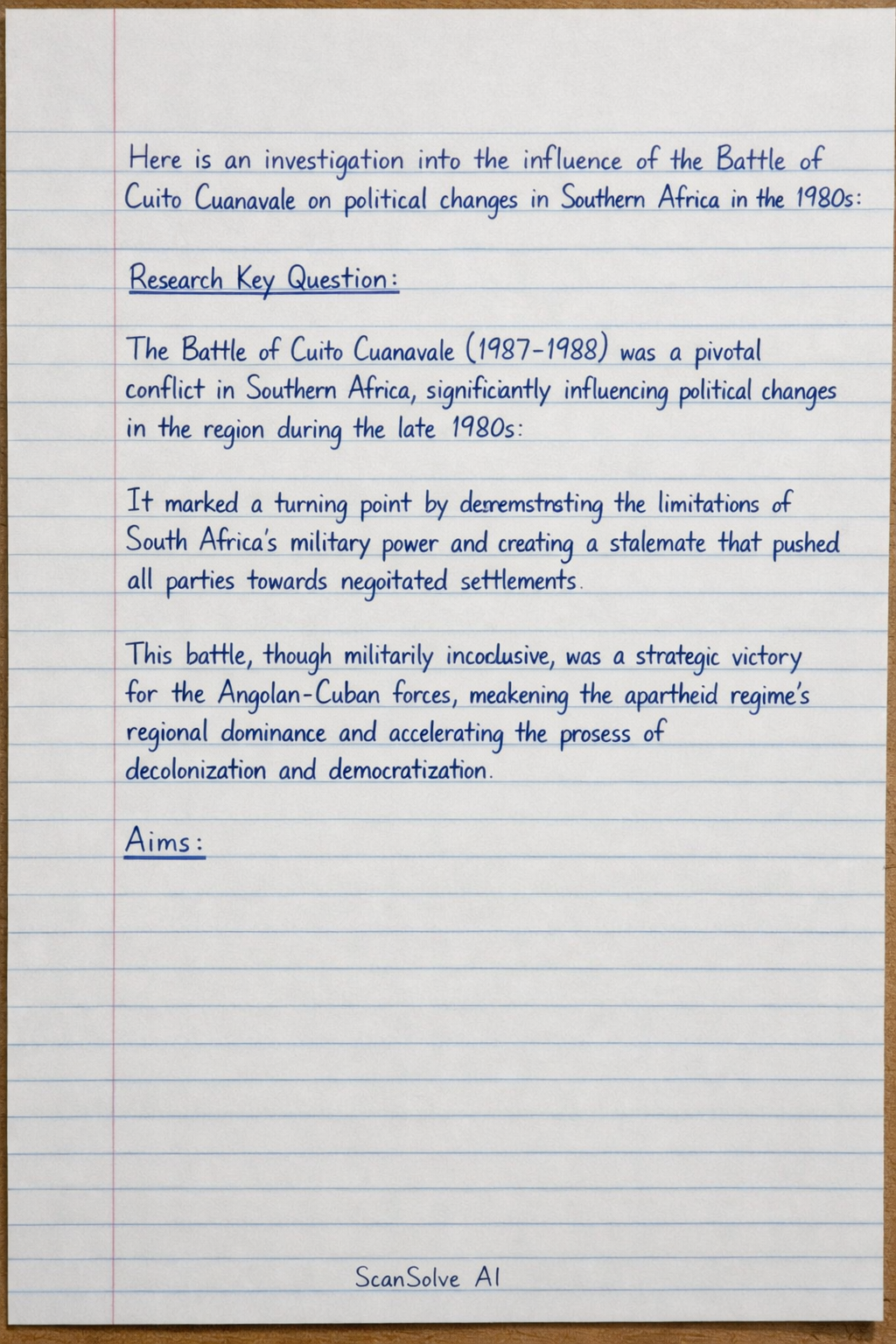
Here is an investigation into the influence of the Battle of Cuito Cuanavale on political changes in Southern Africa in the 1980s:
Research Key Question:
The Battle of Cuito Cuanavale (1987-1988) was a pivotal conflict in Southern Africa, significantly influencing political changes in the region during the late 1980s. It marked a turning point by demonstrating the limitations of South Africa's military power and creating a stalemate that pushed all parties towards negotiated settlements. This battle, though militarily inconclusive, was a strategic victory for the Angolan-Cuban forces, weakening the apartheid regime's regional dominance and accelerating the process of decolonization and democratization.
Aims:
-
To investigate how the battle of Cuito Cuanavale influenced political changes in Southern Africa in the 1980s: The battle led to a shift in the regional power balance, forcing South Africa to reconsider its military strategy and its costly involvement in Angola. It created the conditions for the Tripartite Accord (New York Accords) in 1988, which facilitated the withdrawal of Cuban troops from Angola and the implementation of UN Resolution 435 for Namibia's independence. This demonstrated that military solutions were no longer viable for the apartheid regime, paving the way for diplomatic resolutions across the region.
-
To investigate the impact of the battle of Cuito Cuanavale on Namibia: The battle was a direct catalyst for Namibia's independence. The Tripartite Accord, signed shortly after the battle, explicitly linked the withdrawal of Cuban forces from Angola to South Africa's withdrawal from Namibia and the implementation of UN-supervised elections. This led to Namibia gaining its independence in March 1990, ending decades of South African occupation.
-
To investigate the impact of the battle of Cuito Cuanavale on South Africa: The battle had profound implications for South Africa's apartheid regime. It exposed the high human and financial costs of maintaining its military interventions and the South African Border War. The perceived military setback and the subsequent regional peace agreements contributed to a growing sense of crisis within the apartheid government. This, combined with international sanctions and internal resistance, intensified pressure on the regime, ultimately contributing to the unbanning of liberation movements, the release of Nelson Mandela, and the start of negotiations for a democratic South Africa in the early 1990s.
Still stuck on this one?
Ask a follow-up, and the answer starts from this question.
More History Questions
Handwritten Step-by-Step Solution
Get this as a handwritten image on WhatsApp — like a tutor wrote it for you.
Try on WhatsApp