
We read your photo as:
More than 1/2" in pipe 12-3/4" or less in outer diameter. More than 2% of the nominal pipe diameter in pipe over 12-3/4" in outer diameter. All statements are true.
ScanSolve AI Answer
Answer
Step-by-step solution
4 stepsAnalyze the question.
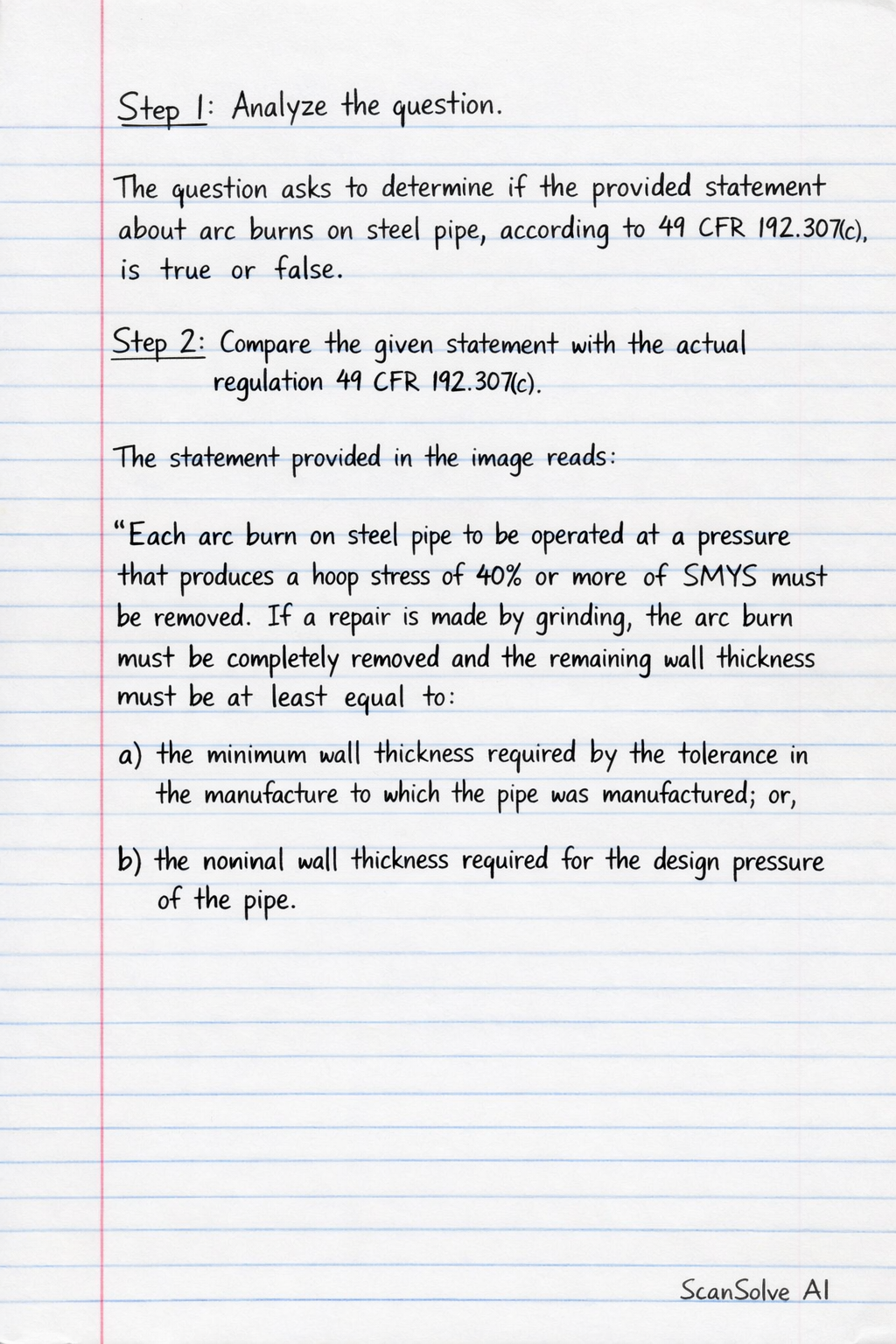
The question asks to determine if the provided statement about arc burns on steel pipe, according to 49 CFR 192.307(c), is true or false.
Compare the given statement with the actual regulation 49 CFR 192.307(c).
The statement provided in the image reads: "Each arc burn on steel pipe to be operated at a pressure that produces a hoop stress of 40% or more of SMYS must be removed. If a repair is made by grinding, the arc burn must be completely removed and the remaining wall thickness must be at least equal to: a) the minimum wall thickness required by the tolerance in the manufacture to which the pipe was manufactured; or, the nominal wall thickness required for the design pressure of the pipe."
The actual text of 49 CFR 192.307(c) states: "Each arc burn on steel pipe to be operated at a pressure that produces a hoop stress of 40 percent or more of SMYS must be removed. If a repair is made by grinding, the arc burn must be completely removed and the remaining wall thickness must be at least equal to: (1) The minimum wall thickness required by the tolerance in the specification to which the pipe was manufactured; or (2) The nominal wall thickness required for the design pressure of the pipe."
Identify any discrepancies.
There is a subtle but important difference in the wording of the first condition for the remaining wall thickness. The statement in the question uses "tolerance in the manufacture", while the regulation uses "tolerance in the specification". A specification is a document that defines the requirements, including tolerances, for manufacturing. While tolerances are applied during manufacture, they are defined by a specification. Therefore, the wording in the question is not an exact match to the regulation.
Conclude based on the comparison.
Due to the precise wording difference ("manufacture" instead of "specification"), the statement as presented is not entirely accurate according to the exact text of 49 CFR 192.307(c).
The final answer is
Try one yourself
A new problem that tests the same skill.
Still stuck on this one?
Ask a follow-up, and the answer starts from this question.
More Law Questions
Handwritten Step-by-Step Solution
Get this as a handwritten image on WhatsApp — like a tutor wrote it for you.
Try on WhatsApp