
We read your photo as:
1- Molecular geometry for CO₂ is nonlinear with net dipole.
ScanSolve AI Answer
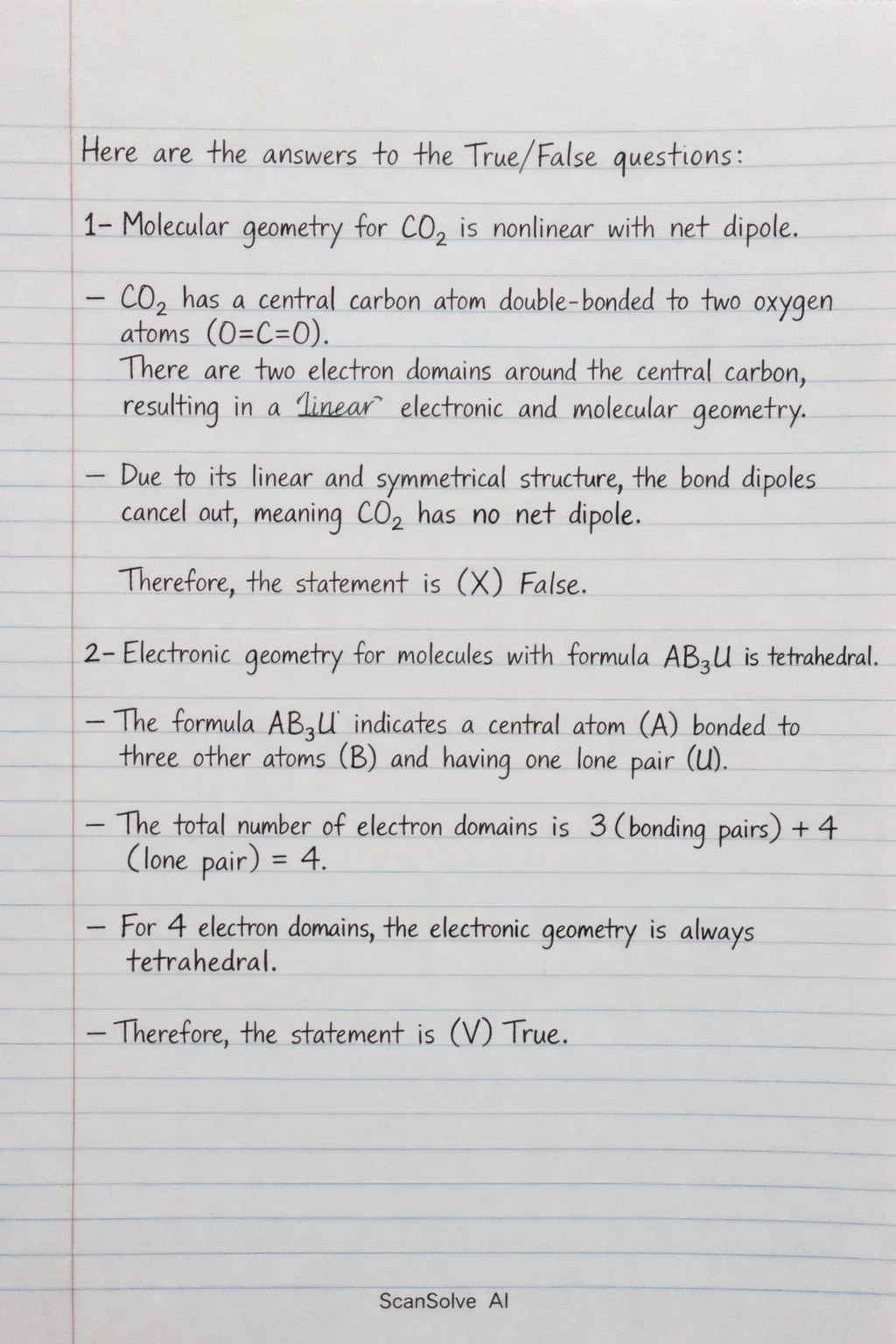
Here are the answers to the True/False questions:
1- Molecular geometry for is nonlinear with net dipole.
- has a central carbon atom double-bonded to two oxygen atoms (). There are two electron domains around the central carbon, resulting in a linear electronic and molecular geometry.
- Due to its linear and symmetrical structure, the bond dipoles cancel out, meaning has no net dipole.
- Therefore, the statement is (X) False.
2- Electronic geometry for molecules with formula is tetrahedral.
- The formula indicates a central atom (A) bonded to three other atoms (B) and having one lone pair (U).
- The total number of electron domains is .
- For 4 electron domains, the electronic geometry is always tetrahedral.
- Therefore, the statement is (V) True.
3- Electronic geometry equal to molecular geometry for molecule.
- In , Phosphorus (P) is the central atom. It forms a double bond with Oxygen (O) and single bonds with three Chlorine (Cl) atoms.
- The central P atom has 4 bonding domains (1 double bond to O, 3 single bonds to Cl) and no lone pairs.
- With 4 electron domains and no lone pairs, both the electronic geometry and the molecular geometry are tetrahedral.
- Therefore, the statement is (V) True.
4- Molecular geometry for hybridization molecules is trigonal planar.
- hybridization corresponds to 3 electron domains.
- If all 3 domains are bonding pairs (e.g., ), the molecular geometry is trigonal planar.
- However, if there are 2 bonding pairs and 1 lone pair (e.g., ), the molecular geometry is bent.
- Since not all hybridized molecules have a trigonal planar molecular geometry, the statement is too general.
- Therefore, the statement is (X) False.
5- V.B.T. predicts hybridization at one oxygen atom for molecule and diamagnetic.
- In the molecule, each oxygen atom forms one sigma bond and one pi bond, and each has two lone pairs. This arrangement is consistent with hybridization for the sigma framework and lone pairs.
- However, Valence Bond Theory (VBT) in its simplest form typically predicts to be diamagnetic (all electrons paired). Experimentally, is known to be paramagnetic (has unpaired electrons), which is correctly predicted by Molecular Orbital Theory (MOT).
- Since the prediction of diamagnetism is incorrect, the entire statement is false.
- Therefore, the statement is (X) False.
6- The energy of nonbonding orbitals higher than anti bonding molecular orbitals.
- Nonbonding orbitals are typically atomic orbitals that do not participate in bonding and have energies similar to the original atomic orbitals.
- Antibonding molecular orbitals are formed from the destructive interference of atomic orbitals and are always higher in energy than the corresponding bonding molecular orbitals and the original atomic orbitals.
- Therefore, antibonding orbitals are generally higher in energy than nonbonding orbitals.
- Therefore, the statement is (X) False.
7- All hetero triatomic molecules in linear structure have net dipole.
- A hetero triatomic molecule consists of three atoms, where at least two are different.
- Consider (). It is a hetero triatomic molecule (carbon is different from oxygen) and has a linear structure. However, the two equal and opposite bond dipoles cancel out, resulting in no net dipole.
- Since is a counterexample, the statement is false.
- Therefore, the statement is (X) False.
8- Repulsion force between bonded pair and lone pair of electrons is higher than that between lone pair and lone pair.
- According to VSEPR theory, the order of electron pair repulsion is: Lone pair-Lone pair (LP-LP) > Lone pair-Bonded pair (LP-BP) > Bonded pair-Bonded pair (BP-BP).
- The statement claims LP-BP repulsion is higher than LP-LP repulsion, which is incorrect.
- Therefore, the statement is (X) False.
9- Each lone pair of electron on central atom is counted as one region of high electron density.
- In VSEPR theory, electron domains (regions of high electron density) include single bonds, multiple bonds (double or triple bonds count as one domain), and lone pairs.
- Each lone pair on the central atom is indeed considered one electron domain.
- Therefore, the statement is (V) True.
10- The molecule has bent shape.
- In , Sulfur (S) is the central atom. It forms two bonds with oxygen atoms and has one lone pair.
- The central S atom has 2 bonding domains (one double bond, one single bond, or two resonance structures with double bonds) and 1 lone pair.
- Total electron domains = 3.
- Electronic geometry: Trigonal planar.
- Molecular geometry: With 2 bonding domains and 1 lone pair, the molecular geometry is bent (or V-shaped).
- Therefore, the statement is (V) True.
Still stuck on this one?
Ask a follow-up, and the answer starts from this question.
More Mathematics Questions
Handwritten Step-by-Step Solution
Get this as a handwritten image on WhatsApp — like a tutor wrote it for you.
Try on WhatsApp