
We read your photo as:
14 (i) Locate the C.o.g. of the cylinder shown below.
ScanSolve AI Answer
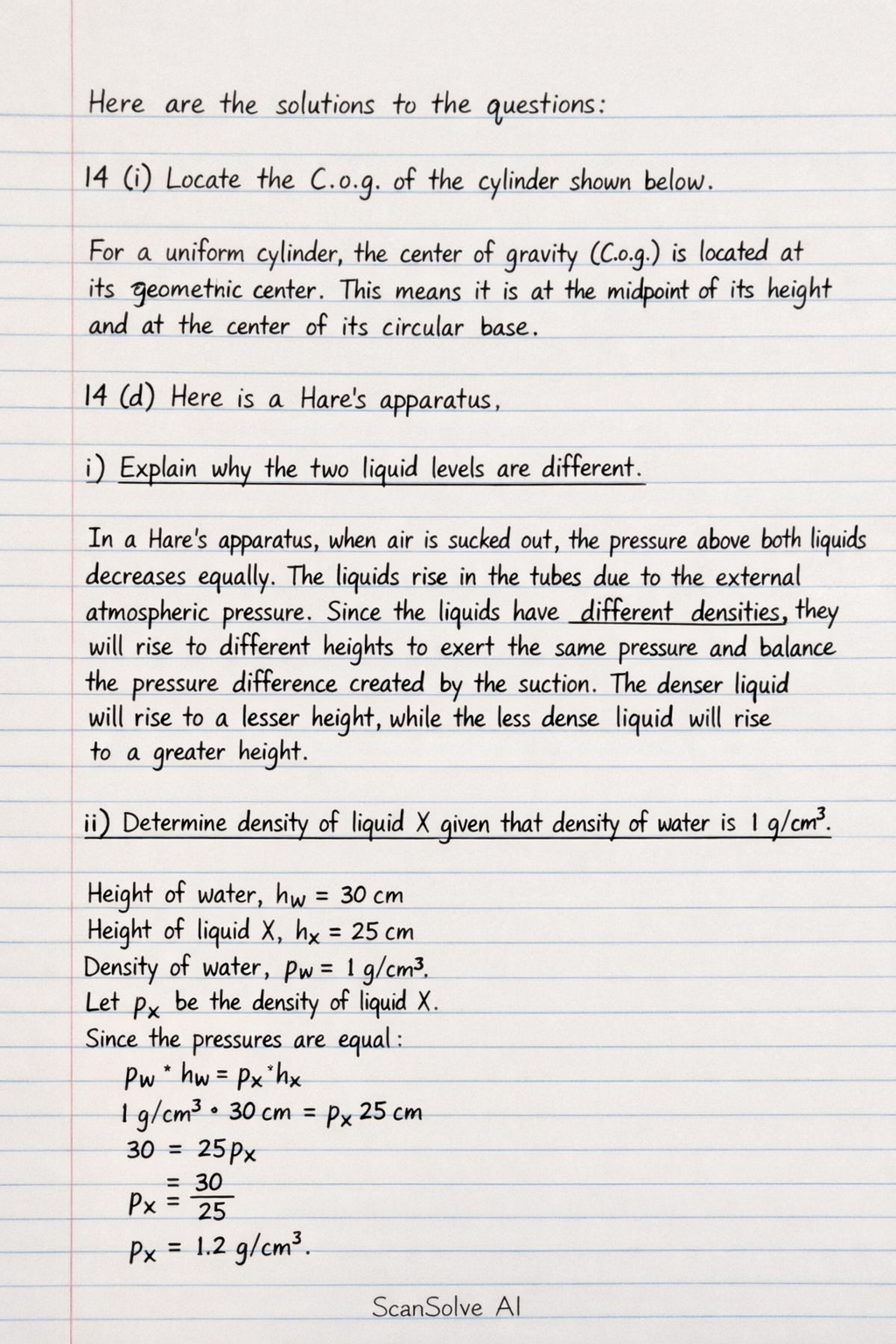
Here are the solutions to the questions:
14 (i) Locate the C.o.g. of the cylinder shown below.
For a uniform cylinder, the center of gravity (C.o.g.) is located at its geometric center. This means it is at the midpoint of its height and at the center of its circular base.
14 (d) Here is a Hare's apparatus,
-
i) Explain why the two liquid levels are different. In a Hare's apparatus, when air is sucked out, the pressure above both liquids decreases equally. The liquids rise in the tubes due to the external atmospheric pressure. Since the liquids have different densities, they will rise to different heights to exert the same pressure and balance the pressure difference created by the suction. The denser liquid will rise to a lesser height, while the less dense liquid will rise to a greater height.
-
ii) Determine density of liquid X given that density of water is 1 g/cm³. From the diagram: Height of water, Height of liquid X, Density of water,
In a Hare's apparatus, the pressure exerted by the columns of liquid is equal:
Since (acceleration due to gravity) is constant, we can simplify to:
To find the density of liquid X, :
Substitute the given values:
The density of liquid X is .
16 (i) Distinguish between concave and convex mirrors.
- A concave mirror has its reflecting surface curved inwards, like the inside of a spoon. It converges parallel rays of light to a focal point.
- A convex mirror has its reflecting surface curved outwards, like the outside of a spoon. It diverges parallel rays of light, making them appear to come from a virtual focal point behind the mirror.
Still stuck on this one?
Ask a follow-up, and the answer starts from this question.
More Mathematics Questions
Handwritten Step-by-Step Solution
Get this as a handwritten image on WhatsApp — like a tutor wrote it for you.
Try on WhatsApp