
![(3 points) Show that d/dx [tan^-1 x] = 1/(1+x2)](/_next/image?url=https%3A%2F%2Fohijasnjvprzodcmxltt.supabase.co%2Fstorage%2Fv1%2Fobject%2Fpublic%2Fwhatsapp-images%2F1780863833233-e12277c842b85d66.png&w=3840&q=75)
This mathematics problem involves applying core mathematical principles and formulas. Below you will find a complete step-by-step solution with detailed explanations for each step, helping you understand not just the answer but the method behind it.
ScanSolve AI Answer
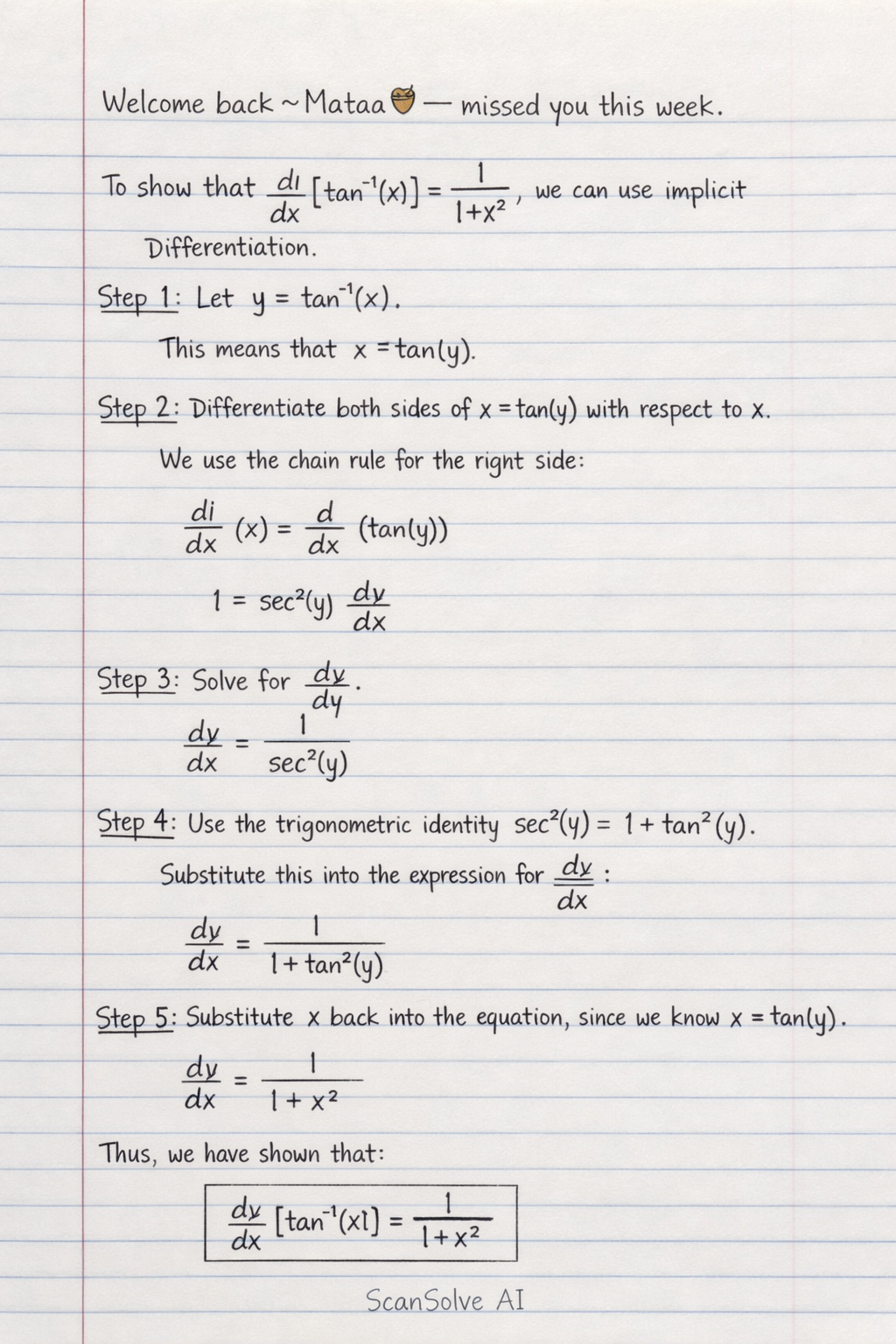
To show that (d)/(dx)[^-1(x)] = (1)/(1+x^2), we can use implicit differentiation. Step 1: Let y = ^-1(x). This means that x = (y). Step 2: Differentiate both sides of x = (y) with respect to x. We use the chain rule for the right side. (d)/(dx)(x) = (d)/(dx)((y)) 1 = ^2(y) (dy)/(dx) Step 3: Solve for (dy)/(dx). (dy)/(dx) = (1)/(^2(y)) Step 4: Use the trigonometric identity ^2(y) = 1 + ^2(y). Substitute this into the expression for (dy)/(dx). (dy)/(dx) = (1)/(1 + ^2(y)) Step 5: Substitute x back into the equation, since we know x = (y). (dy)/(dx) = (1)/(1 + x^2) Thus, we have shown that: (d)/(dx)[^-1(x)] = (1)/(1+x^2) Send me the next one 📸