
We read your photo as:
A circular hole of 50 mm diameter is cut out from a circular disc of 100 mm diameter as shown in the figure below. Find the centre of gravity of the section from A.
ScanSolve AI Answer
Answer
Step-by-step solution
3 stepsTo find the center of gravity (centroid) of the shaded area from point A, we will treat the shaded area as a composite of a large circular disc and a smaller circular hole. We'll use point A as our origin .
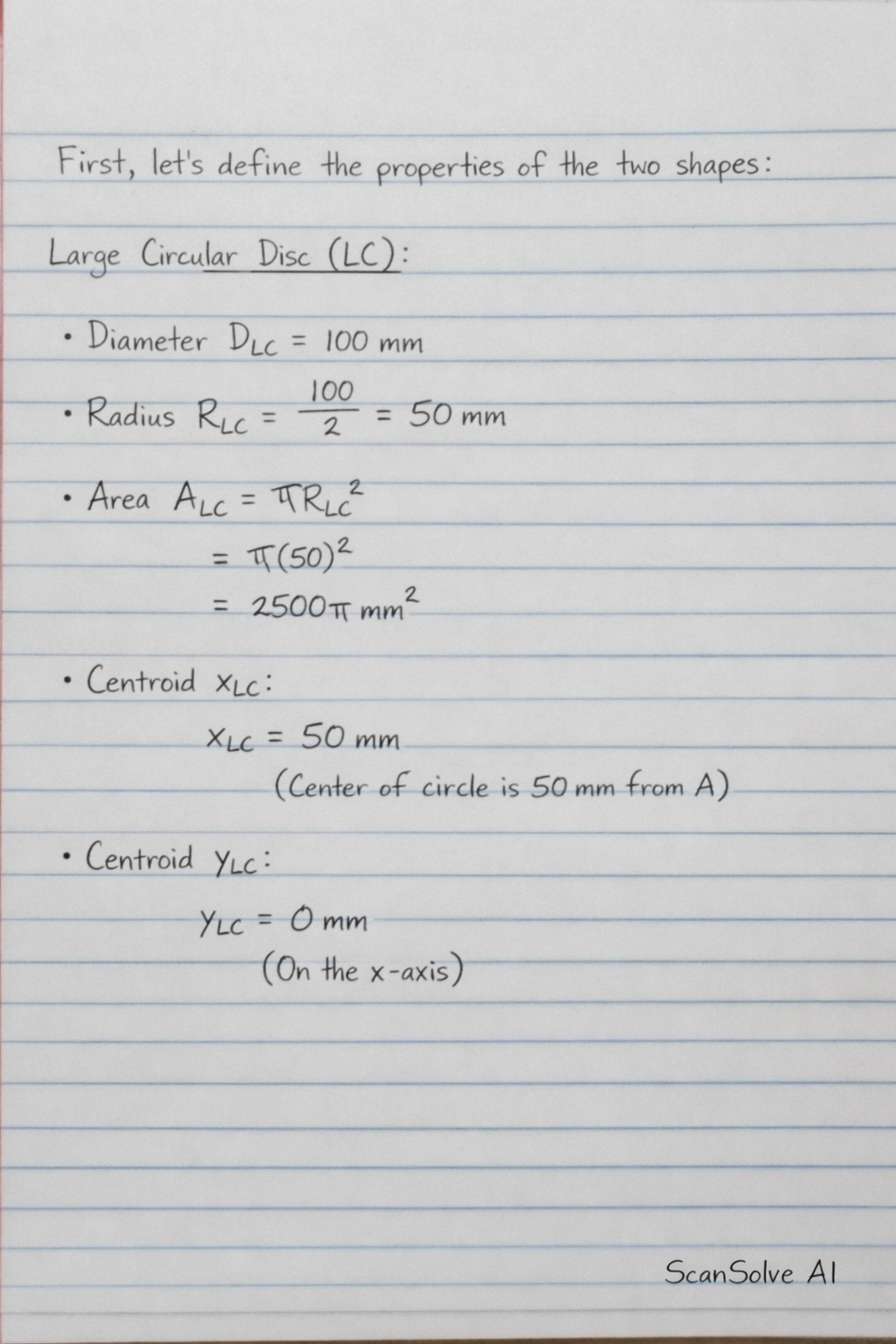
First, let's define the properties of the two shapes:
-
Large Circular Disc (LC):
- Diameter
- Radius
- Area
- Centroid : Since A is the leftmost point of the large circle and the diameter is , the center of the large circle is at from A.
- Centroid : The line A-B is the axis of symmetry, so .
-
Circular Hole (H):
- Diameter
- Radius
- Area
- Centroid : The hole is also symmetric about the line A-B, so .
- Centroid : The diagram's dimensioning for the hole's position is ambiguous. However, the visual representation clearly shows the hole is offset to the right, not concentric with the large circle. A common interpretation for such offset holes, consistent with the visual, is that the right edge of the hole is tangent to the right edge of the large circle.
- The right edge of the large circle is at from A.
- If the right edge of the hole is tangent to this, then .
- .
- Alternatively, if the dimension from A to the center of the hole is interpreted as the distance from A to the left edge of the hole, then , which gives , so . This interpretation is consistent with the visual and leads to a centroid shift.
Calculate the total area of the shaded region.
The shaded area is the area of the large circle minus the area of the hole.
Calculate the x-coordinate of the centroid () of the shaded area.
The formula for the centroid of a composite area with a cutout is:
Substitute the values:
Simplify the fraction:
Calculate the y-coordinate of the centroid () of the shaded area.
Since both the large circle and the hole are symmetric about the line A-B (our x-axis), their individual centroids lie on this axis. Therefore, the centroid of the composite shaded area will also lie on this axis.
The center of gravity of the section from A is at:
Still stuck on this one?
Ask a follow-up, and the answer starts from this question.
More Mathematics Questions
Handwritten Step-by-Step Solution
Get this as a handwritten image on WhatsApp — like a tutor wrote it for you.
Try on WhatsApp