We read your photo as:

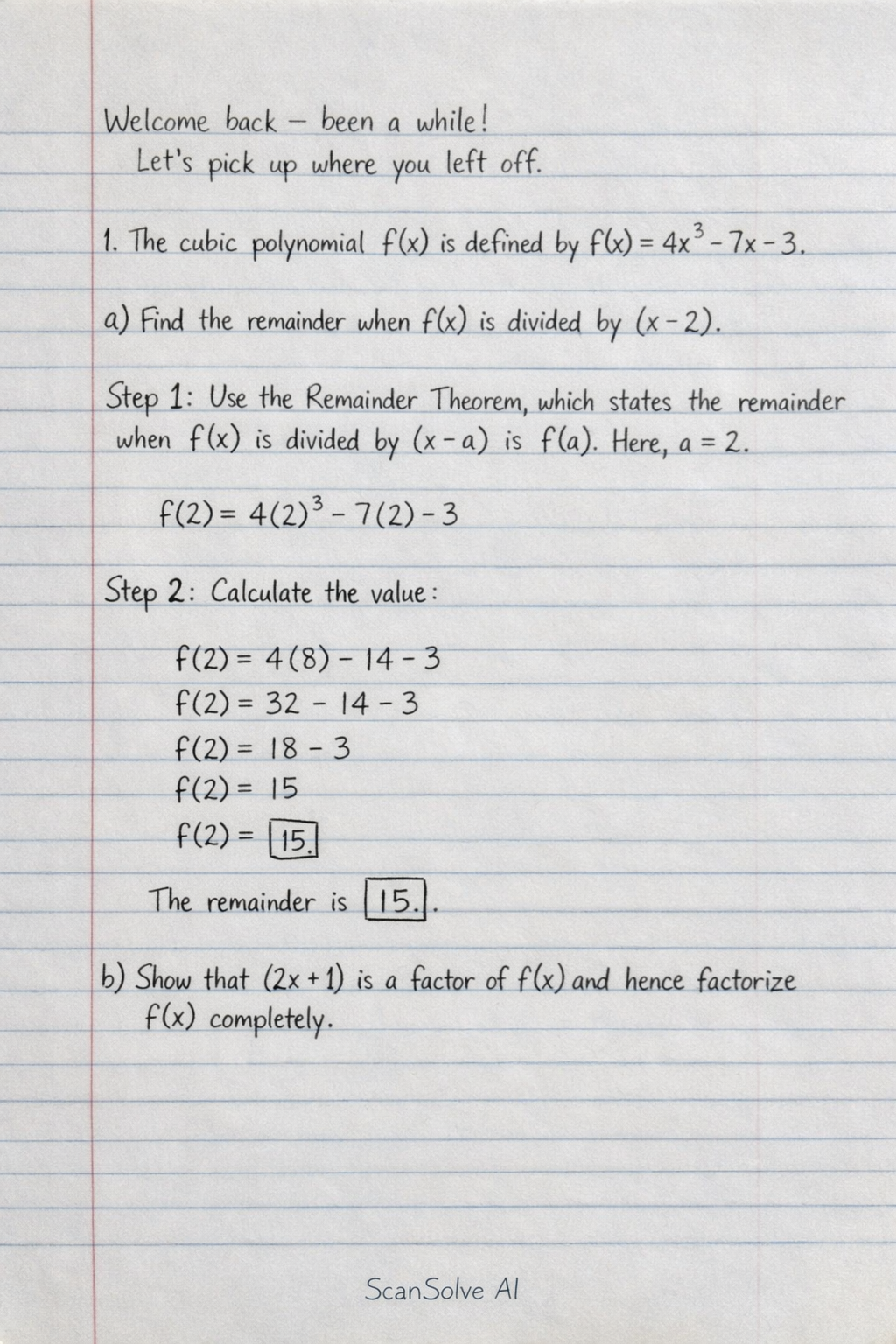
A cubic polynomial is defined by f(x) = 4x3 − 7x − 3. Find the remainder when f(x) is divided by (x-2). Show that (2x+1) is a factor of f(x) and hence factorize f(x) completely.

Mathematics

ScanSolve AI Answer

Answers

3 parts
a
15
b

(2x+1)(x+1)(2x-3)

c

120∘,180∘,240∘120^\circ, 180^\circ, 240^\circ

Graph of f(x) = 4x³ − 7x − 3

Use the left and right arrow keys to trace the curve, up and down to jump between key points, and plus and minus to zoom.

Key points of f(x) = 4x³ − 7x − 3
Pointxy
x-intercept−10
Maximum−0.760.56
x-intercept−0.50
y-intercept0−3
Minimum0.76−6.56
x-intercept1.50

Step-by-step solution

7 steps

1. The cubic polynomial f(x)f(x) is defined by f(x)=4x3−7x−3f(x) = 4x^3 - 7x - 3.

Part a· 2 steps

Find the remainder when f(x)f(x) is divided by (x−2)(x-2).

  1. Use the Remainder Theorem, which states that the remainder when f(x)f(x) is divided by (x−a)(x-a) is f(a)f(a).

    Here, a=2a=2.

    f(2)=4(2)3−7(2)−3f(2) = 4(2)^3 - 7(2) - 3
  2. Calculate the value.

    f(2)=4(8)−14−3f(2) = 4(8) - 14 - 3 f(2)=32−14−3f(2) = 32 - 14 - 3 f(2)=18−3f(2) = 18 - 3 f(2)=15f(2) = 15

    The remainder is 15\boxed{15}.

Part b(2x+1)(x+1)(2x-3)

Show that (2x+1)(2x+1) is a factor of f(x)f(x) and hence factorize f(x)f(x) completely.

  1. Use the Factor Theorem.

    If (2x+1)(2x+1) is a factor, then f(−12)f\left(-\frac{1}{2}\right) must be 0.

    f(−12)=4(−12)3−7(−12)−3f\left(-\frac{1}{2}\right) = 4\left(-\frac{1}{2}\right)^3 - 7\left(-\frac{1}{2}\right) - 3 f(−12)=4(−18)+72−3f\left(-\frac{1}{2}\right) = 4\left(-\frac{1}{8}\right) + \frac{7}{2} - 3 f(−12)=−12+72−3f\left(-\frac{1}{2}\right) = -\frac{1}{2} + \frac{7}{2} - 3 f(−12)=62−3f\left(-\frac{1}{2}\right) = \frac{6}{2} - 3 f(−12)=3−3f\left(-\frac{1}{2}\right) = 3 - 3 f(−12)=0f\left(-\frac{1}{2}\right) = 0

    Since f(−12)=0f\left(-\frac{1}{2}\right) = 0, (2x+1)(2x+1) is a factor of f(x)f(x).

  2. Perform polynomial division to find the other factor.

    Dividing 4x3−7x−34x^3 - 7x - 3 by (2x+1)(2x+1) gives 2x2−x−32x^2 - x - 3.
    So, f(x)=(2x+1)(2x2−x−3)f(x) = (2x+1)(2x^2 - x - 3).

  3. Factorize the quadratic expression 2x2−x−32x^2 - x - 3.

    2x2−x−3=2x2−3x+2x−32x^2 - x - 3 = 2x^2 - 3x + 2x - 3 =x(2x−3)+1(2x−3)= x(2x - 3) + 1(2x - 3) =(x+1)(2x−3)= (x+1)(2x-3)

    Therefore, the complete factorization of f(x)f(x) is (2x+1)(x+1)(2x−3)\boxed{(2x+1)(x+1)(2x-3)}.

Part c

120∘,180∘,240∘120^\circ, 180^\circ, 240^\circ

Solve the equation 4cos⁡3θ−7cos⁡θ−3=04\cos^3\theta - 7\cos\theta - 3 = 0, for 0≤θ≤360∘0 \le \theta \le 360^\circ.

  1. Let x=cos⁡θx = \cos\theta.

    The equation becomes 4x3−7x−3=04x^3 - 7x - 3 = 0, which is f(x)=0f(x)=0.
    From part b), we know f(x)=(2x+1)(x+1)(2x−3)f(x) = (2x+1)(x+1)(2x-3).
    So, (2x+1)(x+1)(2x−3)=0(2x+1)(x+1)(2x-3) = 0.
    This gives the solutions for xx:

    • 2x+1=0  ⟹  x=−122x+1 = 0 \implies x = -\frac{1}{2}
    • x+1=0  ⟹  x=−1x+1 = 0 \implies x = -1
    • 2x−3=0  ⟹  x=322x-3 = 0 \implies x = \frac{3}{2}
  2. Substitute back x=cos⁡θx = \cos\theta and solve for θ\theta.

    • cos⁡θ=−12\cos\theta = -\frac{1}{2} The reference angle is α=cos⁡−1(12)=60∘\alpha = \cos^{-1}\left(\frac{1}{2}\right) = 60^\circ. Since cos⁡θ\cos\theta is negative, θ\theta is in the second or third quadrant. θ=180∘−60∘=120∘\theta = 180^\circ - 60^\circ = 120^\circ θ=180∘+60∘=240∘\theta = 180^\circ + 60^\circ = 240^\circ

    • cos⁡θ=−1\cos\theta = -1 θ=180∘\theta = 180^\circ

    • cos⁡θ=32\cos\theta = \frac{3}{2} There are no solutions for this case, as the range of cos⁡θ\cos\theta is [−1,1][-1, 1].

    The solutions for θ\theta are 120∘,180∘,240∘\boxed{120^\circ, 180^\circ, 240^\circ}.

Part d

If α\alpha and β\beta are the roots of the equation x2−4x+2=0x^2 - 4x + 2 = 0, find the equation whose roots are α+1β\alpha + \frac{1}{\beta} and $\beta +

Was this helpful?

Try one yourself

A new problem that tests the same skill.

Still stuck on this one?

Ask a follow-up, and the answer starts from this question.

Got a different question?Ask your own question
Handwritten step-by-step solution preview

Handwritten Step-by-Step Solution

Get this as a handwritten image on WhatsApp — like a tutor wrote it for you.

Try on WhatsApp