
We read your photo as:
A group needs to model the constraints and cost for a chalet booking. The constraints are: at least 4 Type A, at least 4 Type B, the ratio of Type A to Type B is at least 1:2, and the total number of
ScanSolve AI Answer
Step-by-step solution
8 stepsHere are the solutions to the problems.
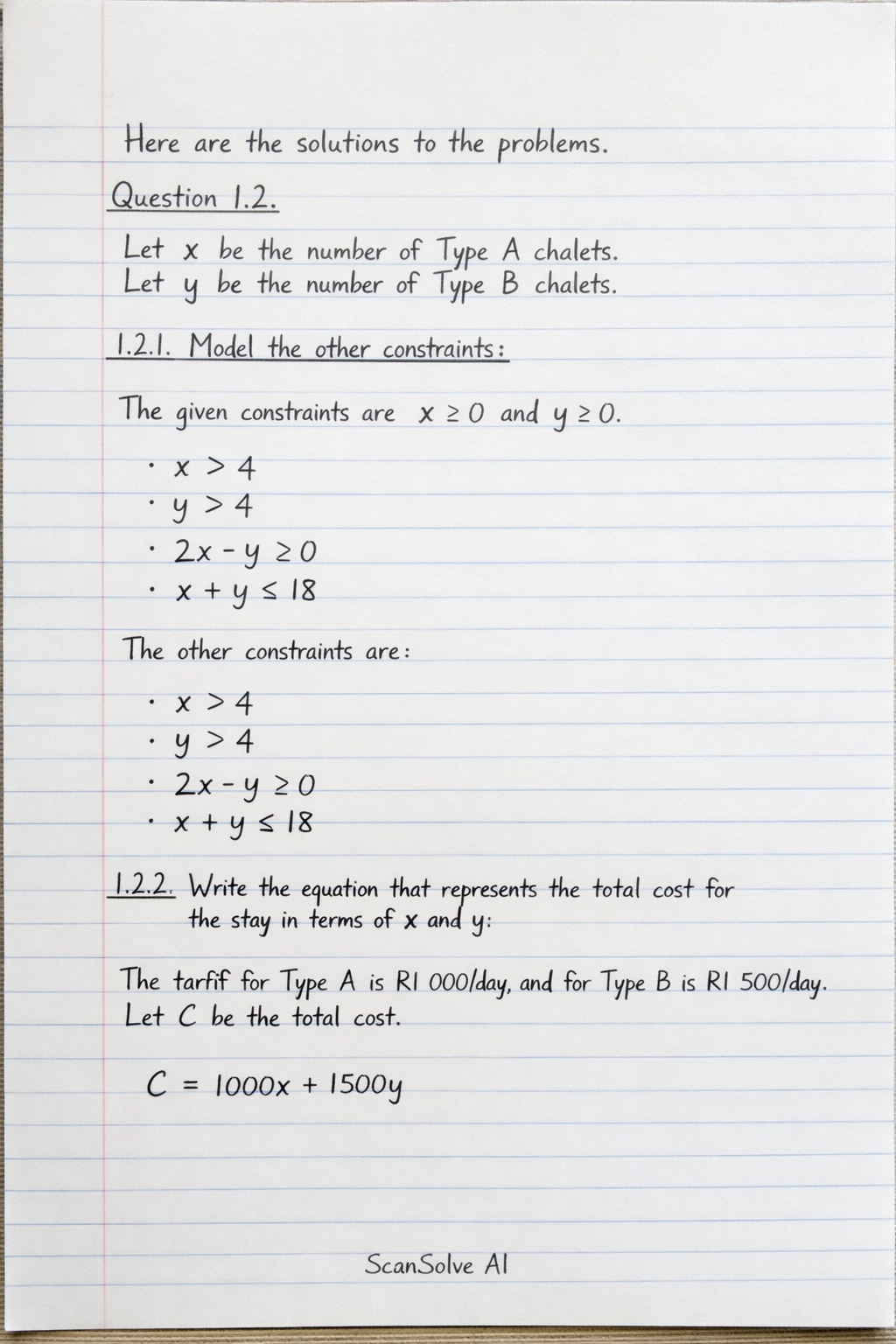
Question 1.2
- Let be the number of Type A chalets.
- Let be the number of Type B chalets.
1.2.1 Model the other constraints:
The given constraints are and .
- "at least 4 couples who want to stay in the type A chalets":
- "not less than 4 of the type B chalets to place families":
- "ratio of type A to type B must be at least one to two":
- "The group needs 18 chalets at the most":
The other constraints are:
1.2.2 Write the equation that represents the total cost for the stay in terms of and :
The tariff for Type A is R1 000/day, and for Type B is R1 500/day.
Let be the total cost.
1.2.3 Determine the gradient for the search line:
The search line is the objective function . To find the gradient, we express in terms of :
Rearrange the cost equation to solve for .
Divide by 1500.
Simplify the coefficient of .
The gradient of the search line is .
1.2.4
a) Using a scale of 1 unit = 2 chalets, represent the inequalities graphically on the attached ADDENDUM A (1.2.4).
The inequalities to be graphed are:(A graph is required for this part, which is not provided. The lines to be drawn are , , , and .)
b) Indicate the feasible region on the graph.
(The feasible region is the area on the graph that satisfies all the inequalities simultaneously. It is a polygon formed by the intersection of the constraint lines.)c) Draw the search line on the graph and calculate the maximum cost for their stay.
Identify the vertices of the feasible region by finding the intersection points of the constraint lines.
The constraint lines are , , , and .
- Intersection of and :
- Intersection of and :
- Intersection of and : . So
- Intersection of and : Substitute into . Then . So The vertices of the feasible region are , , , and .
Evaluate the objective function at each vertex.
- At :
- At :
- At :
- At :
Determine the maximum cost.
The maximum cost is the largest value obtained.
The maximum cost for their stay is .1.2.5 Due to cancellations of tourists, the group on arrival consisted of 10 families who needed type B chalets and 3 couples who required type A chalets. Will the tour leader be able to meet the requirements of all the tourist in their booked chalets? Give a reason for your answer with reference to the feasible region.
Identify the new requirements for and .
The new requirements are (3 couples for Type A) and (10 families for Type B). This corresponds to the point .
Check if the point $(3,10)$ lies within the feasible region defined by the original constraints.
The constraints are:
- : For , is False.
- : For , $
Still stuck on this one?
Ask a follow-up, and the answer starts from this question.
More Mathematics Questions
Handwritten Step-by-Step Solution
Get this as a handwritten image on WhatsApp — like a tutor wrote it for you.
Try on WhatsApp