We read your photo as:

A hollow hemisphere bowl has an external radius of 21 cm and an internal radius of 17.5 cm. If the density of the material is 9.3 g/cm³, calculate the mass of the bowl.

Mathematics

ScanSolve AI Answer

Answer

76.0 kg\text{76.0 kg}

2252h\text{2252h}

Step-by-step solution

7 steps
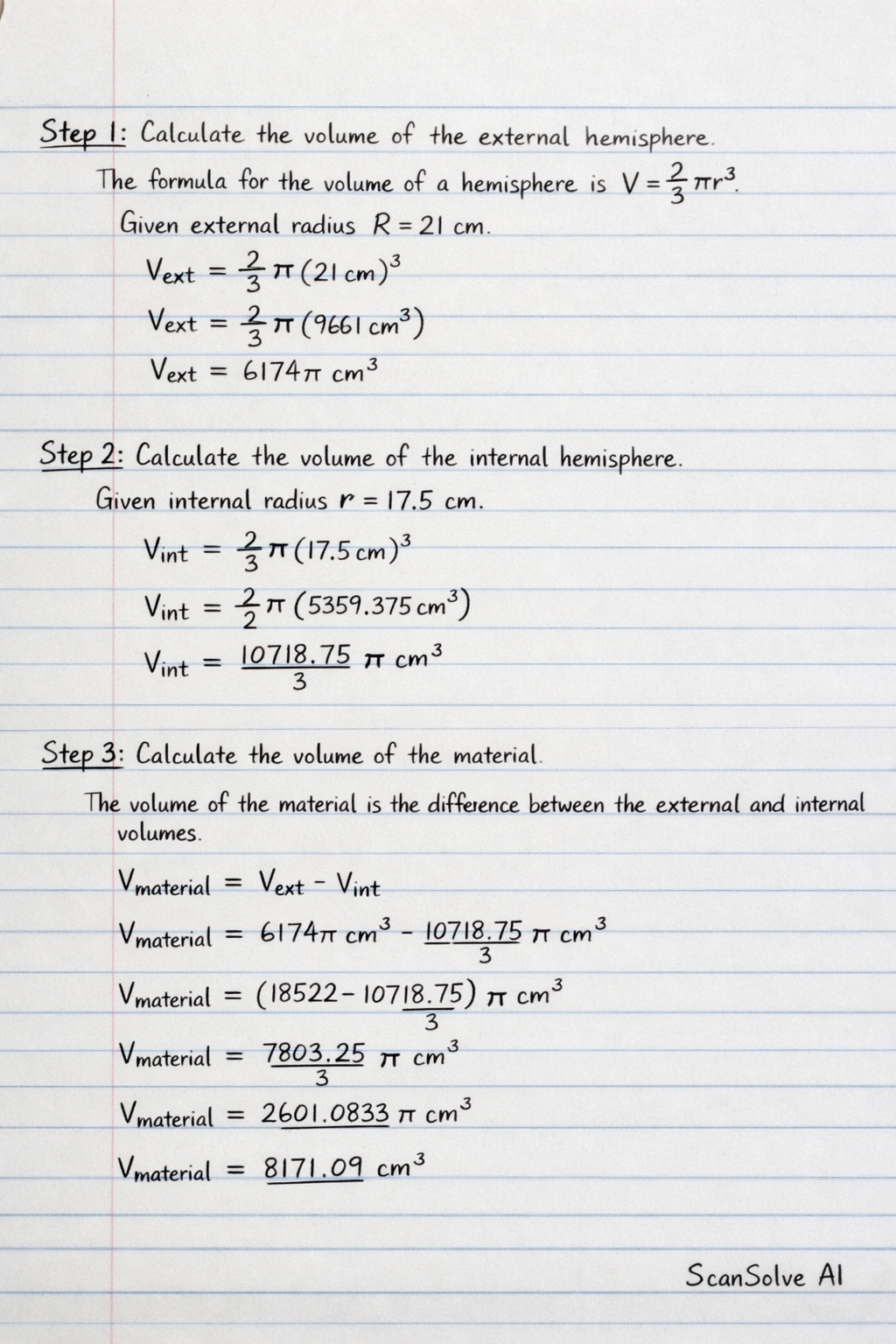
  1. Calculate the volume of the external hemisphere.

    The formula for the volume of a hemisphere is V=23πr3V = \frac{2}{3}\pi r^3.
    Given external radius R=21 cmR = 21 \text{ cm}.

    Vext=23π(21 cm)3V_{ext} = \frac{2}{3}\pi (21 \text{ cm})^3 Vext=23π(9261 cm3)V_{ext} = \frac{2}{3}\pi (9261 \text{ cm}^3) Vext=6174π cm3V_{ext} = 6174\pi \text{ cm}^3
  2. Calculate the volume of the internal hemisphere.

    Given internal radius r=17.5 cmr = 17.5 \text{ cm}.

    Vint=23π(17.5 cm)3V_{int} = \frac{2}{3}\pi (17.5 \text{ cm})^3 Vint=23π(5359.375 cm3)V_{int} = \frac{2}{3}\pi (5359.375 \text{ cm}^3) Vint=10718.753π cm3V_{int} = \frac{10718.75}{3}\pi \text{ cm}^3
  3. Calculate the volume of the material.

    The volume of the material is the difference between the external and internal volumes.

    Vmaterial=Vext−VintV_{material} = V_{ext} - V_{int} Vmaterial=6174π cm3−10718.753π cm3V_{material} = 6174\pi \text{ cm}^3 - \frac{10718.75}{3}\pi \text{ cm}^3 Vmaterial=(18522−10718.753)π cm3V_{material} = \left( \frac{18522 - 10718.75}{3} \right)\pi \text{ cm}^3 Vmaterial=7803.253π cm3V_{material} = \frac{7803.25}{3}\pi \text{ cm}^3 Vmaterial≈2601.0833π cm3V_{material} \approx 2601.0833 \pi \text{ cm}^3 Vmaterial≈8171.09 cm3V_{material} \approx 8171.09 \text{ cm}^3
  4. Calculate the mass of the bowl in grams.

    The formula for mass is M=ρ×VM = \rho \times V.
    Given density ρ=9.3 g/cm3\rho = 9.3 \text{ g/cm}^3.

    M=9.3 g/cm3×7803.253π cm3M = 9.3 \text{ g/cm}^3 \times \frac{7803.25}{3}\pi \text{ cm}^3 M=3.1×7803.25π gM = 3.1 \times 7803.25 \pi \text{ g} M=24189.975π gM = 24189.975 \pi \text{ g} M≈75997.14 gM \approx 75997.14 \text{ g}
  5. Convert the mass to kilograms.

    There are 1000 grams in 1 kilogram.

    Mkg=75997.14 g1000M_{kg} = \frac{75997.14 \text{ g}}{1000} Mkg≈75.997 kgM_{kg} \approx 75.997 \text{ kg}

    Rounding to one decimal place:

    Mkg≈76.0 kgM_{kg} \approx 76.0 \text{ kg}

    The mass of the bowl is 76.0 kg\boxed{\text{76.0 kg}}.

  6. Convert the movie duration from decimal hours to hours and minutes.

    The movie lasted 2.3 hours.
    This is 2 full hours and 0.3 of an hour.
    To convert 0.3 hours to minutes:

    0.3 hours×60 minutes/hour=18 minutes0.3 \text{ hours} \times 60 \text{ minutes/hour} = 18 \text{ minutes}

    So, the movie duration is 2 hours and 18 minutes.

  7. Subtract the duration from the end time to find the start time.

    The movie ended at 0110h (1:10 AM).
    We need to subtract 2 hours and 18 minutes from 0110h.
    First, subtract 2 hours:

    0110h−2 hours=2310h (on the previous day)0110\text{h} - 2\text{ hours} = 2310\text{h} \text{ (on the previous day)}

    Now, subtract 18 minutes from 2310h:
    We have 10 minutes, so we need to borrow 1 hour (60 minutes) from the hours.

    23h 10min→22h (60+10)min=22h 70min23\text{h } 10\text{min} \rightarrow 22\text{h } (60+10)\text{min} = 22\text{h } 70\text{min} 22h 70min−18min=22h 52min22\text{h } 70\text{min} - 18\text{min} = 22\text{h } 52\text{min}

    So, the start time is 2252h.

    The time on Ali's watch when the movie started was 2252h\boxed{\text{2252h}}.

Was this helpful?

Try one yourself

A new problem that tests the same skill.

Still stuck on this one?

Ask a follow-up, and the answer starts from this question.

Got a different question?Ask your own question
Handwritten step-by-step solution preview

Handwritten Step-by-Step Solution

Get this as a handwritten image on WhatsApp — like a tutor wrote it for you.

Try on WhatsApp