
We read your photo as:
A) i) List all the members of M and N. ii) Find M ∩ N. iii) Represent M and N on a Venn diagram. b) A farmer uses 1/3 of his land to plant cassava, 2/3 of the remaining land to plant maize and the res
ScanSolve AI Answer
Step-by-step solution
6 stepsHere are the solutions to the problems:
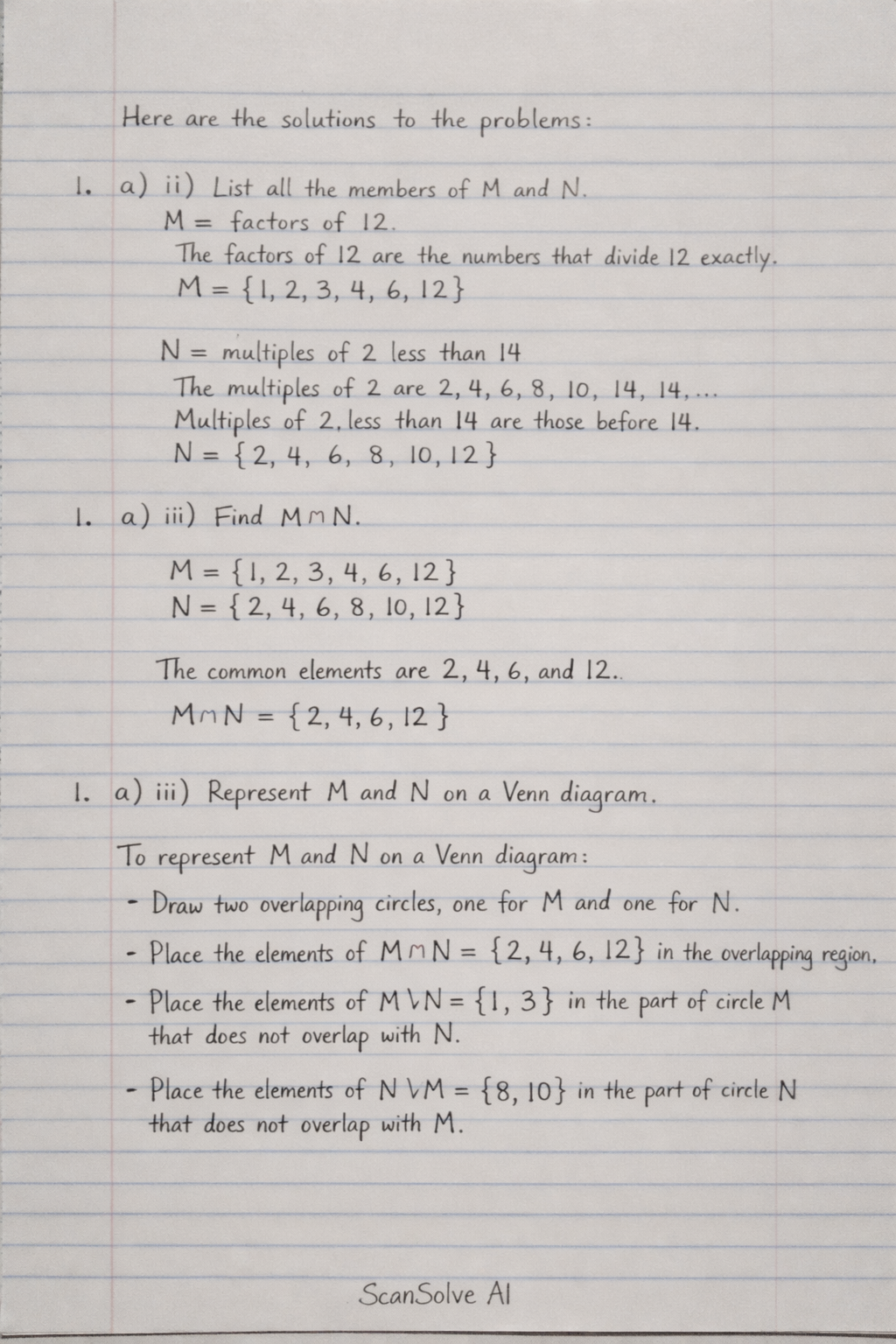
1. a) i) List all the members of M and N.
- M = {factors of 12} The factors of 12 are the numbers that divide 12 exactly.
- N = {multiples of 2 less than 14} The multiples of 2 are 2, 4, 6, 8, 10, 12, 14, ... Multiples of 2 less than 14 are those before 14.
1. a) ii) Find M N.
The intersection M N consists of elements that are common to both set M and set N.
The common elements are 2, 4, 6, and 12.
1. a) iii) Represent M and N on a Venn diagram.
To represent M and N on a Venn diagram:
- Draw two overlapping circles, one for M and one for N.
- Place the elements of M N = {2, 4, 6, 12} in the overlapping region.
- Place the elements unique to M (M \ N = {1, 3}) in the part of circle M that does not overlap with N.
- Place the elements unique to N (N \ M = {8, 10}) in the part of circle N that does not overlap with M.
1. b) A farmer uses of his land to plant cassava, of the remaining land to plant maize and the rest vegetables. If vegetables cover an area of 10 acres. What is the total area of the farmer's land?
Let the total area of the farmer's land be acres.
Fraction of land for cassava .
Area for cassava .Calculate the remaining land after planting cassava.
Remaining land .
Calculate the fraction of land for maize.
Fraction of remaining land for maize .
Area for maize .Calculate the total fraction of land used for cassava and maize.
Total fraction for cassava and maize .
To add these fractions, find a common denominator, which is 9.Total fraction for cassava and maize .
Calculate the fraction of land for vegetables.
Fraction for vegetables
Fraction for vegetables .Use the given area for vegetables to find the total area .
We are given that vegetables cover an area of 10 acres.
So, .
To find , multiply both sides by :The total area of the farmer's land is 45 acres.
2. a) There are oranges in three different baskets labelled a, b and c. If the number of oranges in basket a is 82, b is 102 and basket c is 96. Find the total number of oranges in the three baskets using associative property.
The associative property of addition states that when adding three or more numbers, the way in which the numbers are grouped does not affect the sum. That is, .
Number of oranges in basket a = 82
Number of oranges in basket b = 102
Number of oranges in basket c = 96Total number of oranges = .
Using the associative property, we can group them as follows:
Alternatively:
The total number of oranges in the three baskets is 280.
2. b) Copy and complete the table of values for the relations and from -4 to 3.
First, calculate the values for :
- For :
- For :
- For :
- For :
- For :
- For :
- For :
- For :
Next, calculate the values for :
- For :
- For :
- For : $y_2 = 3 - 2
Still stuck on this one?
Ask a follow-up, and the answer starts from this question.
More Mathematics Questions
Handwritten Step-by-Step Solution
Get this as a handwritten image on WhatsApp — like a tutor wrote it for you.
Try on WhatsApp