We read your photo as:

A metal bar in the shape of a cuboid with a cross-sectional area of 6 cm2 and a length of 15 cm is melted down and recast into two identical cones. Each cone has a height of 3 cm. Show that the radius

Mathematics

ScanSolve AI Answer

Answer

3.8 cm\text{3.8 cm}

Step-by-step solution

4 steps
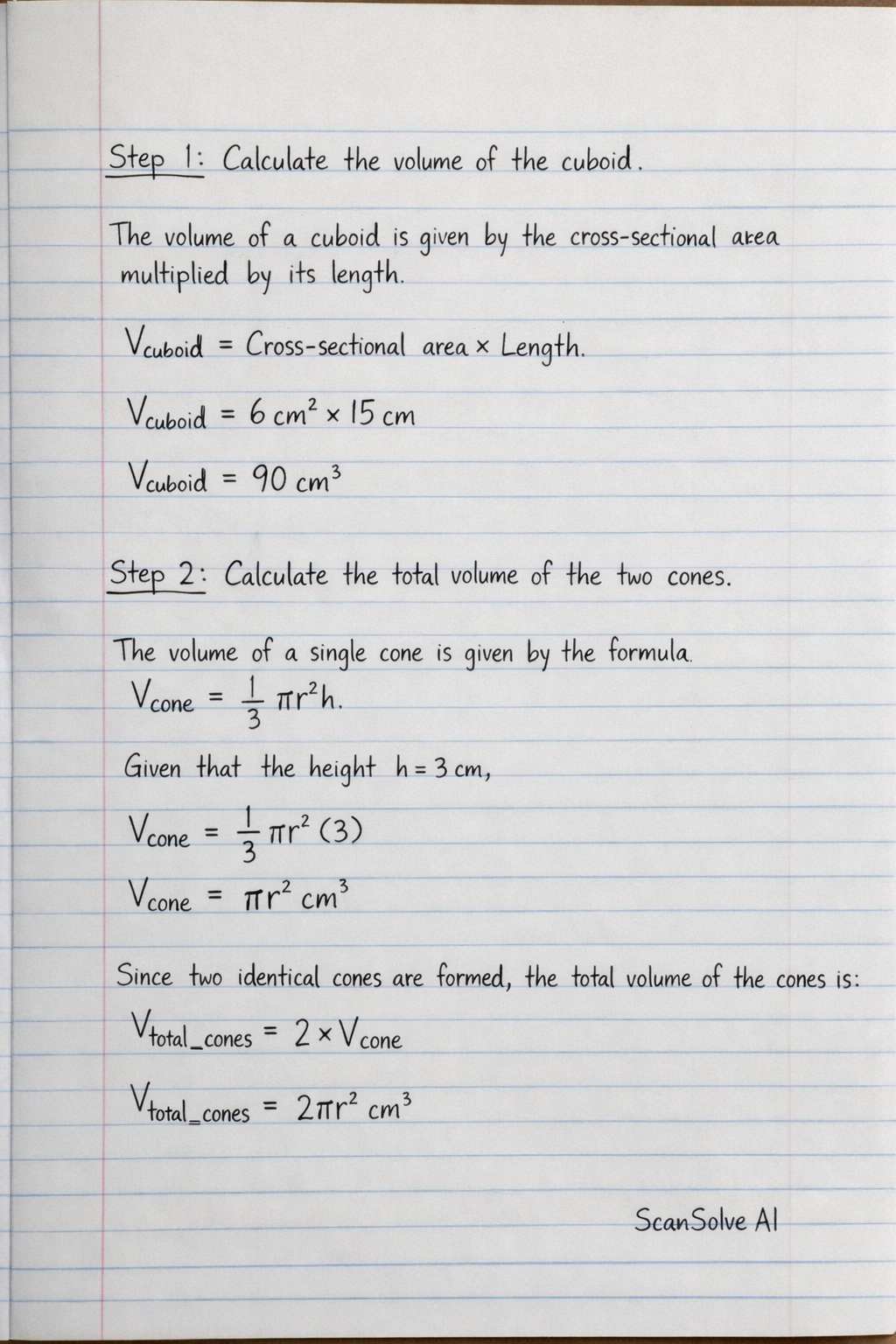
  1. Calculate the volume of the cuboid.

    The volume of a cuboid is given by the cross-sectional area multiplied by its length.

    Vcuboid=Cross-sectional area×LengthV_{cuboid} = \text{Cross-sectional area} \times \text{Length} Vcuboid=6 cm2×15 cmV_{cuboid} = 6 \text{ cm}^2 \times 15 \text{ cm} Vcuboid=90 cm3V_{cuboid} = 90 \text{ cm}^3
  2. Calculate the total volume of the two cones.

    The volume of a single cone is given by the formula Vcone=13πr2hV_{cone} = \frac{1}{3} \pi r^2 h.
    Given that the height h=3 cmh = 3 \text{ cm}.

    Vcone=13πr2(3)V_{cone} = \frac{1}{3} \pi r^2 (3) Vcone=πr2 cm3V_{cone} = \pi r^2 \text{ cm}^3

    Since two identical cones are formed, the total volume of the cones is:

    Vtotal_cones=2×VconeV_{total\_cones} = 2 \times V_{cone} Vtotal_cones=2πr2 cm3V_{total\_cones} = 2 \pi r^2 \text{ cm}^3
  3. Equate the volumes and show the expression for rr.

    Since the metal bar is melted to form the cones without any waste, the volume of the cuboid is equal to the total volume of the two cones.

    Vcuboid=Vtotal_conesV_{cuboid} = V_{total\_cones} 90=2πr290 = 2 \pi r^2

    Now, we solve for r2r^2:

    r2=902πr^2 = \frac{90}{2\pi} r2=45πr^2 = \frac{45}{\pi}

    To find rr, we take the square root of both sides:

    r=45πr = \sqrt{\frac{45}{\pi}}

    We can simplify 45\sqrt{45} as 9×5=9×5=35\sqrt{9 \times 5} = \sqrt{9} \times \sqrt{5} = 3\sqrt{5}.

    r=35πr = \frac{3\sqrt{5}}{\sqrt{\pi}} r=35πr = 3 \sqrt{\frac{5}{\pi}}

    This matches the given expression.

  4. Calculate the value of rr using logarithmic tables.

    Given π=3.14\pi = 3.14.

    r=353.14r = 3 \sqrt{\frac{5}{3.14}}

    To use logarithmic tables, we find log⁡r\log r:

    log⁡r=log⁡(3×(53.14)12)\log r = \log \left( 3 \times \left(\frac{5}{3.14}\right)^{\frac{1}{2}} \right)

    Using logarithm properties, log⁡(ab)=log⁡a+log⁡b\log(ab) = \log a + \log b and log⁡(xn)=nlog⁡x\log(x^n) = n \log x:

    log⁡r=log⁡3+12log⁡(53.14)\log r = \log 3 + \frac{1}{2} \log \left(\frac{5}{3.14}\right)

    Using another property, log⁡(ab)=log⁡a−log⁡b\log(\frac{a}{b}) = \log a - \log b:

    log⁡r=log⁡3+12(log⁡5−log⁡3.14)\log r = \log 3 + \frac{1}{2} (\log 5 - \log 3.14)

    From logarithmic tables:
    log⁡3≈0.4771\log 3 \approx 0.4771
    log⁡5≈0.6990\log 5 \approx 0.6990
    log⁡3.14≈0.4969\log 3.14 \approx 0.4969

    Substitute these values into the equation for log⁡r\log r:

    log⁡r=0.4771+12(0.6990−0.4969)\log r = 0.4771 + \frac{1}{2} (0.6990 - 0.4969) log⁡r=0.4771+12(0.2021)\log r = 0.4771 + \frac{1}{2} (0.2021) log⁡r=0.4771+0.10105\log r = 0.4771 + 0.10105 log⁡r=0.57815\log r = 0.57815

    Now, find the antilog of 0.57815 to get the value of rr.
    Using antilog tables, antilog of 0.57815≈3.78550.57815 \approx 3.7855.
    Rounding to the first decimal place:

    r≈3.8 cmr \approx 3.8 \text{ cm}

    The value of rr to the first decimal place is 3.8 cm\boxed{\text{3.8 cm}}.

Was this helpful?

Try one yourself

A new problem that tests the same skill.

Still stuck on this one?

Ask a follow-up, and the answer starts from this question.

Got a different question?Ask your own question
Handwritten step-by-step solution preview

Handwritten Step-by-Step Solution

Get this as a handwritten image on WhatsApp — like a tutor wrote it for you.

Try on WhatsApp