
We read your photo as:
A packet contains number cards. Sally picked cards with numbers 2, 4, 5 and 9 from the packet. Which of the following sets has prime numbers only?
ScanSolve AI Answer
Answer
Step-by-step solution
12 stepsHere are the solutions to the questions:
1. Prime numbers
Identify prime numbers from the given set of numbers.
A prime number is a natural number greater than 1 that has no positive divisors other than 1 and itself.
- 2 is a prime number.
- 4 is not a prime number ().
- 5 is a prime number.
- 9 is not a prime number ().
Check the given options for sets containing only prime numbers.
- A. 2 and 4: Contains 4, which is not prime.
- B. 2 and 5: Both 2 and 5 are prime numbers.
- C. 4 and 9: Contains 4 and 9, which are not prime.
- D. 5 and 9: Contains 9, which is not prime.
The correct option is B.
2. Largest number of groups
To find the largest number of groups with equal numbers of boys, girls, and teachers, we need to find the Greatest Common Divisor (GCD) of the number of boys, girls, and teachers.
Number of boys = 120
Number of girls = 180
Number of teachers = 24Find the prime factorization of each number.
Identify the common prime factors and their lowest powers.
Common prime factors are 2 and 3.
The lowest power of 2 is (from 180).
The lowest power of 3 is (from 120 and 24).Calculate the GCD.
The largest number of groups formed is 12.
The correct option is A.
3. Temperature change
Start with the initial temperature of the deep freezer.
Initial temperature = .
The temperature was increased by .
Add this increase to the initial temperature.
Final temperature =
Final temperature =The correct option is C.
4. Extra time for planting seedlings
Determine the allocated time per seedling and the actual time taken per seedling.
Allocated time per seedling = of an hour.
Actual time taken per seedling = of an hour.Calculate the extra time taken for each seedling.
Extra time per seedling = Actual time - Allocated time
Calculate the total extra time for all 70 seedlings.
Total extra time = (Extra time per seedling) (Number of seedlings)
Compare this calculation with the given options.
Option D matches this calculation.
The correct option is D.
3 zimekamilika, zimebaki 2 leo. Unapiga hatua.
Try one yourself
A new problem that tests the same skill.
Still stuck on this one?
Ask a follow-up, and the answer starts from this question.
More Mathematics Questions
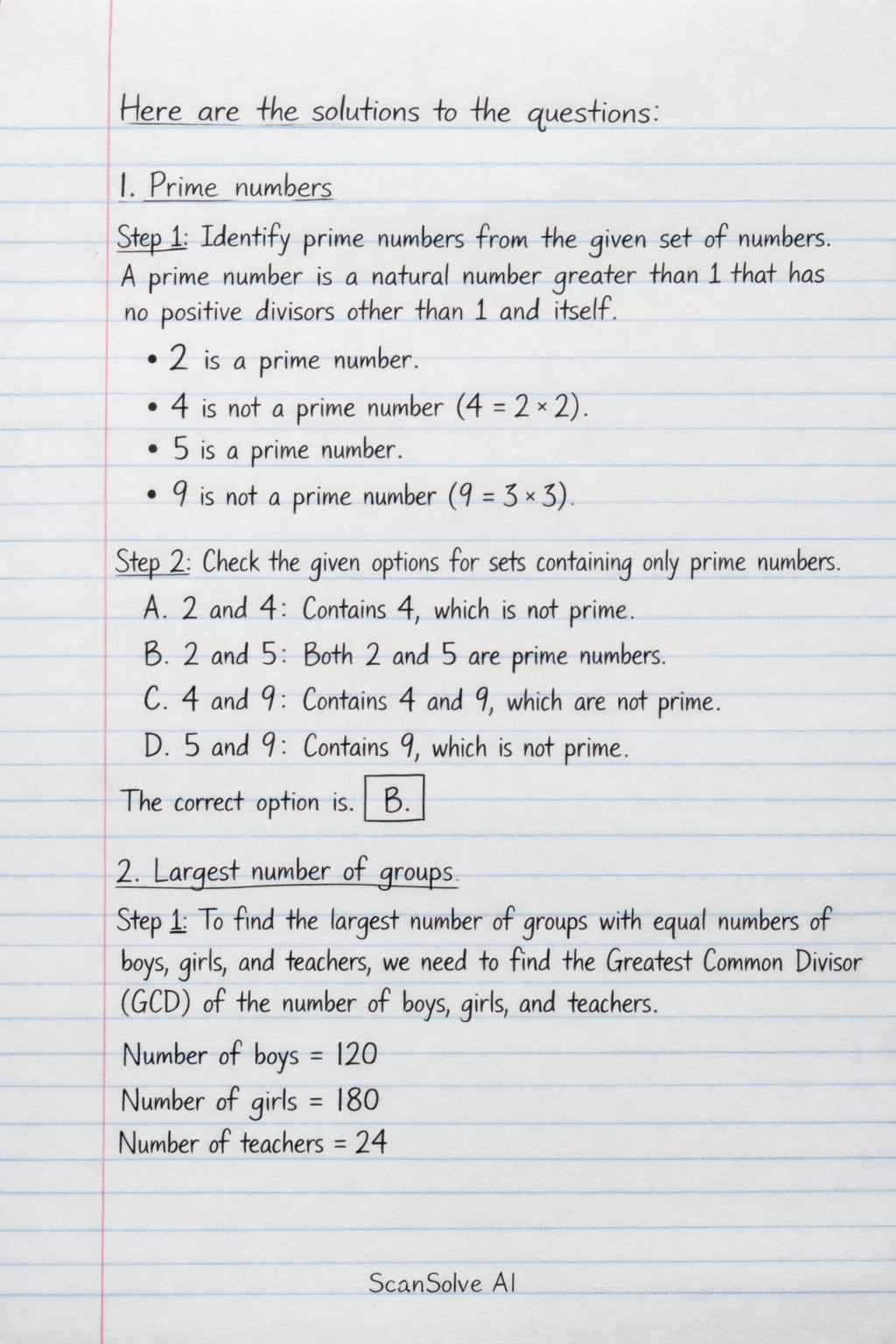
Handwritten Step-by-Step Solution
Get this as a handwritten image on WhatsApp — like a tutor wrote it for you.
Try on WhatsApp