

This mathematics problem involves applying core mathematical principles and formulas. Below you will find a complete step-by-step solution with detailed explanations for each step, helping you understand not just the answer but the method behind it.
ScanSolve AI Answer
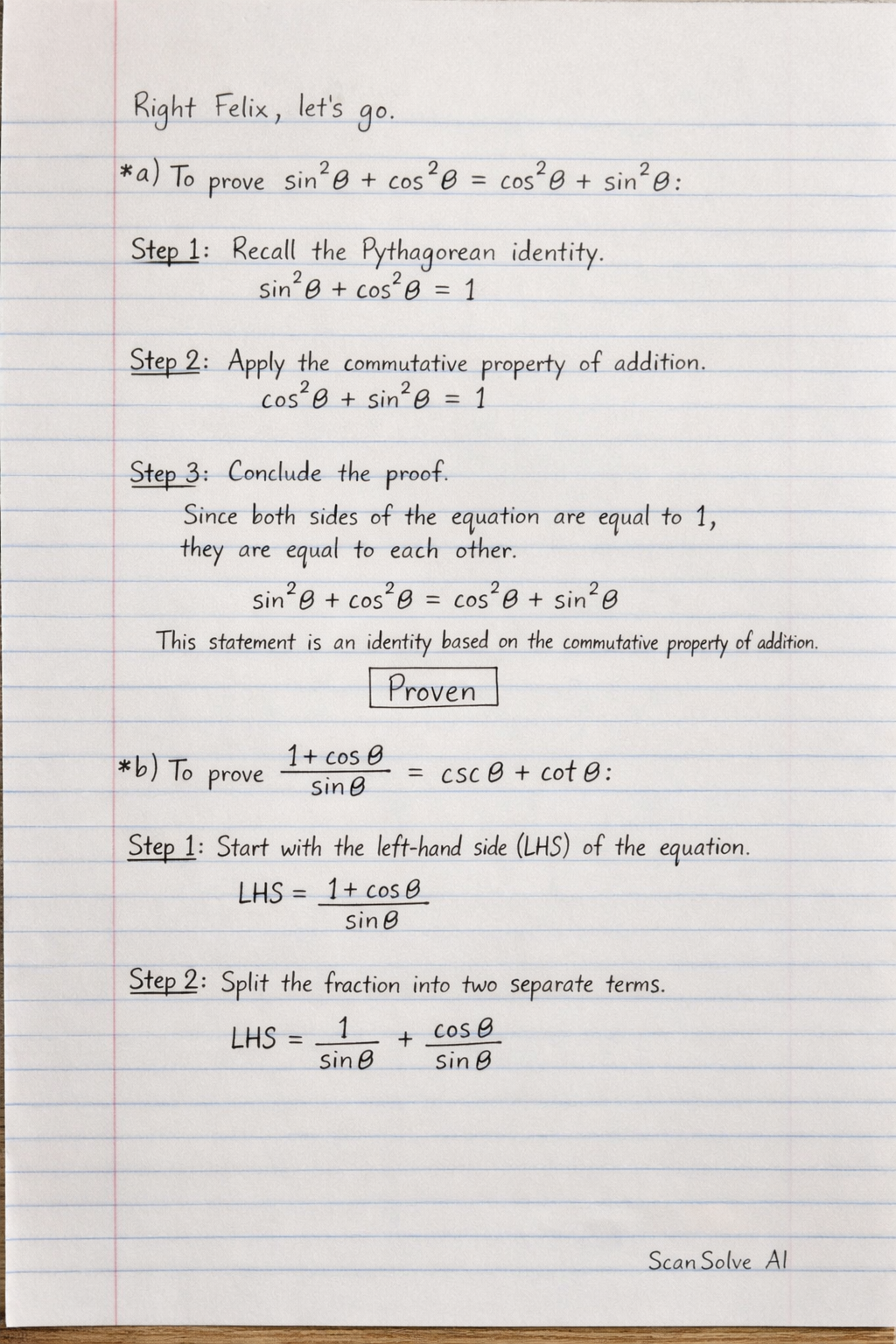
a) To prove ^2 + ^2 = ^2 + ^2 : Step 1: Recall the Pythagorean identity. The fundamental trigonometric identity states that for any angle : ^2 + ^2 = 1 Step 2: Apply the commutative property of addition. The order of addition does not change the sum. Therefore, ^2 + ^2 is also equal to 1. ^2 + ^2 = 1 Step 3: Conclude the proof. Since both sides of the equation are equal to 1, they are equal to each other. ^2 + ^2 = ^2 + ^2 This statement is an identity based on the commutative property of addition. Proven b) To prove (1 + )/( ) = + : Step 1: Start with the left-hand side (LHS) of the equation. LHS = (1 + )/( ) Step 2: Split the fraction into two separate terms. LHS = (1)/( ) + ( )/( ) Step 3: Use the definitions of cosecant and cotangent. Recall that = (1)/( ) and = ( )/( ). LHS = + Step 4: Compare with the right-hand side (RHS). The LHS now matches the RHS. + = RHS Proven Send me the next one 📸