
We read your photo as:
A rectangle has been drawn on a coordinate grid. How can you use the given coordinates to work out the coordinates of the other three vertices?
ScanSolve AI Answer
Step-by-step solution
8 stepsHere are the solutions to the problems:
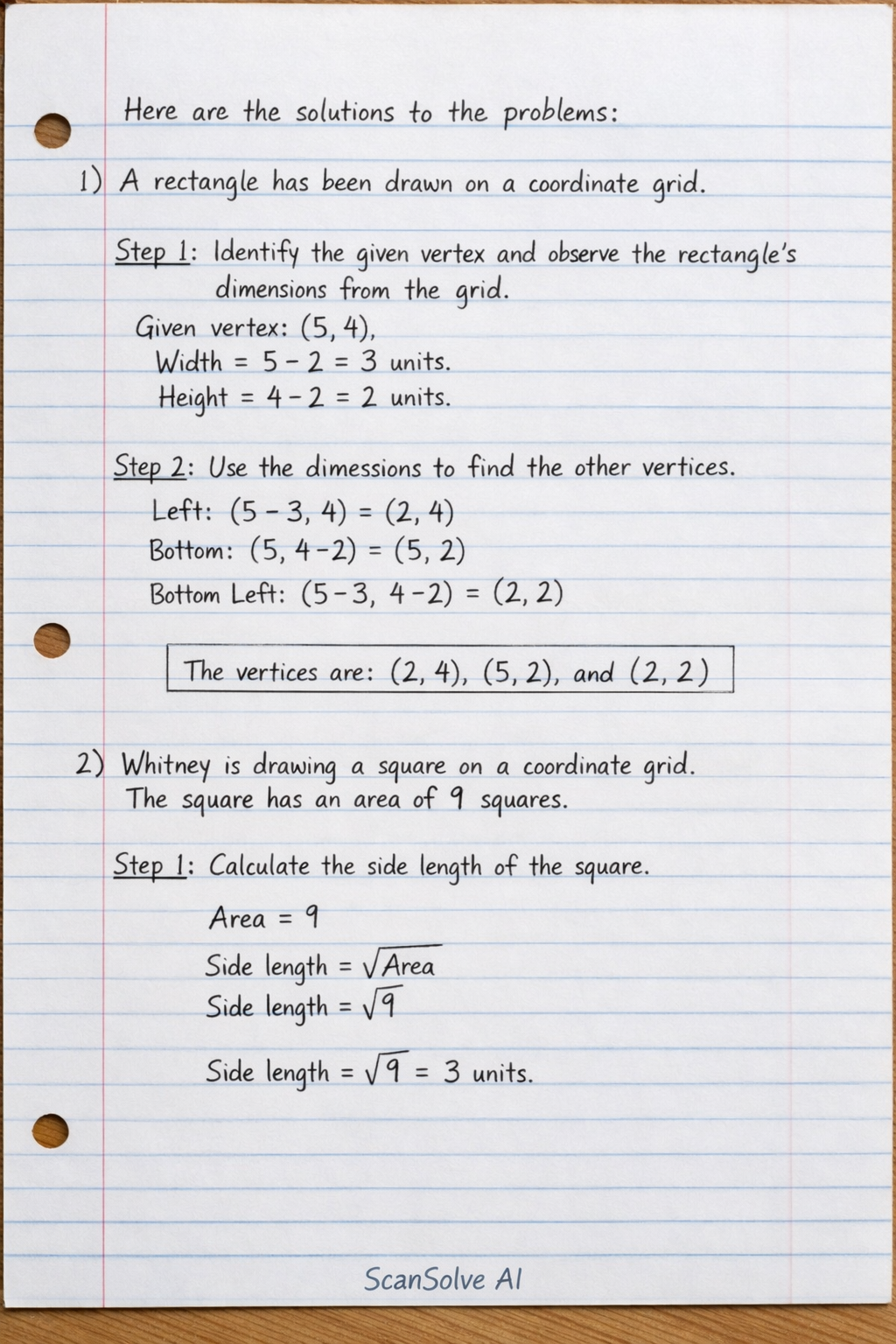
1. A rectangle has been drawn on a coordinate grid.
Identify the given vertex and observe the rectangle's dimensions from the grid.
The given vertex is . From the grid, the rectangle spans from to and from to . This means its width is units and its height is units.
Use the dimensions to find the other vertices.
Since one vertex is , the other vertices can be found by moving 3 units horizontally and 2 units vertically.
The other three vertices are:The coordinates of the other three vertices are .
2. Whitney is drawing a square on a coordinate grid. The square has an area of 9 squares.
Calculate the side length of the square.
The area of a square is given by side length side length.
Determine the possible coordinates for the other three vertices.
The given vertex is . Since the side length is 3 units, the other vertices can be found by adding or subtracting 3 from the x-coordinate and/or y-coordinate of . There are four possible squares.
One possible set of coordinates for the other three vertices is:
Yes, there is more than one possible answer. For example, another set of vertices could be , , and .
The coordinates of the other three vertices could be .
Yes, there is more than one possible answer.3. A rectangle has been drawn on a coordinate grid.
Identify the given vertices and their relationship.
The image shows a rectangle with two given vertices: $(2,3)$ and $(5,7)$. These are opposite vertices of the rectangle.
Determine the coordinates of vertices A and B.
For a rectangle aligned with the axes, if two opposite vertices are and , then the other two vertices are and .
Given and :- Vertex A has the x-coordinate of and the y-coordinate of , so .
- Vertex B has the x-coordinate of and the y-coordinate of , so .
The coordinates of vertices A and B are .
4. Work out the coordinates of points A, B and C.
Identify the known coordinates and the positions of A, B, and C on the L-shaped figure.
The known coordinates are $(2,2)$, $(5,5)$, and $(8,8)$.
- Point A is the top-left corner of the upper rectangle.
- Point B is the bottom-right corner of the lower rectangle.
- Point C is the inner corner of the L-shape, specifically the bottom-left corner of the upper rectangle.
Determine the coordinates for A, B, and C by observing their alignment with the grid lines and known points.
- For point A: Its x-coordinate aligns with the x-coordinate of , which is 5. Its y-coordinate aligns with the y-coordinate of , which is 8. So, .
- For point B: Its x-coordinate aligns with the x-coordinate of , which is 8. Its y-coordinate aligns with the y-coordinate of , which is 5. So, .
- For point C: Its x-coordinate aligns with the x-coordinate of , which is 2. Its y-coordinate aligns with the y-coordinate of , which is 5. So, .
The coordinates of points A, B, and C are .
Still stuck on this one?
Ask a follow-up, and the answer starts from this question.
More Mathematics Questions
Handwritten Step-by-Step Solution
Get this as a handwritten image on WhatsApp — like a tutor wrote it for you.
Try on WhatsApp