We read your photo as:

A shear transformation S maps A(2,3) onto A'(8,3). Find the matrix S. Find the images of B(5,2) and C(4,-1) under S.

Mathematics

ScanSolve AI Answer

This answer stops before the end.

It was cut off when it was first written. Ask ScanSolve this question again for the full working.

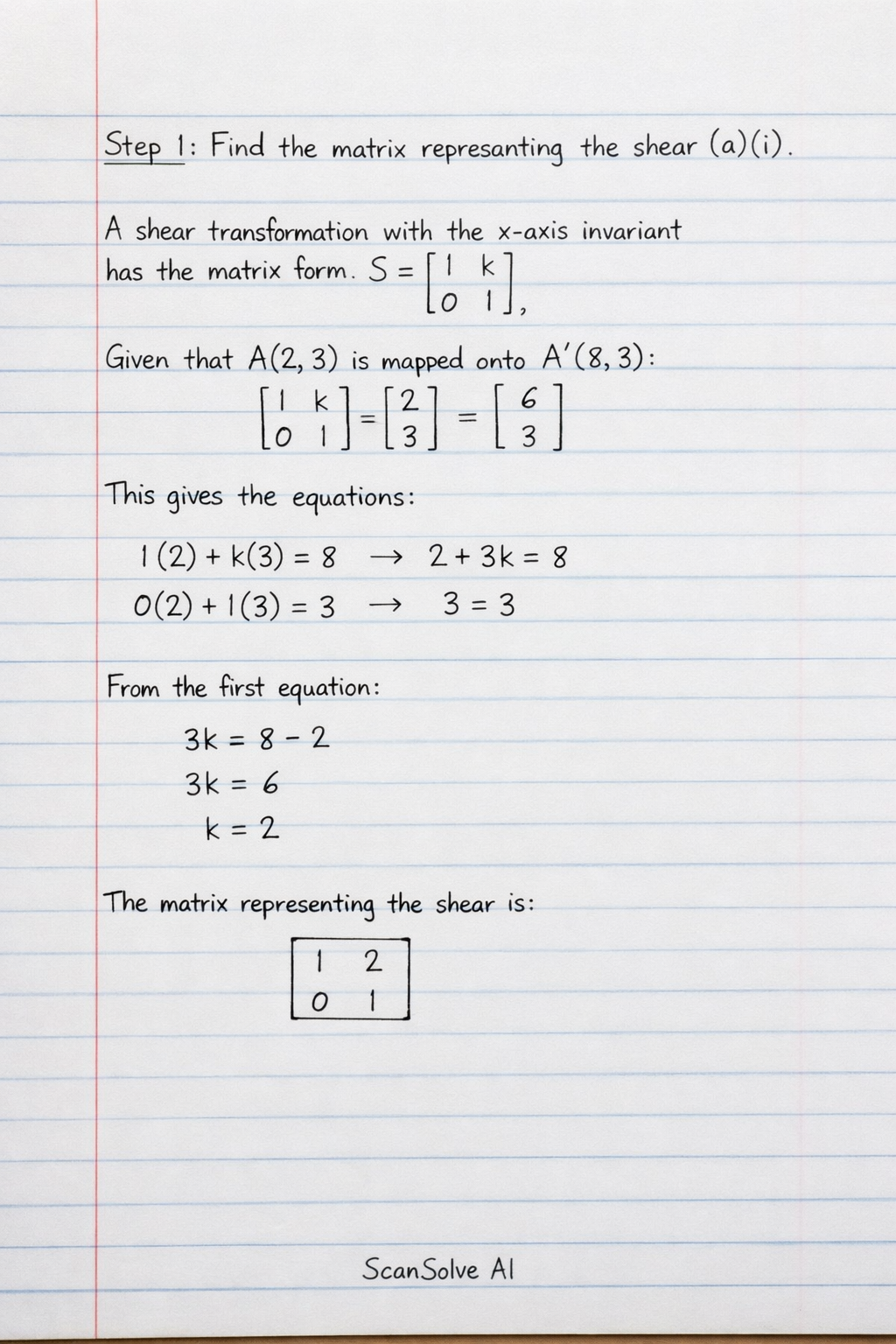
Step 1: Find the matrix representing the shear (a)(i).
A shear transformation with the x-axis invariant has the matrix form S=[1k01]S = \begin{bmatrix} 1 & k \\ 0 & 1 \end{bmatrix}.
Given that A(2,3) is mapped onto A'(8,3):

[1k01][23]=[83]\begin{bmatrix} 1 & k \\ 0 & 1 \end{bmatrix} \begin{bmatrix} 2 \\ 3 \end{bmatrix} = \begin{bmatrix} 8 \\ 3 \end{bmatrix}

This gives the equations:
1(2)+k(3)=8  ⟹  2+3k=81(2) + k(3) = 8 \implies 2 + 3k = 8
0(2)+1(3)=3  ⟹  3=30(2) + 1(3) = 3 \implies 3 = 3
From the first equation:
3k=8−23k = 8 - 2
3k=63k = 6
k=2k = 2
The matrix representing the shear is:

[1201]\boxed{\begin{bmatrix} 1 & 2 \\ 0 & 1 \end{bmatrix}}

Step 2: Find the coordinates of B' and C' (a)(ii).
Using the shear matrix S=[1201]S = \begin{bmatrix} 1 & 2 \\ 0 & 1 \end{bmatrix}:
For B(5,2):

[1201][52]=[1(5)+2(2)0(5)+1(2)]=[5+42]=[92]\begin{bmatrix} 1 & 2 \\ 0 & 1 \end{bmatrix} \begin{bmatrix} 5 \\ 2 \end{bmatrix} = \begin{bmatrix} 1(5) + 2(2) \\ 0(5) + 1(2) \end{bmatrix} = \begin{bmatrix} 5 + 4 \\ 2 \end{bmatrix} = \begin{bmatrix} 9 \\ 2 \end{bmatrix}

So, B' is (9,2)\boxed{(9,2)}.
For C(4,-1):

[1201][4−1]=[1(4)+2(−1)0(4)+1(−1)]=[4−2−1]=[2−1]\begin{bmatrix} 1 & 2 \\ 0 & 1 \end{bmatrix} \begin{bmatrix} 4 \\ -1 \end{bmatrix} = \begin{bmatrix} 1(4) + 2(-1) \\ 0(4) + 1(-1) \end{bmatrix} = \begin{bmatrix} 4 - 2 \\ -1 \end{bmatrix} = \begin{bmatrix} 2 \\ -1 \end{bmatrix}

So, C' is (2,−1)\boxed{(2,-1)}.

Step 3: Find the coordinates of triangle A''B''C'' (b)(i).
Triangle A''B''C'' is the image of A'B'C' under the transformation matrix M=[−2001]M = \begin{bmatrix} -2 & 0 \\ 0 & 1 \end{bmatrix}.
Coordinates of A' are (8,3), B' are (9,2), and C' are (2,-1).
For A'(8,3):

[−2001][83]=[−2(8)+0(3)0(8)+1(3)]=[−163]\begin{bmatrix} -2 & 0 \\ 0 & 1 \end{bmatrix} \begin{bmatrix} 8 \\ 3 \end{bmatrix} = \begin{bmatrix} -2(8) + 0(3) \\ 0(8) + 1(3) \end{bmatrix} = \begin{bmatrix} -16 \\ 3 \end{bmatrix}

So, A'' is (−16,3)\boxed{(-16,3)}.
For B'(9,2):

[−2001][92]=[−2(9)+0(2)0(9)+1(2)]=[−182]\begin{bmatrix} -2 & 0 \\ 0 & 1 \end{bmatrix} \begin{bmatrix} 9 \\ 2 \end{bmatrix} = \begin{bmatrix} -2(9) + 0(2) \\ 0(9) + 1(2) \end{bmatrix} = \begin{bmatrix} -18 \\ 2 \end{bmatrix}

So, B'' is (−18,2)\boxed{(-18,2)}.
For C'(2,-1):

[−2001][2−1]=[−2(2)+0(−1)0(2)+1(−1)]=[−4−1]\begin{bmatrix} -2 & 0 \\ 0 & 1 \end{bmatrix} \begin{bmatrix} 2 \\ -1 \end{bmatrix} = \begin{bmatrix} -2(2) + 0(-1) \\ 0(2) + 1(-1) \end{bmatrix} = \begin{bmatrix} -4 \\ -1 \end{bmatrix}

So, C'' is (−4,−1)\boxed{(-4,-1)}.

Step 4: Describe the transformation M fully (b)(ii).
The transformation matrix is M=[−2001]M = \begin{bmatrix} -2 & 0 \\ 0 & 1 \end{bmatrix}.
This matrix represents a stretch with a scale factor of -2 parallel to the x-axis (with the y-axis as the invariant line). This can also be described as a reflection in the y-axis combined with a stretch of factor 2 parallel to the x-axis.

Step 5: Determine a single matrix that maps triangle A''B''C'' onto triangle ABC (c).
The transformation from ABC to A''B''C'' is given by the product of the matrices MM and SS, in that order: MSMS.

Was this helpful?

Still stuck on this one?

Ask a follow-up, and the answer starts from this question.

Got a different question?Ask your own question
Handwritten step-by-step solution preview

Handwritten Step-by-Step Solution

Get this as a handwritten image on WhatsApp — like a tutor wrote it for you.

Try on WhatsApp