
We read your photo as:
A spinner is spun 100 times. The results are shown in the table below. Calculate the experimental probability of spinning an 8, a 5, and a 7.
ScanSolve AI Answer
Step-by-step solution
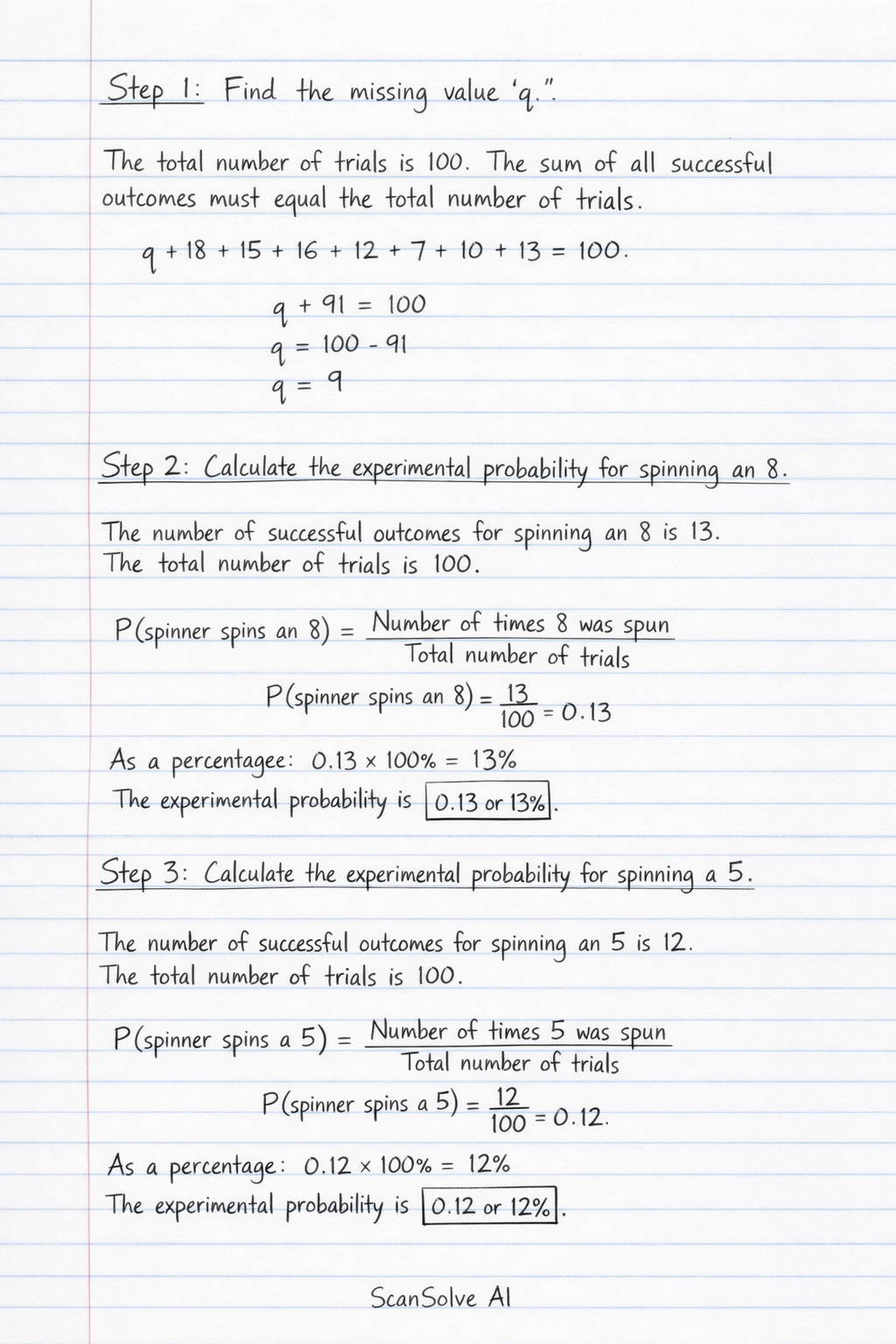
5 stepsFind the missing value 'q'.
The total number of trials is 100. The sum of all successful outcomes must equal the total number of trials.
Calculate the experimental probability for spinning an 8.
The number of successful outcomes for spinning an 8 is 13. The total number of trials is 100.
As a percentage:
The experimental probability is .Calculate the experimental probability for spinning a 5.
The number of successful outcomes for spinning a 5 is 12. The total number of trials is 100.
As a percentage:
The experimental probability is .Calculate the experimental probability for spinning a 7.
The number of successful outcomes for spinning a 7 is 10. The total number of trials is 100.
As a percentage:
The experimental probability is .Calculate the experimental probability for spinning 1 and 4.
This means spinning a 1 OR spinning a 4.
The number of successful outcomes for spinning a 1 is 9.
The number of successful outcomes for spinning a 4 is 16.
The total number of successful outcomes for spinning 1 or 4 is .
The total number of trials is 100.As a percentage:
The experimental probability is .
Still stuck on this one?
Ask a follow-up, and the answer starts from this question.
More Mathematics Questions
Handwritten Step-by-Step Solution
Get this as a handwritten image on WhatsApp — like a tutor wrote it for you.
Try on WhatsApp