
We read your photo as:
Adeoti threw a fair dice 250 times and got the following frequency table. Find the relative frequency of throwing a 4, an even number, and throwing a 3 or 5.
ScanSolve AI Answer
Answers
3 partsStep-by-step solution
9 stepsHere are the relative frequencies:
The total number of trials is 250.
The formula for relative frequency is:
Part a· 3 steps
Find the relative frequency of throwing a 4.
Identify the frequency of throwing a 4.
From the table, the frequency of throwing a 4 is 42.
Calculate the relative frequency.
Simplify the fraction.
The relative frequency of throwing a 4 is .
Part b
Find the relative frequency of throwing an even number.
Identify the frequencies of even numbers.
The even numbers on a die are 2, 4, and 6.
Frequency of 2 = 43
Frequency of 4 = 42
Frequency of 6 = 42Calculate the total frequency of throwing an even number.
Calculate the relative frequency.
The relative frequency of throwing an even number is .
Part c
What is the relative frequency of throwing a 3 or 5.
Identify the frequencies of throwing a 3 or 5.
Frequency of 3 = 40
Frequency of 5 = 43Calculate the total frequency of throwing a 3 or 5.
Calculate the relative frequency.
The relative frequency of throwing a 3 or 5 is .
Try one yourself
A new problem that tests the same skill.
Still stuck on this one?
Ask a follow-up, and the answer starts from this question.
More Mathematics Questions
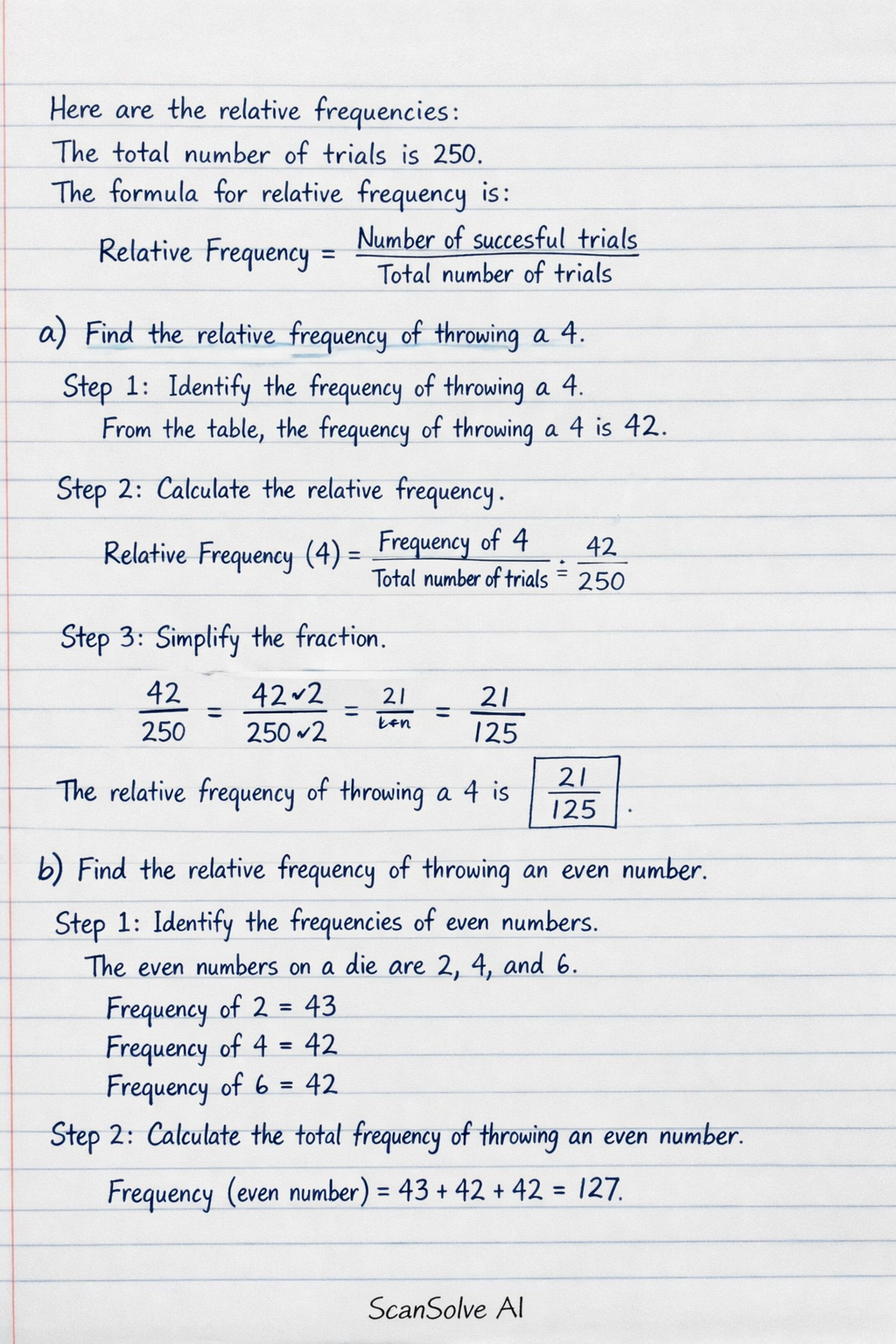
Handwritten Step-by-Step Solution
Get this as a handwritten image on WhatsApp — like a tutor wrote it for you.
Try on WhatsApp