
We read your photo as:
A) Write down the binomial expansion of (1-y)6, simplify all terms. b) By putting y = (x − x2) in (a), deduce the expansion of (1 - x + x2)6 in ascending powers as far as the term in x5. c) By taking x = 0.1, in (b), evaluate 0.916 correct to two decimal places.
ScanSolve AI Answer
Use the left and right arrow keys to trace the curve, up and down to jump between key points, and plus and minus to zoom.
| Point | x | y |
|---|---|---|
| x-intercept | 0 | 0 |
| Maximum | 0.5 | 0.25 |
| x-intercept | 1 | 0 |
Step-by-step solution
10 stepsQ7 a)
To write down the binomial expansion of , we use the binomial theorem . Here, , , and .
Write out the binomial expansion terms.
Calculate the binomial coefficients and simplify each term.
Substitute these values:
The binomial expansion is .
Q7 b)
To deduce the expansion of in ascending powers of as far as the term in , we substitute into the expansion from part (a).Substitute into the expansion of .
We need to expand each term of up to .
Expand powers of up to .
Terms and higher will start with or higher, so they are not needed for terms up to .
Substitute these expansions into the binomial expansion from part (a) and collect terms.
Collect coefficients for each power of .
Constant term: 1
Coefficient of :
Coefficient of :
Coefficient of :
Coefficient of :
Coefficient of :The expansion of up to the term in is:
Q7 c)
To evaluate correct to two decimal places by taking in (b).Verify that makes equal to .
Substitute into :
So, .
Substitute into the expansion obtained in part (b).
Calculate the sum.
Round the result to two decimal places.
The value of correct to two decimal places is .
Still stuck on this one?
Ask a follow-up, and the answer starts from this question.
More Mathematics Questions
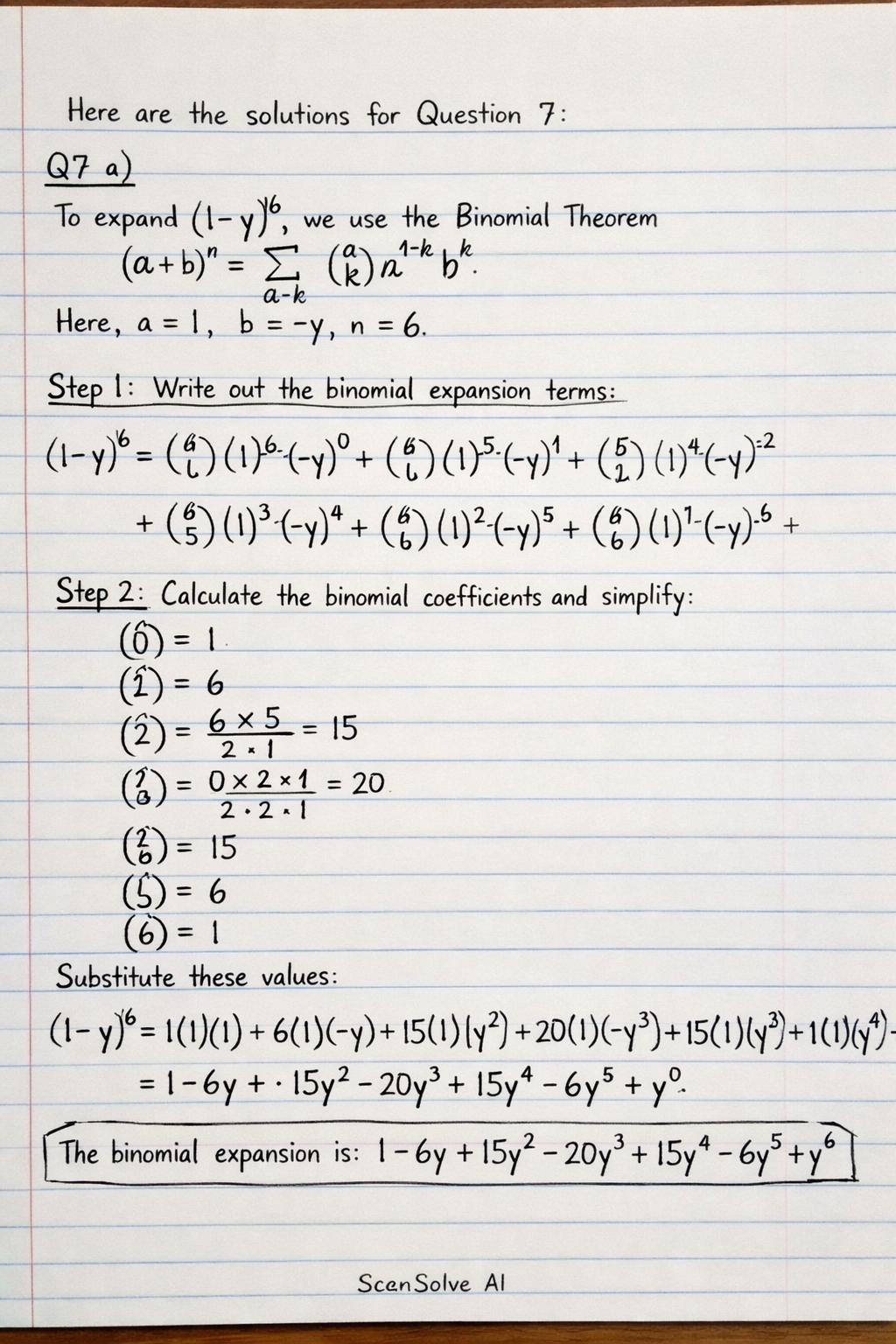
Handwritten Step-by-Step Solution
Get this as a handwritten image on WhatsApp — like a tutor wrote it for you.
Try on WhatsApp