
We read your photo as:
ABCD is a rectangle where AB = 4m and BC = 3m. Forces 5N, 10N, 8N, 12N and 6N acts along the lines AB, BC, CD, AD and AC respectively in the order of letters. Find the sum of moments of these forces about: a) A, b) B, c) E where C is on DA produced and AE = 1m.
ScanSolve AI Answer
Answers
3 partsStep-by-step solution
15 stepsFirst, let's define the rectangle ABCD and the forces acting on it.
Given: ABCD is a rectangle with AB = 4m and BC = 3m.
Therefore, CD = 4m and AD = 3m.
Let's set up a coordinate system with A at the origin (0,0).
A = (0,0)
B = (4,0)
C = (4,3)
D = (0,3)
The forces and their lines of action are:
- along AB (from A to B)
- along BC (from B to C)
- along CD (from C to D)
- along AD (from A to D)
- along AC (from A to C)
The length of the diagonal AC can be found using the Pythagorean theorem:
We will use the convention that counter-clockwise (CCW) moments are positive and clockwise (CW) moments are negative. The moment of a force about a point is given by , where is the force and is the perpendicular distance from the point to the line of action of the force. If a force's line of action passes through the point, its moment about that point is zero.
Part a· 4 steps
Find the sum of moments of these forces about A
Identify forces passing through A.
Forces (5N along AB), (12N along AD), and (6N along AC) all pass through point A. Therefore, their moments about A are zero.
Calculate the moment of (10N along BC) about A.
The line of action of is the line x=4. The perpendicular distance from A(0,0) to this line is AB = 4m.
The force acts from B to C (upwards). This creates a clockwise rotation about A.Calculate the moment of (8N along CD) about A.
The line of action of is the line y=3. The perpendicular distance from A(0,0) to this line is AD = 3m.
The force acts from C to D (leftwards). This creates a clockwise rotation about A.Sum all moments about A.
The sum of moments about A is .
Part b
Find the sum of moments of these forces about B
Identify forces passing through B.
Forces (5N along AB) and (10N along BC) both pass through point B. Therefore, their moments about B are zero.
Calculate the moment of (8N along CD) about B.
The line of action of is the line y=3. The perpendicular distance from B(4,0) to this line is BC = 3m.
The force acts from C to D (leftwards). This creates a counter-clockwise rotation about B.Calculate the moment of (12N along AD) about B.
The line of action of is the line x=0. The perpendicular distance from B(4,0) to this line is AB = 4m.
The force acts from A to D (upwards). This creates a clockwise rotation about B.Calculate the moment of (6N along AC) about B.
The line of action of is the diagonal AC. We need the perpendicular distance from B to the line AC.
In right triangle ABC, the area is .
The area can also be expressed as , where is the perpendicular distance from B to AC.The force acts from A to C. This creates a clockwise rotation about B.
Sum all moments about B.
The sum of moments about B is .
Part c
Find the sum of moments of these forces about E where C is on DA produced and AE = 1m.
The phrase "C is on DA produced" is likely a typo. We will interpret "E is on DA produced and AE = 1m" to mean that E is on the line containing AD, extended past A, such that the distance AE is 1m.
Since A is (0,0) and D is (0,3), the line AD is the y-axis (x=0). Extending past A means E is at (0,-1).
E = (0,-1).
Calculate the moment of (5N along AB) about E.
The line of action of is the line y=0. The perpendicular distance from E(0,-1) to y=0 is 1m.
The force acts from A to B (rightwards). This creates a counter-clockwise rotation about E.Calculate the moment of (10N along BC) about E.
The line of action of is the line x=4. The perpendicular distance from E(0,-1) to x=4 is 4m.
The force acts from B to C (upwards). This creates a clockwise rotation about E.Calculate the moment of (8N along CD) about E.
The line of action of is the line y=3. The perpendicular distance from E(0,-1) to y=3 is .
The force acts from C to D (leftwards). This creates a clockwise rotation about E.Calculate the moment of (12N along AD) about E.
The line of action of is the line x=0. This line passes through E(0,-1). Therefore, its moment about E is zero.
Calculate the moment of (6N along AC) about E.
The line of action of is the line AC, which passes through A(0,0) and C(4,3). The equation of this line is , or .
The perpendicular distance from E(0,-1) to is:The force acts from A to C. E is below A. This creates a clockwise rotation about E.
Sum all moments about E.
The sum of moments about E is .
Try one yourself
A new problem that tests the same skill.
Still stuck on this one?
Ask a follow-up, and the answer starts from this question.
More Mathematics Questions
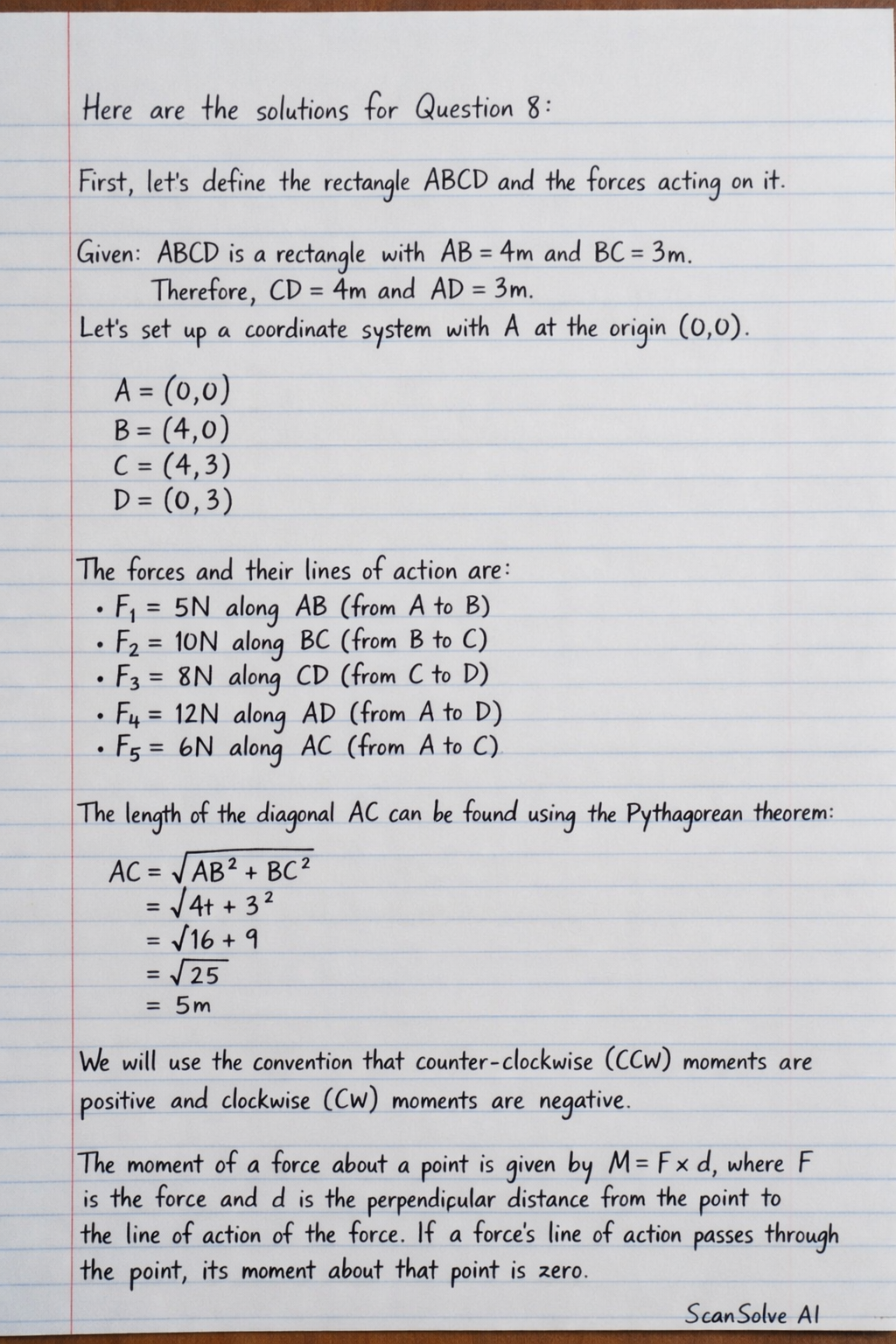
Handwritten Step-by-Step Solution
Get this as a handwritten image on WhatsApp — like a tutor wrote it for you.
Try on WhatsApp