
This mathematics problem involves applying core mathematical principles and formulas. Below you will find a complete step-by-step solution with detailed explanations for each step, helping you understand not just the answer but the method behind it.
ScanSolve AI Answer
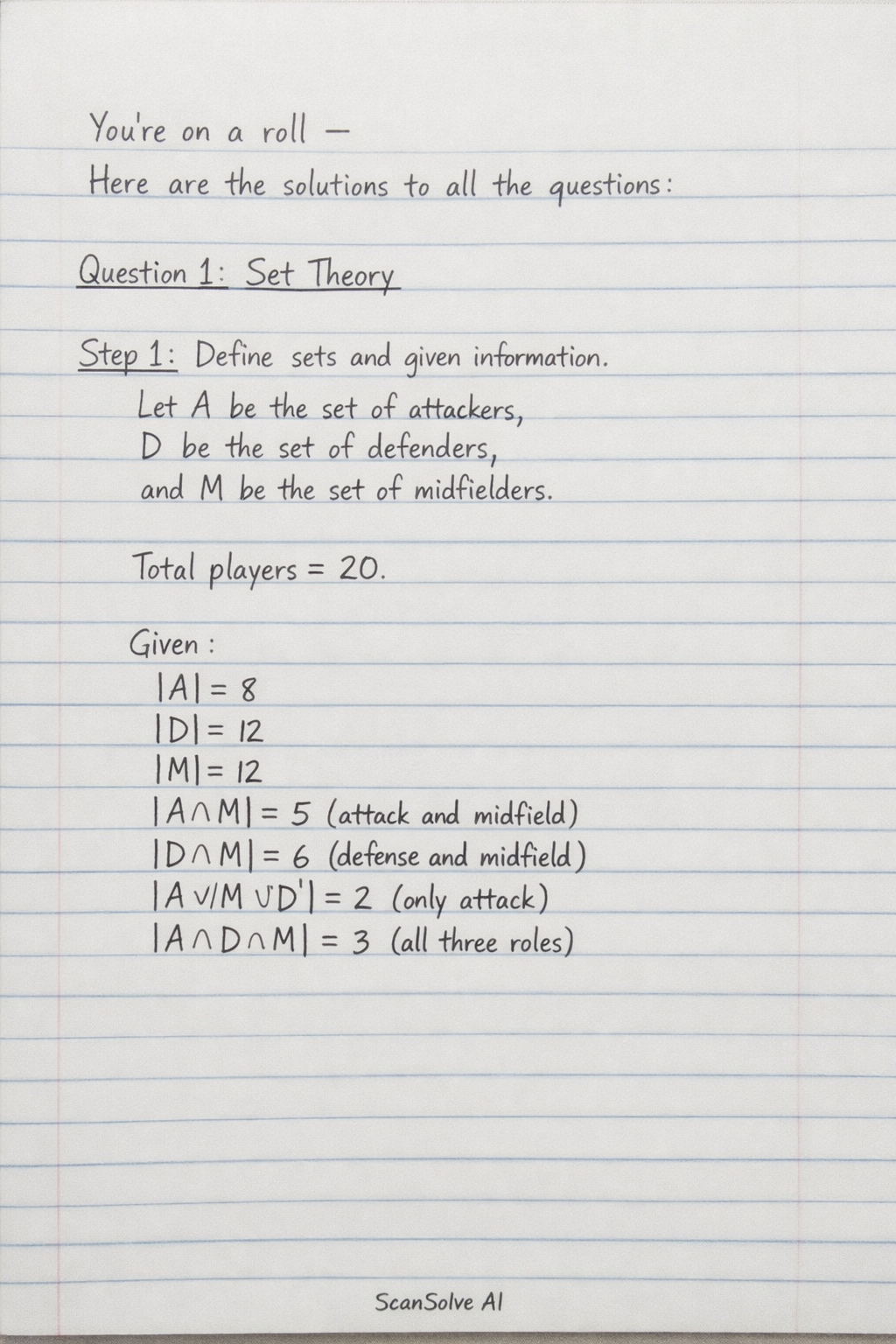
Here are the solutions to all the questions: Question 1: Set Theory Step 1: Define sets and given information. Let A be the set of attackers, D be the set of defenders, and M be the set of midfielders. Total players = 20. Given: |A| = 8 |D| = 12 |M| = 12 |A M| = 5 (attack and midfield) |D M| = 6 (defense and midfield) |A (M D)| = 2 (only attack) |A D M| = 3 (all three roles) Step 2: Calculate the number of players in each distinct region of the Venn diagram. • Players in all three roles (A D M): 3 • Players in attack and midfield only (A M D): |A M| - |A D M| = 5 - 3 = 2 • Players in defense and midfield only (D M A): |D M| - |A D M| = 6 - 3 = 3 • Players in attack only (A (M D)): 2 • Players in attack and defense only (A D M): |A D M| = |A| - (|A (M D)| + |A M D| + |A D M|) |A D M| = 8 - (2 + 2 + 3) = 8 - 7 = 1 • Players in defense only (D (A M)): |D (A M)| = |D| - (|A D M| + |D M A| + |A D M|) |D (A M)| = 12 - (1 + 3 + 3) = 12 - 7 = 5 • Players in midfield only (M (A D)): |M (A D)| = |M| - (|A M D| + |D M A| + |A D M|) |M (A D)| = 12 - (2 + 3 + 3) = 12 - 8 = 4 i. Illustrate the information in a Venn diagram A Venn diagram would show three overlapping circles (A, D, M) with the following numbers in each distinct region: • Only Attack (A only): 2 • Only Defense (D only): 5 • Only Midfield (M only): 4 • Attack and Defense only (A D M): 1 • Attack and Midfield only (A M D): 2 • Defense and Midfield only (D M A): 3 • Attack, Defense, and Midfield (A D M): 3 ii. Find the number of players that can play only midfield The number of players that can play only midfield is 4. iii. Find the number of players that can play exactly 2 roles The number of players that can play exactly 2 roles is 1 + 2 + 3 = 6. --- Question 2: Functions Step 1: State the domain of each function. For f(x) = 1 - 2x: The domain of f is R. For g(x) = (1)/(x+3): The domain of g is \x R x ≠ -3\. Step 2: Show that g(a) = g(b) a = b and state the conclusion. Assume g(a) = g(b). (1)/(a+3) = (1)/(b+3) b+3 = a+3 b = a Conclusion: The function g(x) is injective (or one-to-one). Step 3: Find the inverse function g^-1(x). Let y = g(x) = (1)/(x+3). Swap x and y: x = (1)/(y+3) x(y+3) = 1 xy + 3x = 1 xy = 1 - 3x y = (1 - 3x)/(x) The inverse function g^-1(x) is (1 - 3x)/(x). Step 4: Find the composite function f(g(x)). f(g(x)) = 1 - 2((1)/(x+3)) = 1 - (2)/(x+3) = (x+3-2)/(x+3) = (x+1)/(x+3) Step 5: Solve the equation f(g(x)) = g^-1(x). (x+1)/(x+3) = (1-3x)/(x) x(x+1) = (1-3x)(x+3) x^2 + x = x + 3 - 3x^2 - 9x x^2 + x = -3x^2 - 8x + 3 4x^2 + 9x - 3 = 0 Step 6: Use the quadratic formula to find the values of x. Using x = -b ± sqrt(b^2 - 4ac)2a for a=4, b=9, c=-3: x = -9 ± sqrt(9^2 - 4(4)(-3))2(4) x = -9 ± sqrt(81 + 48)8 x = -9 ± sqrt(129)8 The values of x are -9 ± sqrt(129)8. --- Question 3: Sequences Step 1: Define the terms of the arithmetic sequence (A.P.) and set up equations. Let the first term be a and the common difference be d. The second, fourth, and eighth terms are a+d, a+3d, and a+7d. These form a G.P.: (a+3d)^2 = (a+d)(a+7d) (1) The sum of the third and fifth terms is 20: (a+2d) + (a+4d) = 20 2a + 6d = 20 a + 3d = 10 (2) Step 2: Solve the system of equations to find a and d. Substitute (2) into (1): (10)^2 = (a+d)(a+7d) 100 = (10-3d+d)(10-3d+7d) 100 = (10-2d)(10+4d) 100 = 100 + 40d - 20d - 8d^2 0 = 20d - 8d^2 8d^2 - 20d = 0 4d(2d - 5) = 0 This gives d=0 or d=(5)/(2). If d=0, then a=10. If d=(5)/(2), then a = 10 - 3((5)/(2)) = 10 - (15)/(2) = (5)/(2). We use a=(5)/(2) and d=(5)/(2) for a non-trivial sequence. I. The first four terms Step 3: Calculate the first four terms. a_1 = a = (5)/(2) a_2 = a+d = (5)/(2) + (5)/(2) = 5 a_3 = a+2d = (5)/(2) + 2((5)/(2)) = (5)/(2) + 5 = (15)/(2) a_4 = a+3d = (5)/(2) + 3((5)/(2)) = (5)/(2) + (15)/(2) = 10 The first four terms are (5)/(2), 5, (15)/(2), 10. II. The sum of the first ten terms of the arithmetic sequence Step 4: Calculate the sum of the first ten terms. Using S_n = (n)/(2)(2a + (n-1)d): S_10 = (10)/(2)(2((5)/(2)) + (10-1)((5)/(2))) S_10 = 5(5 + 9((5)/(2))) S_10 = 5(5 + (45)/(2)) S_10 = 5((10)/(2) + (45)/(2)) S_10 = 5((55)/(2)) S_10 = (275)/(2) The sum of the first ten terms is (275)/(2) or 137.5. What's next?