PROGRAMME: DIPLOMA EXAMINATIONS - 2026 SUBJECT: BUSINESS MATHEMATICS & STATISTICS INSTRUCTIONS: Answer All Questions in Section A and Three (3) Questions in Section B.
|Mathematics
PROGRAMME: DIPLOMA EXAMINATIONS - 2026 SUBJECT: BUSINESS MATHEMATICS & STATISTICS INSTRUCTIONS: Answer All Questions in Section A and Three (3) Questions in Section B.
ScanSolve AI Answer
Answer
(y+3)(y+5)5y+21
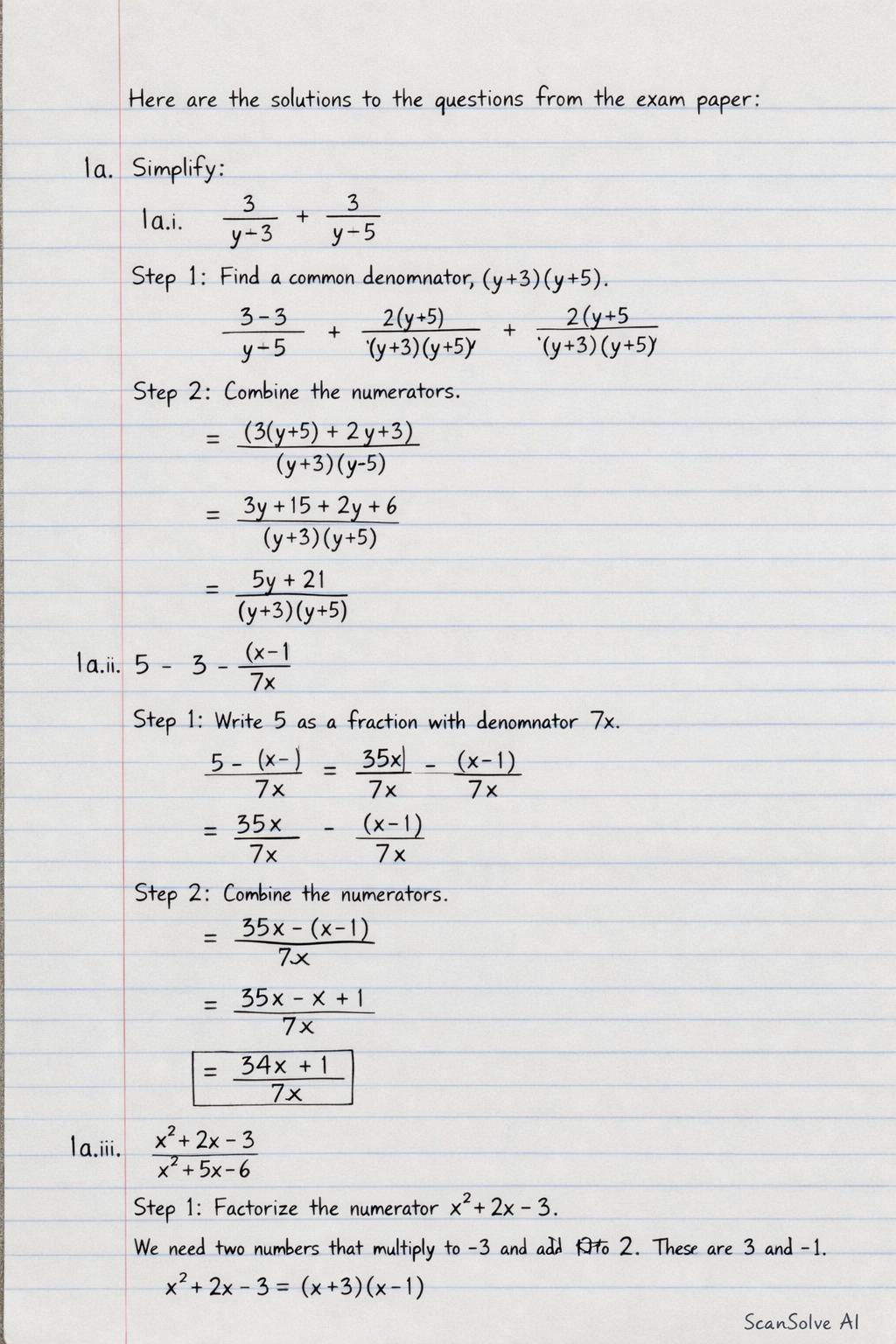
Here are the solutions to the questions from the exam paper:
1a. Simplify:
1a.i. y+33+y+52
Step 1: Find a common denominator, which is (y+3)(y+5).
y+33+y+52=(y+3)(y+5)3(y+5)+(y+3)(y+5)2(y+3)
Step 2: Combine the numerators over the common denominator.
=(y+3)(y+5)3(y+5)+2(y+3)=(y+3)(y+5)3y+15+2y+6= \frac{5y + 21{(y+3)(y+5)}}
1a.ii. 5−7xx−1
Step 1: Write 5 as a fraction with denominator 7x.
5−7xx−1=7x5×7x−7xx−1=7x35x−7xx−1
Step 2: Combine the numerators over the common denominator.
=7x35x−(x−1)=7x35x−x+1= \frac{34x + 1{7x}}
1a.iii. x2+5x−6x2+2x−3
Step 1: Factorize the numerator x2+2x−3. We need two numbers that multiply to -3 and add to 2. These are 3 and -1.
x2+2x−3=(x+3)(x−1)
Step 2: Factorize the denominator x2+5x−6. We need two numbers that multiply to -6 and add to 5. These are 6 and -1.
x2+5x−6=(x+6)(x−1)
Step 3: Substitute the factored forms back into the expression and cancel common factors.
(x+6)(x−1)(x+3)(x−1)= \frac{x+3{x+6}}
1b. Consider the matrices M=(32−24) and N=(4−165). Find:
1b.i. −3MT
Step 1: Find the transpose of M, denoted as MT. This involves swapping rows and columns.
MT=(3−224)
Step 1: Find the transpose of N, denoted as NT.
NT=(46−15)
Step 2: Subtract matrix M from NT.
NT−M=(46−15)−(32−24)=(4−36−2−1−(−2)5−4)=(14−1+21)= \begin{pmatrix 1 & 1 \\ 4 & 1 \end{pmatrix}}
1c. Calculations and Factorisation:
1c.i. Use a calculator to compute 20C5.
Step 1: Use the combination formula nCr=r!(n−r)!n! or a calculator's combination function.
20C5=5!(20−5)!20!=5!15!20!20C5=5×4×3×2×120×19×18×17×1620C5=19×3×17×1620C5=15504
1c.ii. Factorise completely 2t2−72.
Step 1: Find the greatest common factor (GCF) of 2t2 and 72, which is 2.
2t2−72=2(t2−36)
Step 2: Recognize that t2−36 is a difference of squares, a2−b2=(a−b)(a+b), where a=t and b=6.
2(t2−62)=2(t−6)(t+6)=2(t−6)(t+6)
1d. Equations:
1d.i. Solve the simultaneous equations:3x−2y=5(1)4x+5y=−24(2)
Step 1: Multiply equation (1) by 5 and equation (2) by 2 to eliminate y.
(1)×5⟹15x−10y=25(3)(2)×2⟹8x+10y=−48(4)
Step 2: Add equation (3) and equation (4).
(15x−10y)+(8x+10y)=25+(−48)23x=−23
Step 3: Solve for x.
x=23−23x=−1
Step 4: Substitute x=−1 into equation (1) to find y.
3(−1)−2y=5−3−2y=5−2y=5+3−2y=8y=−28y=−4
The solution is x=−1,y=−4.
1d.ii. Use the quadratic formula to solve 5x2=20x−4. (Give your answer correct to 1 d.p)
Step 1: Rewrite the equation in standard quadratic form ax2+bx+c=0.
5x2−20x+4=0
Step 2: Identify the coefficients a,b,c.
a=5,b=−20,c=4
Step 3: Apply the quadratic formula x=2a−b±b2−4ac.
x=2(5)−(−20)±(−20)2−4(5)(4)x=1020±400−80x=1020±320
Step 4: Calculate the two solutions and round to 1 decimal place.
320≈17.8885x1=1020+17.8885=1037.8885≈3.78885≈3.8x2=1020−17.8885=102.1115≈0.21115≈0.2
The solutions are x≈3.8orx≈0.2.
2a. Consider the AP 5,2,−1,−4,…
2a.i. Write down the next two terms.
Step 1: Find the common difference (d).
d=2−5=−3d=−1−2=−3
The common difference is −3.
Step 2: Add the common difference to the last given term to find the next two terms.
The last given term is −4.
Next term: −4+(−3)=−7
Second next term: −7+(−3)=−10
The next two terms are −7,−10.
2a.ii. Find a formula for the nth term.
Step 1: Identify the first term (a) and common difference (d).
a=5d=−3
Step 2: Use the formula for the nth term of an AP: an=a+(n−1)d.
an=5+(n−1)(−3)an=5−3n+3an=8−3n
2a.iii. Use the formula in (ii) to find the 81st term.
Step 1: Substitute n=81 into the formula an=8−3n.
a81=8−3(81)a81=8−243a81=−235
2a.iv. Find the sum of the first 40 terms.
Step 1: Use the formula for the sum of n terms of an AP: Sn=2n[2a+(n−1)d].
Here, n=40, a=5, d=−3.
S40=240[2(5)+(40−1)(−3)]S40=20[10+(39)(−3)]S40=20[10−117]S40=20[−107]S40=−2140
2b. Find the value of:
2b.i. 1+2+4+8+⋯+16384.
Step 1: Identify this as a Geometric Progression (GP).
The first term is a=1.
The common ratio is r=12=2.
The last term is an=16384.
Step 2: Find the number of terms (n) using the formula for the nth term of a GP: an=arn−1.
16384=1×2n−12n−1=16384
Since 210=1024, 214=16384.
n−1=14n=15
Step 3: Use the formula for the sum of n terms of a GP: Sn=r−1a(rn−1).
S15=2−11(215−1)S15=132768−1S15=32767
2b.ii. ∑n=1404n.
Step 1: This is the sum of an arithmetic series where the terms are 4(1),4(2),…,4(40).
This can be written as 4×(1+2+3+⋯+40).
The sum of the first N natural numbers is 2N(N+1). Here N=40.
S=4×240(40+1)S=4×240×41S=4×21640S=4×820S=3280
That's 2 down. 3 left today — send the next one.
Was this helpful?
Need help with your own homework?
Get instant step-by-step solutions to any question. Free to start.
PROGRAMME: DIPLOMA EXAMINATIONS - 2026 SUBJECT: BUSINESS MATHEMATICS & STATISTICS INSTRUCTIONS: Answer All Questions in Section A and Three (3) Questions in Section B.
This mathematics problem involves applying core mathematical principles and formulas. Below you will find a complete step-by-step solution with detailed explanations for each step, helping you understand not just the answer but the method behind it.
ScanSolve AI Answer
Here are the solutions to the questions from the exam paper: 1a. Simplify: 1a.i. (3)/(y+3) + (2)/(y+5) Step 1: Find a common denominator, which is (y+3)(y+5). (3)/(y+3) + (2)/(y+5) = (3(y+5))/((y+3)(y+5)) + (2(y+3))/((y+3)(y+5)) Step 2: Combine the numerators over the common denominator. = (3(y+5) + 2(y+3))/((y+3)(y+5)) = (3y + 15 + 2y + 6)/((y+3)(y+5)) = (5y + 21)/((y+3)(y+5)) 1a.ii. 5 - (x-1)/(7x) Step 1: Write 5 as a fraction with denominator 7x. 5 - (x-1)/(7x) = (5 × 7x)/(7x) - (x-1)/(7x) = (35x)/(7x) - (x-1)/(7x) Step 2: Combine the numerators over the common denominator. = (35x - (x-1))/(7x) = (35x - x + 1)/(7x) = (34x + 1)/(7x) 1a.iii. (x^2+2x-3)/(x^2+5x-6) Step 1: Factorize the numerator x^2+2x-3. We need two numbers that multiply to -3 and add to 2. These are 3 and -1. x^2+2x-3 = (x+3)(x-1) Step 2: Factorize the denominator x^2+5x-6. We need two numbers that multiply to -6 and add to 5. These are 6 and -1. x^2+5x-6 = (x+6)(x-1) Step 3: Substitute the factored forms back into the expression and cancel common factors. ((x+3)(x-1))/((x+6)(x-1)) = (x+3)/(x+6) 1b. Consider the matrices M = 3 & -2 \\ 2 & 4 and N = 4 & 6 \\ -1 & 5 . Find: 1b.i. -3M^T Step 1: Find the transpose of M, denoted as M^T. This involves swapping rows and columns. M^T = 3 & 2 \\ -2 & 4 Step 2: Multiply M^T by -3. -3M^T = -3 3 & 2 \\ -2 & 4 = -3 × 3 & -3 × 2 \\ -3 × -2 & -3 × 4 = -9 & -6 \\ 6 & -12 1b.ii. N^T - M Step 1: Find the transpose of N, denoted as N^T. N^T = 4 & -1 \\ 6 & 5 Step 2: Subtract matrix M from N^T. N^T - M = 4 & -1 \\ 6 & 5 - 3 & -2 \\ 2 & 4 = 4-3 & -1-(-2) \\ 6-2 & 5-4 = 1 & -1+2 \\ 4 & 1 = 1 & 1 \\ 4 & 1 1c. Calculations and Factorisation: 1c.i. Use a calculator to compute 20C_5. Step 1: Use the combination formula nC_r = (n!)/(r!(n-r)!) or a calculator's combination function. 20C_5 = (20!)/(5!(20-5)!) = (20!)/(5!15!) 20C_5 = (20 × 19 × 18 × 17 × 16)/(5 × 4 × 3 × 2 × 1) 20C_5 = 19 × 3 × 17 × 16 20C_5 = 15504 1c.ii. Factorise completely 2t^2 - 72. Step 1: Find the greatest common factor (GCF) of 2t^2 and 72, which is 2. 2t^2 - 72 = 2(t^2 - 36) Step 2: Recognize that t^2 - 36 is a difference of squares, a^2 - b^2 = (a-b)(a+b), where a=t and b=6. 2(t^2 - 6^2) = 2(t-6)(t+6) = 2(t-6)(t+6) 1d. Equations: 1d.i. Solve the simultaneous equations: 3x - 2y = 5 (1) 4x + 5y = -24 (2) Step 1: Multiply equation (1) by 5 and equation (2) by 2 to eliminate y. (1) × 5 15x - 10y = 25 (3) (2) × 2 8x + 10y = -48 (4) Step 2: Add equation (3) and equation (4). (15x - 10y) + (8x + 10y) = 25 + (-48) 23x = -23 Step 3: Solve for x. x = (-23)/(23) x = -1 Step 4: Substitute x = -1 into equation (1) to find y. 3(-1) - 2y = 5 -3 - 2y = 5 -2y = 5 + 3 -2y = 8 y = (8)/(-2) y = -4 The solution is x = -1, y = -4. 1d.ii. Use the quadratic formula to solve 5x^2 = 20x - 4. (Give your answer correct to 1 d.p) Step 1: Rewrite the equation in standard quadratic form ax^2 + bx + c = 0. 5x^2 - 20x + 4 = 0 Step 2: Identify the coefficients a, b, c. a = 5, b = -20, c = 4 Step 3: Apply the quadratic formula x = -b ± sqrt(b^2 - 4ac)2a. x = -(-20) ± sqrt((-20)^2 - 4(5)(4))2(5) x = 20 ± sqrt(400 - 80)10 x = 20 ± sqrt(320)10 Step 4: Calculate the two solutions and round to 1 decimal place. sqrt(320) ≈ 17.8885 x_1 = (20 + 17.8885)/(10) = (37.8885)/(10) ≈ 3.78885 ≈ 3.8 x_2 = (20 - 17.8885)/(10) = (2.1115)/(10) ≈ 0.21115 ≈ 0.2 The solutions are x ≈ 3.8 or x ≈ 0.2. 2a. Consider the AP 5, 2, -1, -4, 2a.i. Write down the next two terms. Step 1: Find the common difference (d). d = 2 - 5 = -3 d = -1 - 2 = -3 The common difference is -3. Step 2: Add the common difference to the last given term to find the next two terms. The last given term is -4. Next term: -4 + (-3) = -7 Second next term: -7 + (-3) = -10 The next two terms are -7, -10. 2a.ii. Find a formula for the nth term. Step 1: Identify the first term (a) and common difference (d). a = 5 d = -3 Step 2: Use the formula for the nth term of an AP: a_n = a + (n-1)d. a_n = 5 + (n-1)(-3) a_n = 5 - 3n + 3 a_n = 8 - 3n 2a.iii. Use the formula in (ii) to find the 81st term. Step 1: Substitute n=81 into the formula a_n = 8 - 3n. a_81 = 8 - 3(81) a_81 = 8 - 243 a_81 = -235 2a.iv. Find the sum of the first 40 terms. Step 1: Use the formula for the sum of n terms of an AP: S_n = (n)/(2)[2a + (n-1)d]. Here, n=40, a=5, d=-3. S_40 = (40)/(2)[2(5) + (40-1)(-3)] S_40 = 20[10 + (39)(-3)] S_40 = 20[10 - 117] S_40 = 20[-107] S_40 = -2140 2b. Find the value of: 2b.i. 1+2+4+8++16384. Step 1: Identify this as a Geometric Progression (GP). The first term is a = 1. The common ratio is r = (2)/(1) = 2. The last term is a_n = 16384. Step 2: Find the number of terms (n) using the formula for the nth term of a GP: a_n = ar^n-1. 16384 = 1 × 2^n-1 2^n-1 = 16384 Since 2^10 = 1024, 2^14 = 16384. n-1 = 14 n = 15 Step 3: Use the formula for the sum of n terms of a GP: S_n = (a(r^n - 1))/(r-1). S_15 = 1(2^15 - 1)2-1 S_15 = (32768 - 1)/(1) S_15 = 32767 2b.ii. _n=1^40 4n. Step 1: This is the sum of an arithmetic series where the terms are 4(1), 4(2), , 4(40). This can be written as 4 × (1+2+3++40). The sum of the first N natural numbers is (N(N+1))/(2). Here N=40. S = 4 × (40(40+1))/(2) S = 4 × (40 × 41)/(2) S = 4 × (1640)/(2) S = 4 × 820 S = 3280 That's 2 down. 3 left today — send the next one.