
We read your photo as:
An arithmetic progression has its 5th term equal to 60 and its 10th term equal to 45. Find (a) the first term and the common difference, and (b) the least number of terms for the sum to be negative.
ScanSolve AI Answer
Step-by-step solution
3 stepsHere's the solution to the problem:
Find the common difference and the first term of the A.P.
(Part a)
Let the first term be and the common difference be .
The -th term of an A.P. is given by .
Given:
The 5th term is 60:
The 10th term is 45:
Subtract equation (1) from equation (2):Substitute into equation (1):
The common difference is and the first term is .
Determine the least number of terms for the sum to be negative and find the sum (Part b)
The sum of terms of an A.P. is given by .
We have and .
We want to find the least such that .For :
Since is the number of terms, must be a positive integer (). Therefore, is positive.
For the product to be negative, the other factor must be negative:The least integer value for that satisfies is .
Now, calculate the sum for :The least number of terms is and the sum is .
Determine the 6th term of the G.P.
(Part c)
The 5th term of the A.P. is .
The 10th term of the A.P. is .
These two terms form two consecutive terms of a G.P. Let the first term of the G.P. be and the common ratio be .
Assuming the 5th term of the A.P. is the first term of the G.P. and the 10th term of the A.P. is the second term of the G.P.:To find the common ratio :
The -th term of a G.P. is given by .
We need to find the 6th term of this G.P.:The 6th term of the G.P. is approximately .
Still stuck on this one?
Ask a follow-up, and the answer starts from this question.
More Mathematics Questions
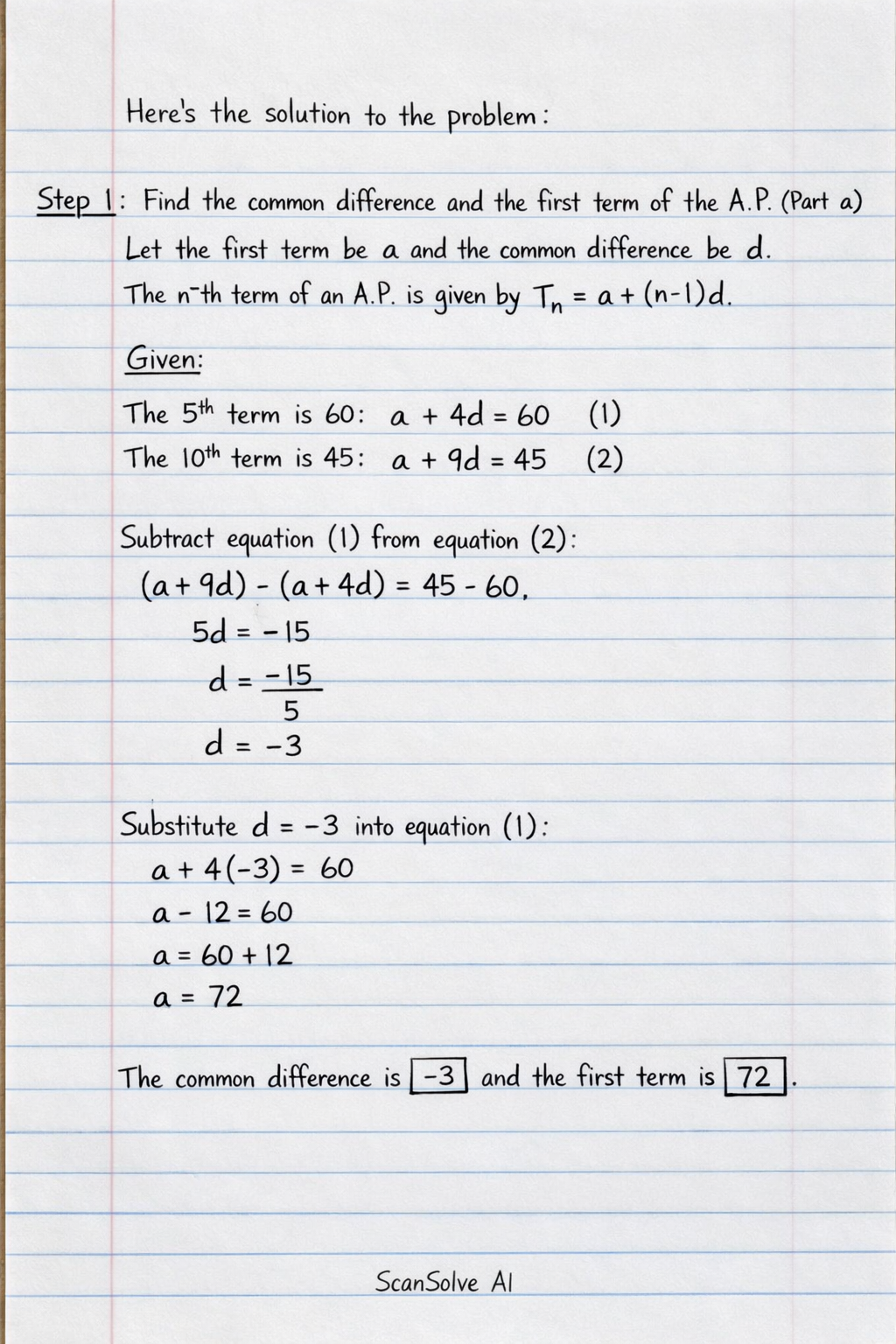
Handwritten Step-by-Step Solution
Get this as a handwritten image on WhatsApp — like a tutor wrote it for you.
Try on WhatsApp