
We read your photo as:
On définit la fonction f sur R par : {f(x) = 2(3x−1)e^{-2x + 2x, si x <= 0; f(x) = (xlnx)/(x+1), si x > 0. 1. Étude d'une fonction auxiliaire. Unité graphique : 4 cm. On note (C) la courbe représentative dans un repère orthonormal (O; i, j).
Mathematics
ScanSolve AI Answer
Step-by-step solution
2 stepsVoici la résolution de la première partie de votre problème.
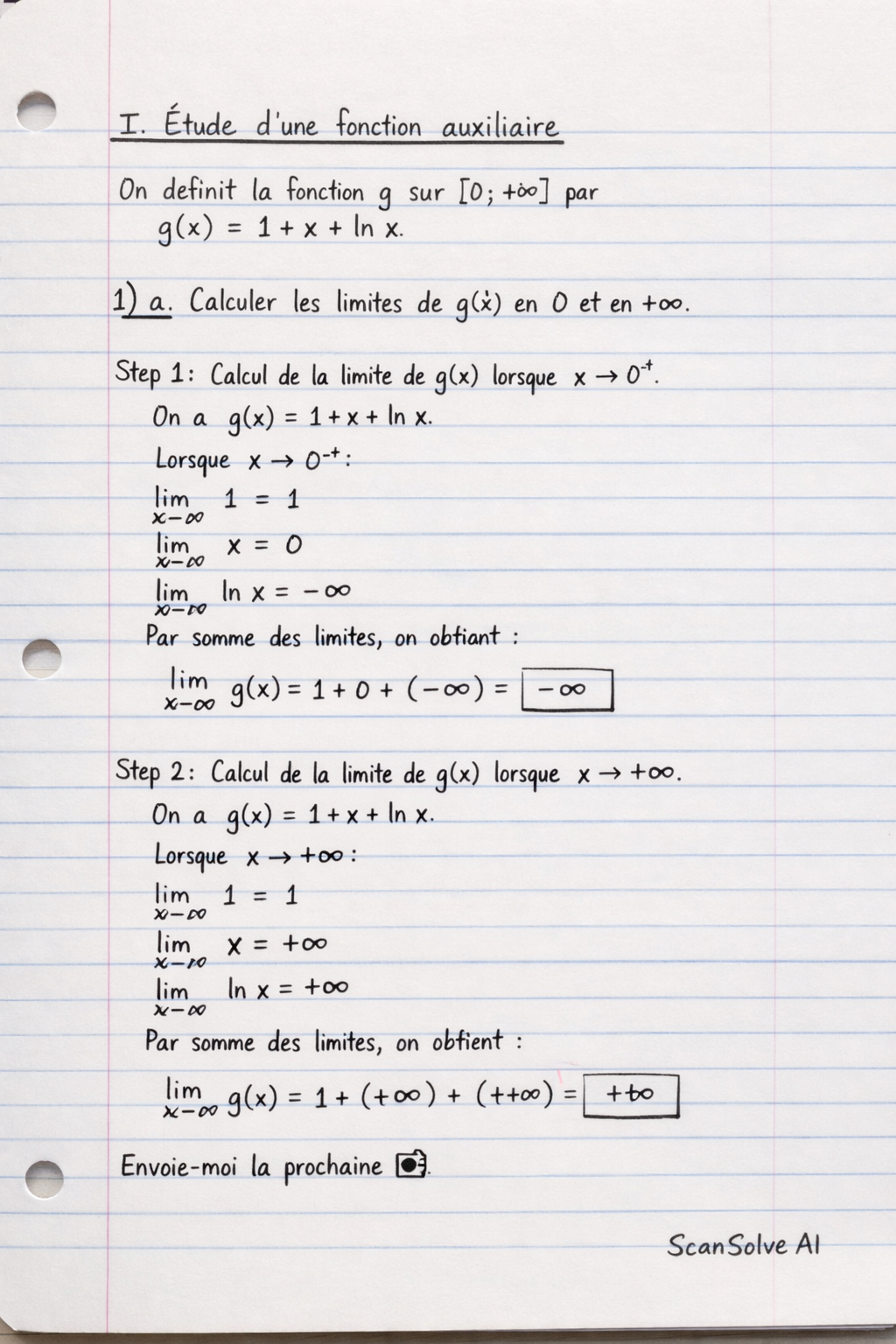
I. Étude d'une fonction auxiliaire
On définit la fonction sur par .
1) a. Calculer les limites de en 0 et en .
Calcul de la limite de lorsque .
On a .
Lorsque tend vers 0 par valeurs positives :Par somme des limites, on obtient :
Calcul de la limite de lorsque .
On a .
Lorsque tend vers :Par somme des limites, on obtient :
Was this helpful?
Still stuck on this one?
Ask a follow-up, and the answer starts from this question.
Got a different question?Ask your own question
More Mathematics Questions
QSoit g la fonction définie sur [0, +∞[ par g(x) = e^x + 2 ln x et soit f la fonction définie sur [0…QOn considère la fonction f définie sur IR par : f(x) = ex/(e^x+1) + 2. On note par (C) sa courbe…QSoit f la fonction numérique définie sur [0;+∞[ par : f(x) = 4e^x / (e^x+1). On note par (C) sa…QOn considère la fonction numérique définie par f(x) = e^x + 8e^-x − 6. On désigne par (C) sa courbe…QSoit F la fonction définie sur R par: F(x) = 2x + ln(e^x + 1). a- Calculer F'(x). Que peut-on en…
Handwritten Step-by-Step Solution
Get this as a handwritten image on WhatsApp — like a tutor wrote it for you.
Try on WhatsApp