
We read your photo as:
An object of area 4cm² is mapped onto an image of area 64cm² under the transformation by matrix((-1, n), (n, 3)). Find the possible values of n.
Mathematics
ScanSolve AI Answer
Answer
Step-by-step solution
4 stepsIdentify the given information and the formula for area transformation.
The area of the object is .
The area of the image is .
The transformation matrix is .
The relationship between the area of the object, the area of the image, and the determinant of the transformation matrix is given by:Calculate the determinant of the matrix .
For a matrix , the determinant is .
Substitute the values into the area transformation formula.
Solve for .
Divide both sides by 4:
Since is always non-negative, will always be positive. Therefore, .
Subtract 2 from both sides:
Take the square root of both sides:
The possible values of are and .
Was this helpful?
Try one yourself
A new problem that tests the same skill.
Still stuck on this one?
Ask a follow-up, and the answer starts from this question.
Got a different question?Ask your own question
More Mathematics Questions
QIn a transformation, an object of area 64cm² is mapped onto an image whose area is 32cm². Given that…QIn transformation an object of area x cm2 is mapped on to an image whose area is 13x cm2. given that…QA transformation matrix P transforms an object of area 10 cm2 to an image of area 60 cm2. If P…QUnderstand the relationship between the area of an object, the area of its image, and the…QThe matrix m = 1 & 5 2 & 7 and matrix n = 2 & 0 6 & 1 find:
Browse by topic:Linear Algebra
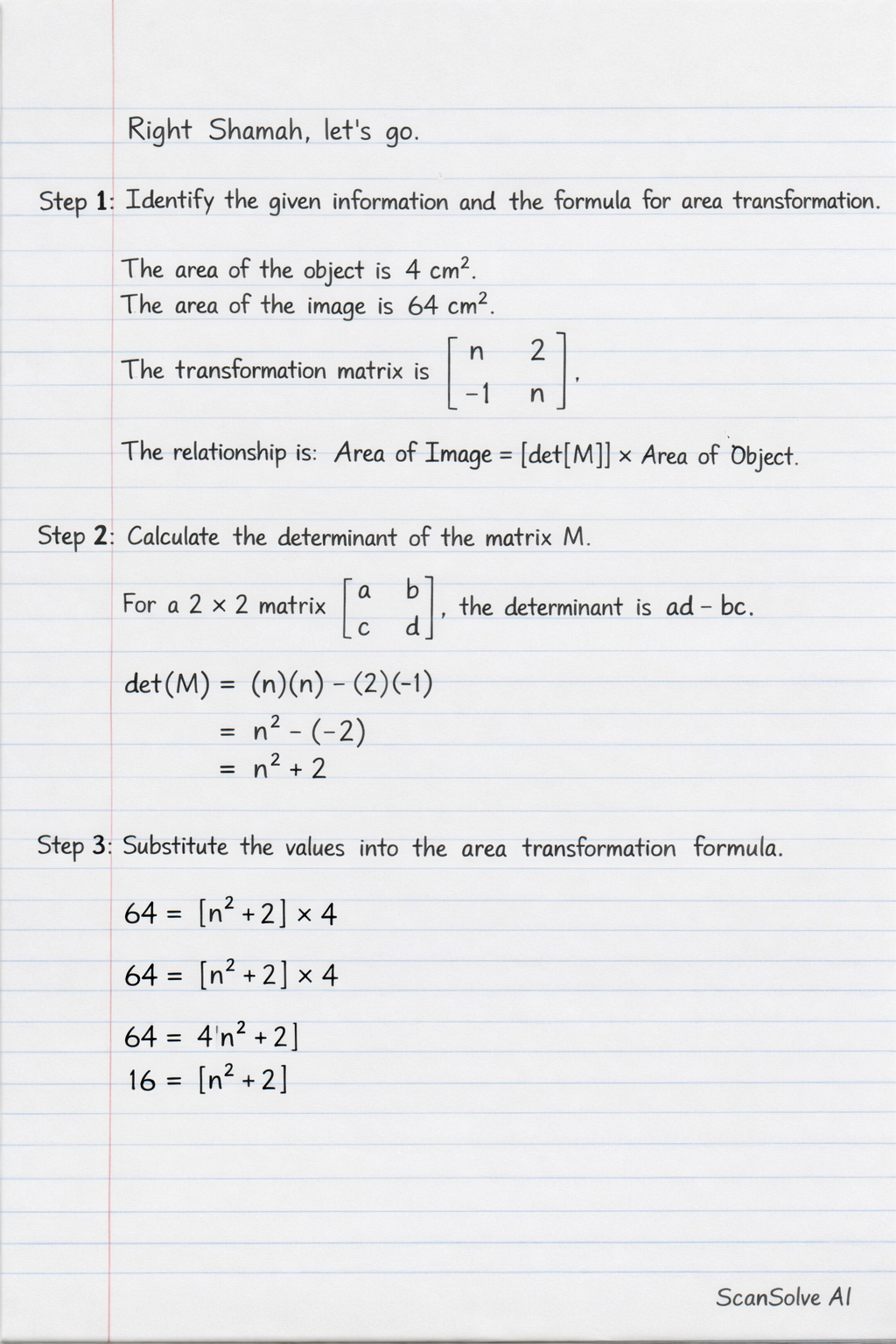
Handwritten Step-by-Step Solution
Get this as a handwritten image on WhatsApp — like a tutor wrote it for you.
Try on WhatsApp