We read your photo as:

Find the angle between the two vectors [1, -1, 1] and [2, 1, 4].

Mathematics

ScanSolve AI Answer

Step-by-step solution

32 steps

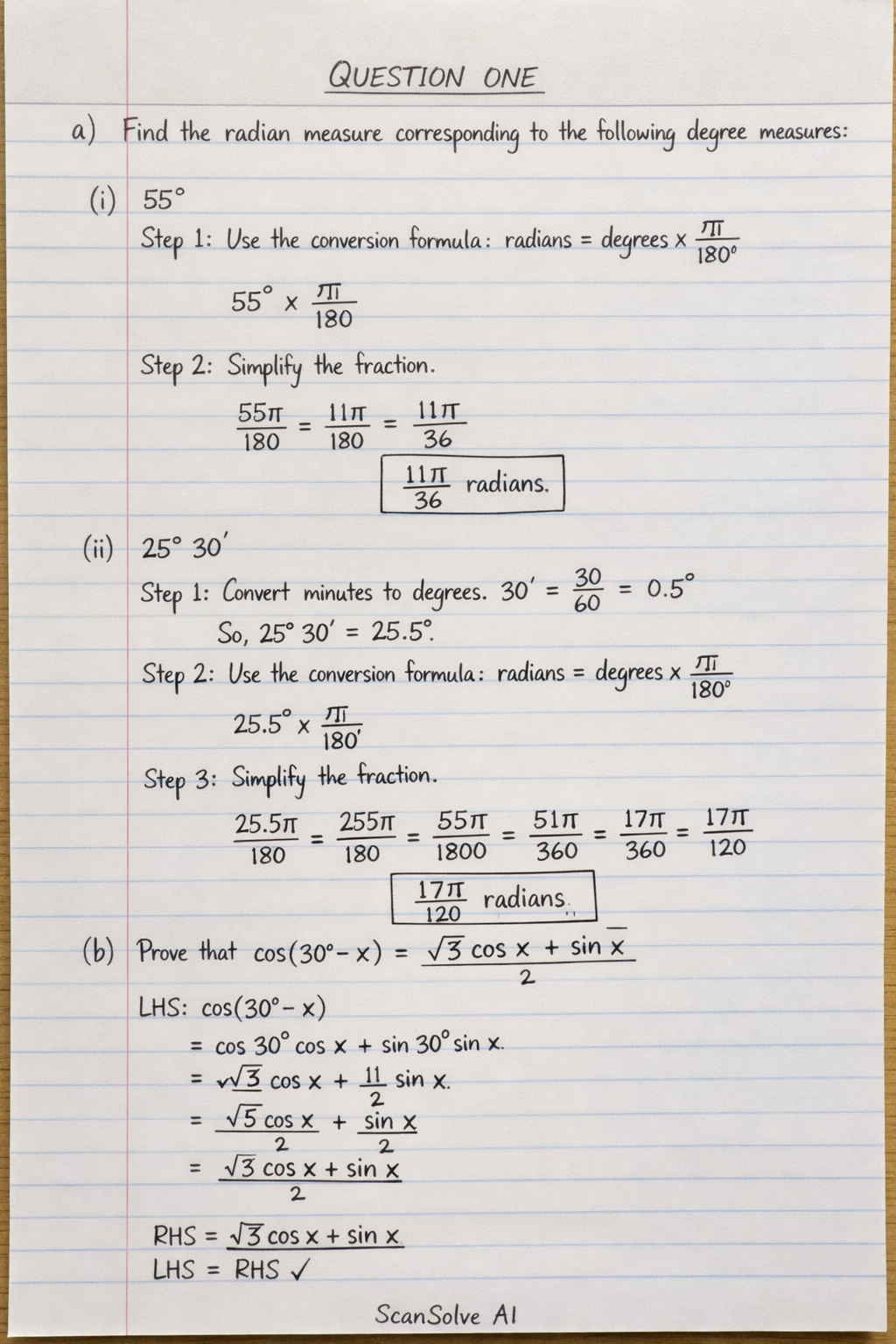
QUESTION ONE

a) Find the radian measure corresponding to the following degree measures:

(i) 55∘55^\circ

  1. Use the conversion formula

    radians=degrees×π180∘\text{radians} = \text{degrees} \times \frac{\pi}{180^\circ}.

    55∘×π180∘55^\circ \times \frac{\pi}{180^\circ}
  2. Simplify the fraction.

    55π180=11π36\frac{55\pi}{180} = \frac{11\pi}{36} 11π36 radians\boxed{\frac{11\pi}{36} \text{ radians}}

    (ii) 25∘30′25^\circ 30'

  3. Convert minutes to degrees.

    30′=3060∘=0.5∘30' = \frac{30}{60}^\circ = 0.5^\circ.
    So, 25∘30′=25.5∘25^\circ 30' = 25.5^\circ.

  4. Use the conversion formula

    radians=degrees×π180∘\text{radians} = \text{degrees} \times \frac{\pi}{180^\circ}.

    25.5∘×π180∘25.5^\circ \times \frac{\pi}{180^\circ}
  5. Simplify the fraction.

    25.5π180=255π1800=51π360=17π120\frac{25.5\pi}{180} = \frac{255\pi}{1800} = \frac{51\pi}{360} = \frac{17\pi}{120} 17π120 radians\boxed{\frac{17\pi}{120} \text{ radians}}

    b) Prove that cos⁡(30∘−x)=3cos⁡x+sin⁡x2\cos(30^\circ-x)=\frac{\sqrt{3}\cos x+\sin x}{2}

  6. Start with the Left Hand Side (LHS) and use the cosine subtraction formula

    cos⁡(A−B)=cos⁡Acos⁡B+sin⁡Asin⁡B\cos(A-B) = \cos A \cos B + \sin A \sin B.
    Let A=30∘A = 30^\circ and B=xB = x.

    LHS=cos⁡(30∘−x)=cos⁡30∘cos⁡x+sin⁡30∘sin⁡x\text{LHS} = \cos(30^\circ-x) = \cos 30^\circ \cos x + \sin 30^\circ \sin x
  7. Substitute the known exact values for cos⁡30∘\cos 30^\circ and sin⁡30∘\sin 30^\circ.

    cos⁡30∘=32\cos 30^\circ = \frac{\sqrt{3}}{2} sin⁡30∘=12\sin 30^\circ = \frac{1}{2} LHS=(32)cos⁡x+(12)sin⁡x\text{LHS} = \left(\frac{\sqrt{3}}{2}\right)\cos x + \left(\frac{1}{2}\right)\sin x
  8. Combine the terms.

    LHS=3cos⁡x+sin⁡x2\text{LHS} = \frac{\sqrt{3}\cos x + \sin x}{2}

    This is equal to the Right Hand Side (RHS).

    LHS=RHS\text{LHS} = \text{RHS}

    Therefore, the identity is proven.

    c) A constant force of F⃗=6i⃗−2j⃗+k⃗\vec{F}=6\vec{i}-2\vec{j}+\vec{k} newtons displaces an object from A=i⃗+j⃗+2k⃗A=\vec{i}+\vec{j}+2\vec{k} to B=3i⃗−j⃗+3k⃗B=3\vec{i}-\vec{j}+3\vec{k} (in metres). Find the work done in newton metres.

  9. Determine the displacement vector d⃗\vec{d}.

    d⃗=B⃗−A⃗\vec{d} = \vec{B} - \vec{A} d⃗=(3i⃗−j⃗+3k⃗)−(i⃗+j⃗+2k⃗)\vec{d} = (3\vec{i} - \vec{j} + 3\vec{k}) - (\vec{i} + \vec{j} + 2\vec{k}) d⃗=(3−1)i⃗+(−1−1)j⃗+(3−2)k⃗\vec{d} = (3-1)\vec{i} + (-1-1)\vec{j} + (3-2)\vec{k} d⃗=2i⃗−2j⃗+k⃗\vec{d} = 2\vec{i} - 2\vec{j} + \vec{k}
  10. Calculate the work done WW using the dot product formula W=F⃗⋅d⃗W = \vec{F} \cdot \vec{d}.

    W=(6i⃗−2j⃗+k⃗)⋅(2i⃗−2j⃗+k⃗)W = (6\vec{i} - 2\vec{j} + \vec{k}) \cdot (2\vec{i} - 2\vec{j} + \vec{k}) W=(6)(2)+(−2)(−2)+(1)(1)W = (6)(2) + (-2)(-2) + (1)(1) W=12+4+1W = 12 + 4 + 1 W=17 NmW = 17 \text{ Nm} W=17 Nm\boxed{W = 17 \text{ Nm}}

    QUESTION TWO

    a) Find the equation of the graph of the type y=ax2+bx+cy=ax^2+bx+c which crosses the x-axis at the points (1,0)(1,0) and (4,0)(4,0) and also passes through the point (3,−4)(3,-4).

  11. Since the graph crosses the x-axis at $(1,0)$ and $(4,0)$, these are the roots of the quadratic equation.

    The equation can be written in factored form as y=a(x−1)(x−4)y = a(x-1)(x-4).

  12. Use the third point (3,−4)(3,-4) to find the value of aa.

    Substitute x=3x=3 and y=−4y=-4 into the equation.

    −4=a(3−1)(3−4)-4 = a(3-1)(3-4) −4=a(2)(−1)-4 = a(2)(-1) −4=−2a-4 = -2a a=−4−2a = \frac{-4}{-2} a=2a = 2
  13. Substitute the value of aa back into the factored form and expand to get the equation in the form y=ax2+bx+cy=ax^2+bx+c.

    y=2(x−1)(x−4)y = 2(x-1)(x-4) y=2(x2−4x−x+4)y = 2(x^2 - 4x - x + 4) y=2(x2−5x+4)y = 2(x^2 - 5x + 4) y=2x2−10x+8\boxed{y = 2x^2 - 10x + 8}

    b) The equation kx2−2x−7=0kx^2-2x-7=0 has two real roots. Find the value of the constant kk.

  14. For a quadratic equation Ax2+Bx+C=0Ax^2+Bx+C=0 to have two real roots, the discriminant Δ=B2−4AC\Delta = B^2 - 4AC must be greater than zero (Δ>0\Delta > 0).

    In the given equation kx2−2x−7=0kx^2-2x-7=0:
    A=kA = k
    B=−2B = -2
    C=−7C = -7

  15. Substitute these values into the discriminant inequality.

    (−2)2−4(k)(−7)>0(-2)^2 - 4(k)(-7) > 0 4+28k>04 + 28k > 0
  16. Solve the inequality for kk.

    28k>−428k > -4 k>−428k > \frac{-4}{28} k>−17\boxed{k > -\frac{1}{7}}

    c) For the given function f(x)=x2−6x+8f(x)=x^2-6x+8, find:

    (i) The x-intercept

  17. To find the x-intercepts, set f(x)=0f(x)=0.

    x2−6x+8=0x^2 - 6x + 8 = 0
  18. Factor the quadratic equation.

    (x−2)(x−4)=0(x-2)(x-4) = 0
  19. Solve for xx.

    x−2=0  ⟹  x=2x-2 = 0 \implies x = 2 x−4=0  ⟹  x=4x-4 = 0 \implies x = 4 The x-intercepts are (2,0) and (4,0)\boxed{\text{The x-intercepts are } (2,0) \text{ and } (4,0)}

    (ii) The y-intercept

  20. To find the y-intercept, set x=0x=0.

    f(0)=(0)2−6(0)+8f(0) = (0)^2 - 6(0) + 8 f(0)=8f(0) = 8 The y-intercept is (0,8)\boxed{\text{The y-intercept is } (0,8)}

    (iii) The line of symmetry

  21. For a quadratic function f(x)=ax2+bx+cf(x)=ax^2+bx+c, the line of symmetry is given by the formula x=−b2ax = -\frac{b}{2a}.

    In f(x)=x2−6x+8f(x)=x^2-6x+8, we have a=1a=1 and b=−6b=-6.

    x=−−62(1)x = -\frac{-6}{2(1)} x=62x = \frac{6}{2} x=3x = 3 The line of symmetry is x=3\boxed{\text{The line of symmetry is } x = 3}

    (iv) Hence sketch the graph

  22. Identify key points

    • x-intercepts: (2,0)(2,0) and (4,0)(4,0)
    • y-intercept: (0,8)(0,8)
    • Line of symmetry: x=3x=3
    • Vertex: The x-coordinate of the vertex is on the line of symmetry, x=3x=3. Substitute x=3x=3 into f(x)f(x) to find the y-coordinate. f(3)=(3)2−6(3)+8f(3) = (3)^2 - 6(3) + 8 f(3)=9−18+8f(3) = 9 - 18 + 8 f(3)=−1f(3) = -1 So, the vertex is (3,−1)(3,-1). Since a=1>0a=1 > 0, the parabola opens upwards.
  23. Plot these points and draw a smooth parabola.

    (Self-correction: I cannot draw a graph here, but I can describe it.)
    The graph is a parabola opening upwards, passing through (2,0)(2,0), (4,0)(4,0), and (0,8)(0,8). Its lowest point (vertex) is at (3,−1)(3,-1), and it is symmetric about the vertical line x=3x=3.

    QUESTION THREE

    a) A is a point with coordinates (1,0,3)(1,0,3) and B is a point with coordinates (3,−2,6)(3,-2,6). Find, using column vectors,

    (i) AB⃗\vec{AB}

  24. Express points A and B as position vectors.

    A⃗=(103)\vec{A} = \begin{pmatrix} 1 \\ 0 \\ 3 \end{pmatrix} B⃗=(3−26)\vec{B} = \begin{pmatrix} 3 \\ -2 \\ 6 \end{pmatrix}
  25. Calculate AB⃗=B⃗−A⃗\vec{AB} = \vec{B} - \vec{A}.

    AB⃗=(3−26)−(103)=(3−1−2−06−3)=(2−23)\vec{AB} = \begin{pmatrix} 3 \\ -2 \\ 6 \end{pmatrix} - \begin{pmatrix} 1 \\ 0 \\ 3 \end{pmatrix} = \begin{pmatrix} 3-1 \\ -2-0 \\ 6-3 \end{pmatrix} = \begin{pmatrix} 2 \\ -2 \\ 3 \end{pmatrix} AB⃗=(2−23)\boxed{\vec{AB} = \begin{pmatrix} 2 \\ -2 \\ 3 \end{pmatrix}}

    (ii) The position vector of the point C, which is the mid-point of AB.

  26. Use the midpoint formula for coordinates.

    If A=(x1,y1,z1)A=(x_1, y_1, z_1) and B=(x2,y2,z2)B=(x_2, y_2, z_2), the midpoint CC is (x1+x22,y1+y22,z1+z22)\left(\frac{x_1+x_2}{2}, \frac{y_1+y_2}{2}, \frac{z_1+z_2}{2}\right).

    C=(1+32,0+(−2)2,3+62)C = \left(\frac{1+3}{2}, \frac{0+(-2)}{2}, \frac{3+6}{2}\right) C=(42,−22,92)C = \left(\frac{4}{2}, \frac{-2}{2}, \frac{9}{2}\right) C=(2,−1,92)C = \left(2, -1, \frac{9}{2}\right)
  27. Express the midpoint C as a position vector OC⃗\vec{OC}.

    OC⃗=(2−192)\boxed{\vec{OC} = \begin{pmatrix} 2 \\ -1 \\ \frac{9}{2} \end{pmatrix}}

    b) Vectors OA⃗\vec{OA} and OB⃗\vec{OB} are given by OA⃗=(3−12)\vec{OA}=\begin{pmatrix}3\\-1\\2\end{pmatrix} and OB⃗=(6−4−5)\vec{OB}=\begin{pmatrix}6\\-4\\-5\end{pmatrix}. Calculate the scalar product OA⃗⋅OB⃗\vec{OA} \cdot \vec{OB}.

  28. Perform the scalar (dot) product of the two vectors.

    OA⃗⋅OB⃗=(3)(6)+(−1)(−4)+(2)(−5)\vec{OA} \cdot \vec{OB} = (3)(6) + (-1)(-4) + (2)(-5) OA⃗⋅OB⃗=18+4−10\vec{OA} \cdot \vec{OB} = 18 + 4 - 10 OA⃗⋅OB⃗=22−10\vec{OA} \cdot \vec{OB} = 22 - 10 OA⃗⋅OB⃗=12\boxed{\vec{OA} \cdot \vec{OB} = 12}

    c) Find the angle between the two vectors (1−11)\begin{pmatrix}1\\-1\\1\end{pmatrix} and (214)\begin{pmatrix}2\\1\\4\end{pmatrix}.

  29. Let u⃗=(1−11)\vec{u} = \begin{pmatrix}1\\-1\\1\end{pmatrix} and v⃗=(214)\vec{v} = \begin{pmatrix}2\\1\\4\end{pmatrix}.

    Calculate the dot product u⃗⋅v⃗\vec{u} \cdot \vec{v}.

    u⃗⋅v⃗=(1)(2)+(−1)(1)+(1)(4)\vec{u} \cdot \vec{v} = (1)(2) + (-1)(1) + (1)(4) u⃗⋅v⃗=2−1+4\vec{u} \cdot \vec{v} = 2 - 1 + 4 u⃗⋅v⃗=5\vec{u} \cdot \vec{v} = 5
  30. Calculate the magnitudes of the vectors ∣u⃗∣|\vec{u}| and ∣v⃗∣|\vec{v}|.

    ∣u⃗∣=12+(−1)2+12=1+1+1=3|\vec{u}| = \sqrt{1^2 + (-1)^2 + 1^2} = \sqrt{1 + 1 + 1} = \sqrt{3} ∣v⃗∣=22+12+42=4+1+16=21|\vec{v}| = \sqrt{2^2 + 1^2 + 4^2} = \sqrt{4 + 1 + 16} = \sqrt{21}
  31. Use the formula for the angle θ\theta between two vectors

    cos⁡θ=u⃗⋅v⃗∣u⃗∣∣v⃗∣\cos \theta = \frac{\vec{u} \cdot \vec{v}}{|\vec{u}| |\vec{v}|}.

    cos⁡θ=5321\cos \theta = \frac{5}{\sqrt{3} \sqrt{21}} cos⁡θ=563\cos \theta = \frac{5}{\sqrt{63}} cos⁡θ=59×7\cos \theta = \frac{5}{\sqrt{9 \times 7}} cos⁡θ=537\cos \theta = \frac{5}{3\sqrt{7}}
  32. Calculate θ\theta.

    θ=arccos⁡(537)\theta = \arccos\left(\frac{5}{3\sqrt{7}}\right) θ≈arccos⁡(53×2.64575)\theta \approx \arccos\left(\frac{5}{3 \times 2.64575}\right) θ≈arccos⁡(57.93725)\theta \approx \arccos\left(\frac{5}{7.93725}\right) θ≈arccos⁡(0.63000)\theta \approx \arccos(0.63000) θ≈50.96∘\theta \approx 50.96^\circ θ≈50.96∘ or arccos⁡(537)\boxed{\theta \approx 50.96^\circ \text{ or } \arccos\left(\frac{5}{3\sqrt{7}}\right)}
Was this helpful?

Still stuck on this one?

Ask a follow-up, and the answer starts from this question.

Got a different question?Ask your own question
Handwritten step-by-step solution preview

Handwritten Step-by-Step Solution

Get this as a handwritten image on WhatsApp — like a tutor wrote it for you.

Try on WhatsApp