ANNEXURE B represents a South African map. Answer the questions below based on the annexure.

Mathematics
ANNEXURE B represents a South African map. Answer the questions below based on the annexure.

ScanSolve AI Answer

Answer

713 litres

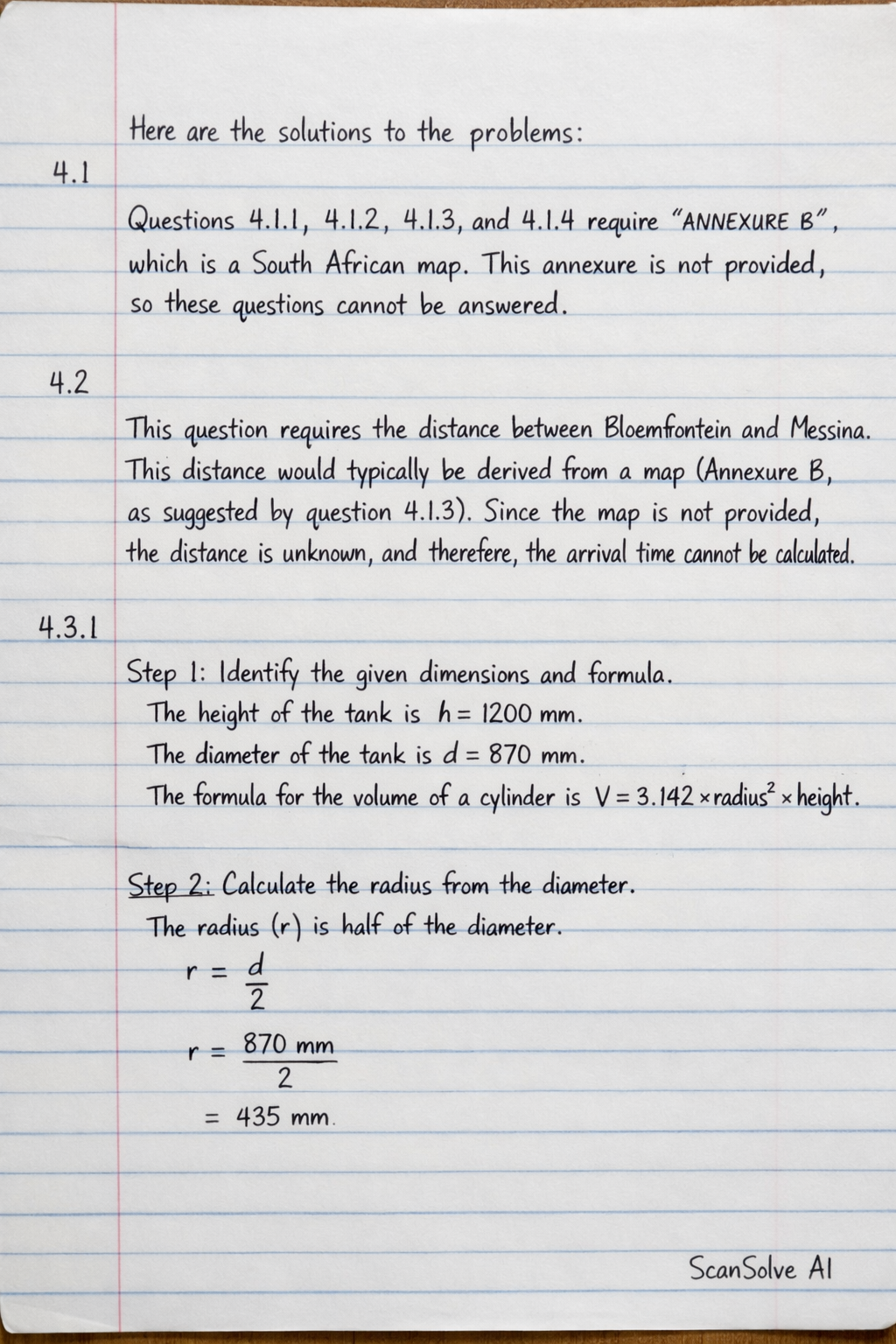
Here are the solutions to the problems:

4.1 Questions 4.1.1, 4.1.2, 4.1.3, and 4.1.4 require "ANNEXURE B", which is a South African map. This annexure is not provided in the image, so these questions cannot be answered.

4.2 This question requires the distance between Bloemfontein and Messina. This distance would typically be derived from a map (Annexure B, as suggested by question 4.1.3). Since the map is not provided, the distance is unknown, and therefore, the arrival time cannot be calculated.

4.3.1 Step 1: Identify the given dimensions and formula. The height of the tank is h=1200h = 1200 mm. The diameter of the tank is d=870d = 870 mm. The formula for the volume of a cylinder is V=3.142×radius2×heightV = 3.142 \times radius^2 \times \text{height}.

Step 2: Calculate the radius from the diameter. The radius (rr) is half of the diameter. r=d2=870mm2=435mmr = \frac{d}{2} = \frac{870 mm}{2} = 435 mm

Step 3: Substitute the values into the volume formula. V=3.142×(435mm)2×1200mmV = 3.142 \times (435 mm)^2 \times 1200 mm V=3.142×189225mm2×1200mmV = 3.142 \times 189225 mm^2 \times 1200 mm

Step 4: Calculate the volume. V=3.142×227070000mm3V = 3.142 \times 227070000 mm^3 V=713453940mm3V = 713453940 mm^3 This calculated volume matches the volume given in the problem statement.

4.3.2 Step 1: Use the volume calculated in 4.3.1. The volume of the tank is V=713453940mm3V = 713 453 940 mm^3.

Step 2: Use the given conversion factor. 1 litre = 1 000 000 mm3^3.

Step 3: Convert the volume from mm3^3 to litres. Vlitres=713453940mm31000000mm3/litreV_{litres} = \frac{713 453 940 mm^3}{1 000 000 mm^3/litre} Vlitres=713.45394litresV_{litres} = 713.45394 litres

Step 4: Round the answer to the nearest litre. Vlitres713litresV_{litres} \approx 713 litres The volume of the tank in litres, rounded to the nearest litre, is 713litres\boxed{713 litres}.

4.3.3 Step 1: Identify the diameter of the tank. The diameter of the tank is d=870d = 870 mm.

Step 2: Convert the diameter from millimeters (mm) to centimeters (cm). Since 1 cm = 10 mm: d=870mm10mm/cm=87cmd = \frac{870 mm}{10 mm/cm} = 87 cm

Step 3: Convert the diameter from centimeters (cm) to inches. Given that 1 inch = 2.54 cm: dinches=87cm2.54cm/inchd_{inches} = \frac{87 cm}{2.54 cm/inch} dinches34.2519685inchesd_{inches} \approx 34.2519685 inches

Step 4: Round the answer to two decimal places. dinches34.25inchesd_{inches} \approx 34.25 inches The diameter of the tank in inches, rounded to two decimal places, is 34.25inches\boxed{34.25 inches}.

3 done, 2 left today. You're making progress.

Was this helpful?

Need help with your own homework?

Get instant step-by-step solutions to any question. Free to start.

Ask Your Question
Handwritten step-by-step solution preview

Handwritten Step-by-Step Solution

Get this as a handwritten image on WhatsApp — like a tutor wrote it for you.

Try on WhatsApp

Still have questions?

Quick Answer

4.1 Questions 4.1.1, 4.1.2, 4.1.3, and 4.1.4 require "ANNEXURE B", which is a South African map.

ANNEXURE B represents a South African map. Answer the questions below based on the annexure.
Mathematics

This mathematics problem involves applying core mathematical principles and formulas. Below you will find a complete step-by-step solution with detailed explanations for each step, helping you understand not just the answer but the method behind it.

ScanSolve AI Answer
Here are the solutions to the problems: 4.1 Questions 4.1.1, 4.1.2, 4.1.3, and 4.1.4 require "ANNEXURE B", which is a South African map. This annexure is not provided in the image, so these questions cannot be answered. 4.2 This question requires the distance between Bloemfontein and Messina. This distance would typically be derived from a map (Annexure B, as suggested by question 4.1.3). Since the map is not provided, the distance is unknown, and therefore, the arrival time cannot be calculated. 4.3.1 Step 1: Identify the given dimensions and formula. The height of the tank is h = 1200 mm. The diameter of the tank is d = 870 mm. The formula for the volume of a cylinder is V = 3.142 × radius^2 × height. Step 2: Calculate the radius from the diameter. The radius (r) is half of the diameter. r = (d)/(2) = 870 mm2 = 435 mm Step 3: Substitute the values into the volume formula. V = 3.142 × (435 mm)^2 × 1200 mm V = 3.142 × 189225 mm^2 × 1200 mm Step 4: Calculate the volume. V = 3.142 × 227070000 mm^3 V = 713453940 mm^3 This calculated volume matches the volume given in the problem statement. 4.3.2 Step 1: Use the volume calculated in 4.3.1. The volume of the tank is V = 713 453 940 mm^3. Step 2: Use the given conversion factor. 1 litre = 1 000 000 mm^3. Step 3: Convert the volume from mm^3 to litres. V_litres = 713 453 940 mm^31 000 000 mm^3/litre V_litres = 713.45394 litres Step 4: Round the answer to the nearest litre. V_litres ≈ 713 litres The volume of the tank in litres, rounded to the nearest litre, is 713 litres. 4.3.3 Step 1: Identify the diameter of the tank. The diameter of the tank is d = 870 mm. Step 2: Convert the diameter from millimeters (mm) to centimeters (cm). Since 1 cm = 10 mm: d = 870 mm10 mm/cm = 87 cm Step 3: Convert the diameter from centimeters (cm) to inches. Given that 1 inch = 2.54 cm: d_inches = 87 cm2.54 cm/inch d_inches ≈ 34.2519685 inches Step 4: Round the answer to two decimal places. d_inches ≈ 34.25 inches The diameter of the tank in inches, rounded to two decimal places, is 34.25 inches. 3 done, 2 left today. You're making progress.