

This mathematics problem involves applying core mathematical principles and formulas. Below you will find a complete step-by-step solution with detailed explanations for each step, helping you understand not just the answer but the method behind it.
ScanSolve AI Answer
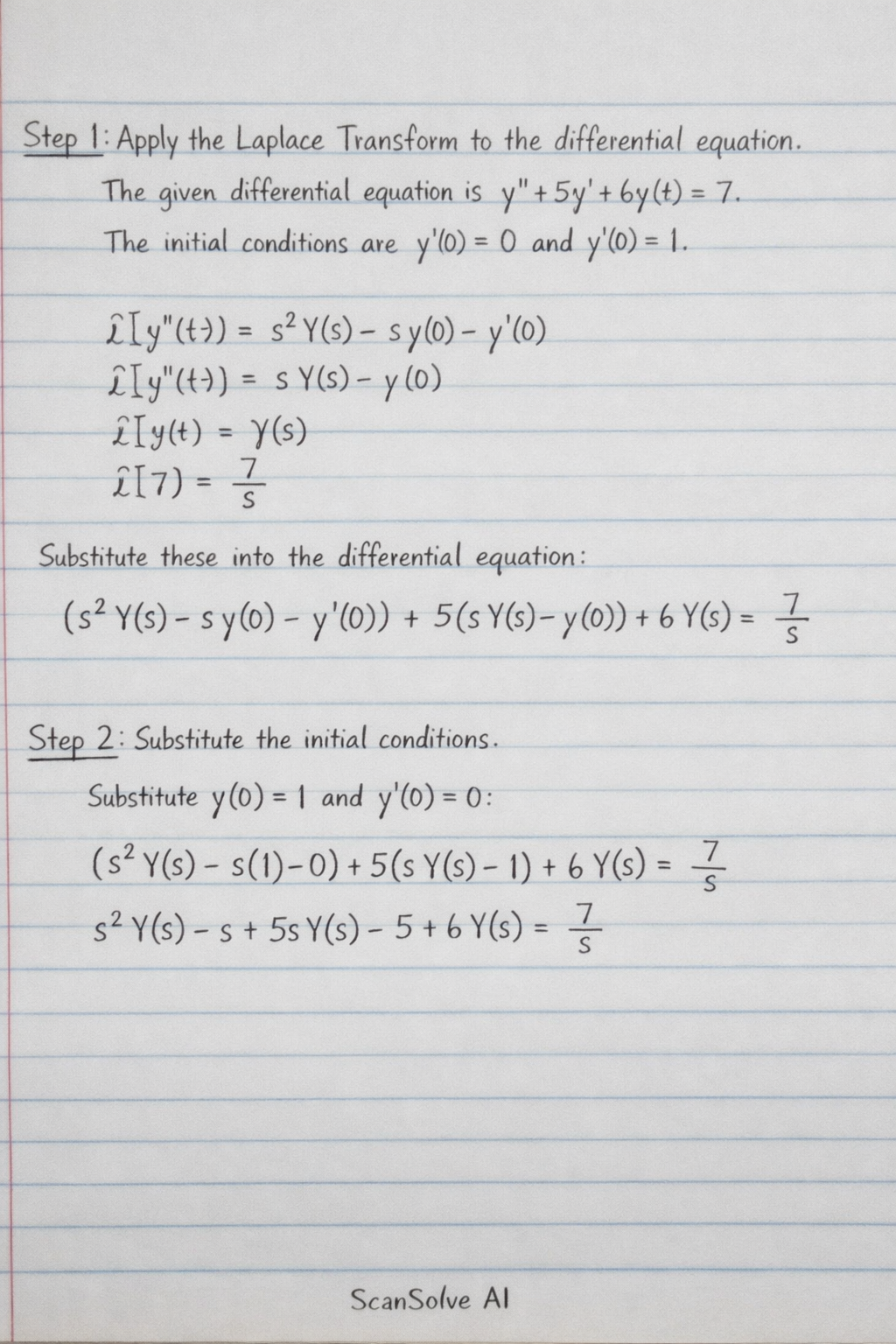
Step 1: Apply the Laplace Transform to the differential equation. The given differential equation is y'' + 5y' + 6y(t) = 7. The initial conditions are y'(0) = 0 and y(0) = 1. Applying the Laplace Transform to each term: L\y''(t)\ = s^2 Y(s) - s y(0) - y'(0) L\y'(t)\ = s Y(s) - y(0) L\y(t)\ = Y(s) L\7\ = (7)/(s) Substitute these into the differential equation: (s^2 Y(s) - s y(0) - y'(0)) + 5(s Y(s) - y(0)) + 6 Y(s) = (7)/(s) Step 2: Substitute the initial conditions. Substitute y(0) = 1 and y'(0) = 0: (s^2 Y(s) - s(1) - 0) + 5(s Y(s) - 1) + 6 Y(s) = (7)/(s) s^2 Y(s) - s + 5s Y(s) - 5 + 6 Y(s) = (7)/(s) Step 3: Solve for Y(s). Group the terms containing Y(s): (s^2 + 5s + 6) Y(s) - s - 5 = (7)/(s) Move the terms without Y(s) to the right side: (s^2 + 5s + 6) Y(s) = (7)/(s) + s + 5 Combine the terms on the right side into a single fraction: (s^2 + 5s + 6) Y(s) = (7 + s^2 + 5s)/(s) Isolate Y(s): Y(s) = (s^2 + 5s + 7)/(s(s^2 + 5s + 6)) Factor the quadratic term in the denominator: s^2 + 5s + 6 = (s+2)(s+3). Y(s) = (s^2 + 5s + 7)/(s(s+2)(s+3)) Step 4: Perform partial fraction decomposition on Y(s). Set up the partial fraction expansion: (s^2 + 5s + 7)/(s(s+2)(s+3)) = (A)/(s) + (B)/(s+2) + (C)/(s+3) Multiply both sides by s(s+2)(s+3) to clear the denominators: s^2 + 5s + 7 = A(s+2)(s+3) + B s(s+3) + C s(s+2) To find A, set s=0: 0^2 + 5(0) + 7 = A(0+2)(0+3) + B(0) + C(0) 7 = A(2)(3) 7 = 6A A = (7)/(6) To find B, set s=-2: (-2)^2 + 5(-2) + 7 = A(0) + B(-2)(-2+3) + C(0) 4 - 10 + 7 = B(-2)(1) 1 = -2B B = -(1)/(2) To find C, set s=-3: (-3)^2 + 5(-3) + 7 = A(0) + B(0) + C(-3)(-3+2) 9 - 15 + 7 = C(-3)(-1) 1 = 3C C = (1)/(3) Substitute the values of A, B, and C back into the partial fraction expansion: Y(s) = (7)/(6s) - (1)/(2(s+2)) + (1)/(3(s+3)) Step 5: Apply the inverse Laplace Transform to find y(t). y(t) = L^-1\(7)/(6s) - (1)/(2(s+2)) + (1)/(3(s+3))\ Using the inverse Laplace Transform properties L^-1\(1)/(s)\ = 1 and L^-1\(1)/(s-a)\ = e^at: y(t) = (7)/(6)L^-1\(1)/(s)\ - (1)/(2)L^-1\(1)/(s+2)\ + (1)/(3)L^-1\(1)/(s+3)\ y(t) = (7)/(6)(1) - (1)/(2)e^-2t + (1)/(3)e^-3t y(t) = (7)/(6) - (1)/(2)e^-2t + (1)/(3)e^-3t The solution is: y(t) = (7)/(6) - (1)/(2)e^-2t + (1)/(3)e^-3t Send me the next one 📸