
We read your photo as:
Calculate the area of a trapezium with parallel sides 0.05 m and 9 cm and height 6 cm. Also, find the total surface area and volume of a cone with slant height 13 cm and radius 5 cm.
ScanSolve AI Answer
Step-by-step solution
10 stepsHere are the solutions for Question Four:
Question Four
a) Calculate the area of the trapezium whose parallel sides are and with an height of .
Convert all units to centimeters.
The parallel sides are and . The height is .
Use the formula for the area of a trapezium.
The area of a trapezium is given by .
b) A cone has a slant height of with a radius of for its circular base. Calculate:
i. Total surface area
ii. VolumeGiven: Slant height , radius . Use .
i. Total surface area
Use the formula for the total surface area of a cone.
The total surface area of a cone is given by .
ii. Volume
Calculate the perpendicular height of the cone using the Pythagorean theorem.
Use the formula for the volume of a cone.
The volume of a cone is given by .
c) Calculate the volume of the cylinder whose height is and a diameter of .
Given: Height , diameter . Use .
Calculate the radius of the cylinder.
Use the formula for the volume of a cylinder.
The volume of a cylinder is given by .
d) Solve the following simultaneous equation using the elimination method.
Simplify equation (2).
Use the elimination method by subtracting equation (1) from equation (3).
Interpret the result.
Since is a false statement, the system of equations is inconsistent. This means there is no solution that satisfies both equations simultaneously.
The system has .
Still stuck on this one?
Ask a follow-up, and the answer starts from this question.
More Mathematics Questions
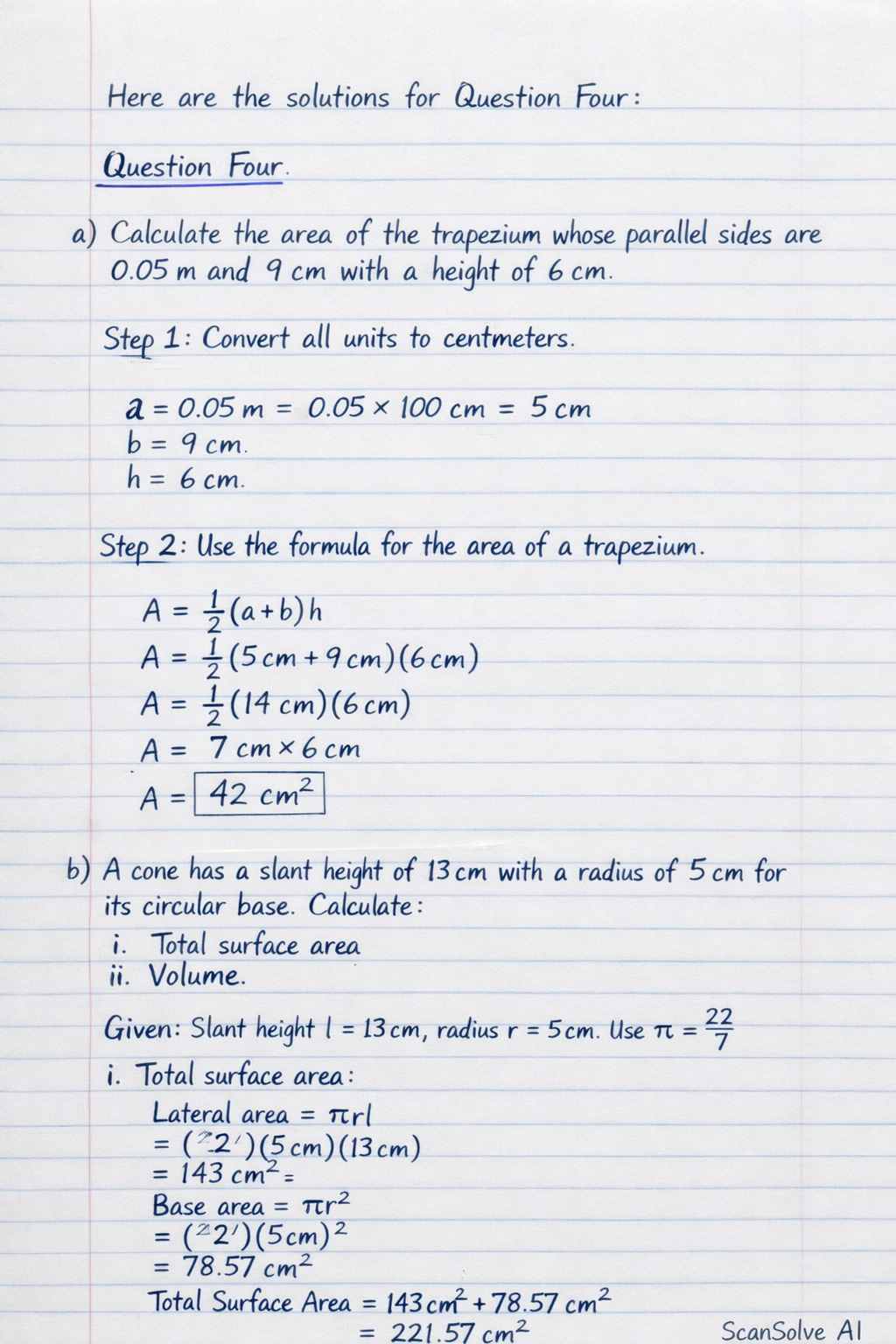
Handwritten Step-by-Step Solution
Get this as a handwritten image on WhatsApp — like a tutor wrote it for you.
Try on WhatsApp