

This mathematics problem involves applying core mathematical principles and formulas. Below you will find a complete step-by-step solution with detailed explanations for each step, helping you understand not just the answer but the method behind it.
ScanSolve AI Answer
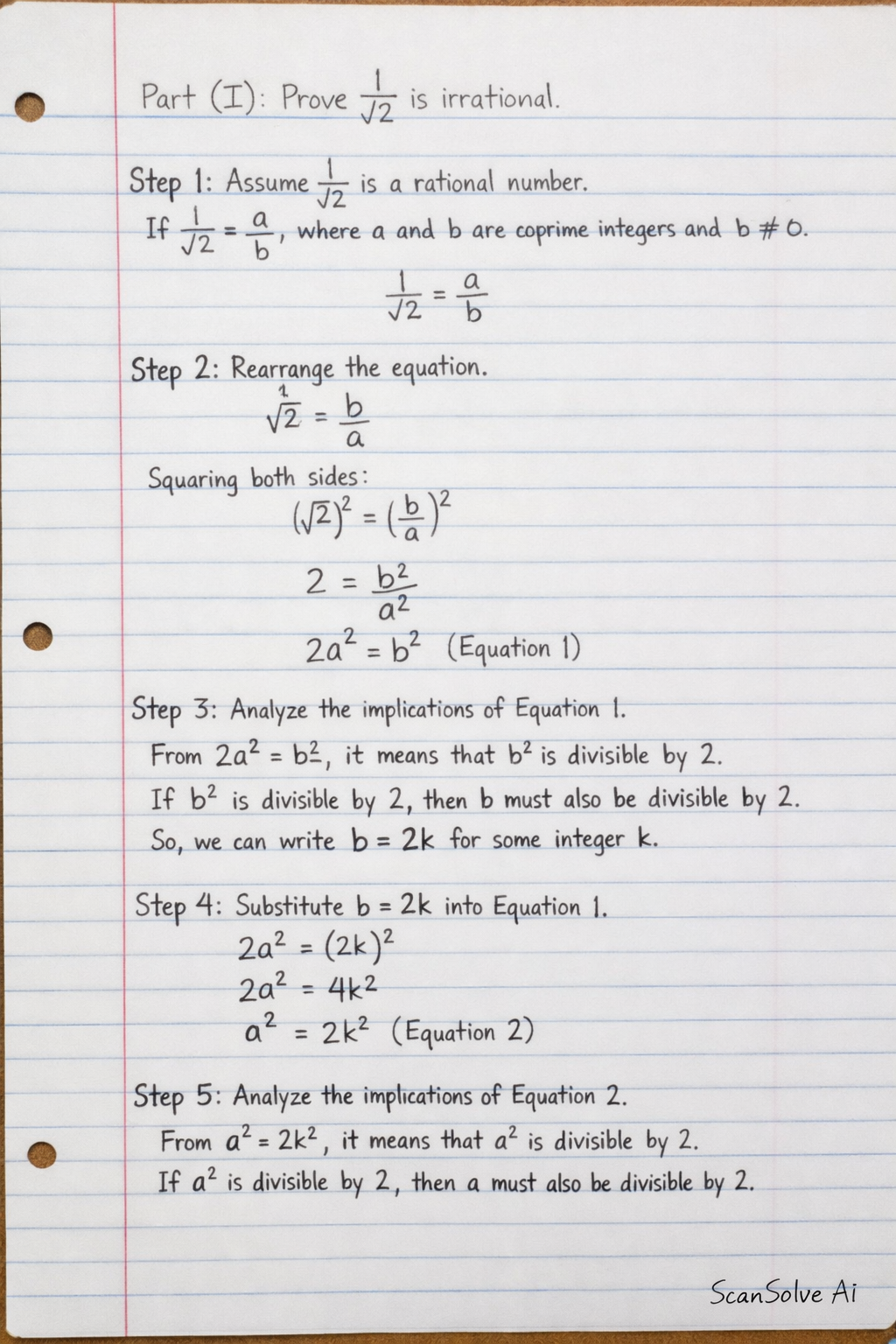
Here's how to prove that the given numbers are irrational: Part (I): Prove (1)/(sqrt(2)) is irrational. Step 1: Assume (1)/(sqrt(2)) is a rational number. If (1)/(sqrt(2)) is rational, it can be written in the form (a)/(b), where a and b are coprime integers and b ≠ 0. (1)/(sqrt(2)) = (a)/(b) Step 2: Rearrange the equation. sqrt(2) = (b)/(a) Squaring both sides: (sqrt(2))^2 = ((b)/(a))^2 2 = (b^2)/(a^2) 2a^2 = b^2 (Equation 1) Step 3: Analyze the implications of Equation 1. From 2a^2 = b^2, it means that b^2 is divisible by 2. If b^2 is divisible by 2, then b must also be divisible by 2. So, we can write b = 2k for some integer k. Step 4: Substitute b=2k into Equation 1. 2a^2 = (2k)^2 2a^2 = 4k^2 a^2 = 2k^2 (Equation 2) Step 5: Analyze the implications of Equation 2. From a^2 = 2k^2, it means that a^2 is divisible by 2. If a^2 is divisible by 2, then a must also be divisible by 2. Step 6: Reach a contradiction. From Step 3, b is divisible by 2. From Step 5, a is divisible by 2. This means that a and b have a common factor of 2. However, in Step 1, we assumed that a and b are coprime integers (meaning they have no common factors other than 1). This contradicts our initial assumption. Step 7: Conclude. Since our assumption leads to a contradiction, our initial assumption that (1)/(sqrt(2)) is rational must be false. Therefore, (1)/(sqrt(2)) is an irrational number. Part (I) is irrational --- Part (II): Prove 7sqrt(5) is irrational. Step 1: Assume 7sqrt(5) is a rational number. If 7sqrt(5) is rational, it can be written in the form (a)/(b), where a and b are coprime integers and b ≠ 0. 7sqrt(5) = (a)/(b) Step 2: Rearrange the equation to isolate sqrt(5). sqrt(5) = (a)/(7b) Step 3: Analyze the implication. Since a and b are integers, a is an integer and 7b is a non-zero integer. Therefore, (a)/(7b) is a rational number. This implies that sqrt(5) is a rational number. Step 4: Reach a contradiction. However, we know that sqrt(5) is an irrational number. This contradicts our conclusion from Step 3. Step 5: Conclude. Since our assumption leads to a contradiction, our initial assumption that 7sqrt(5) is rational must be false. Therefore, 7sqrt(5) is an irrational number. Part (II) is irrational --- Part (III): Prove 6 + sqrt(2) is irrational. Step 1: Assume 6 + sqrt(2) is a rational number. If 6 + sqrt(2) is rational, it can be written in the form (a)/(b), where a and b are coprime integers and b ≠ 0. 6 + sqrt(2) = (a)/(b) Step 2: Rearrange the equation to isolate sqrt(2). sqrt(2) = (a)/(b) - 6 sqrt(2) = (a - 6b)/(b) Step 3: Analyze the implication. Since a and b are integers, a - 6b is an integer and b is a non-zero integer. Therefore, (a - 6b)/(b) is a rational number. This implies that sqrt(2) is a rational number. Step 4: Reach a contradiction. However, we know that sqrt(2) is an irrational number. This contradicts our conclusion from Step 3. Step 5: Conclude. Since our assumption leads to a contradiction, our initial assumption that 6 + sqrt(2) is rational must be false. Therefore, 6 + sqrt(2) is an irrational number. Part (III) is irrational