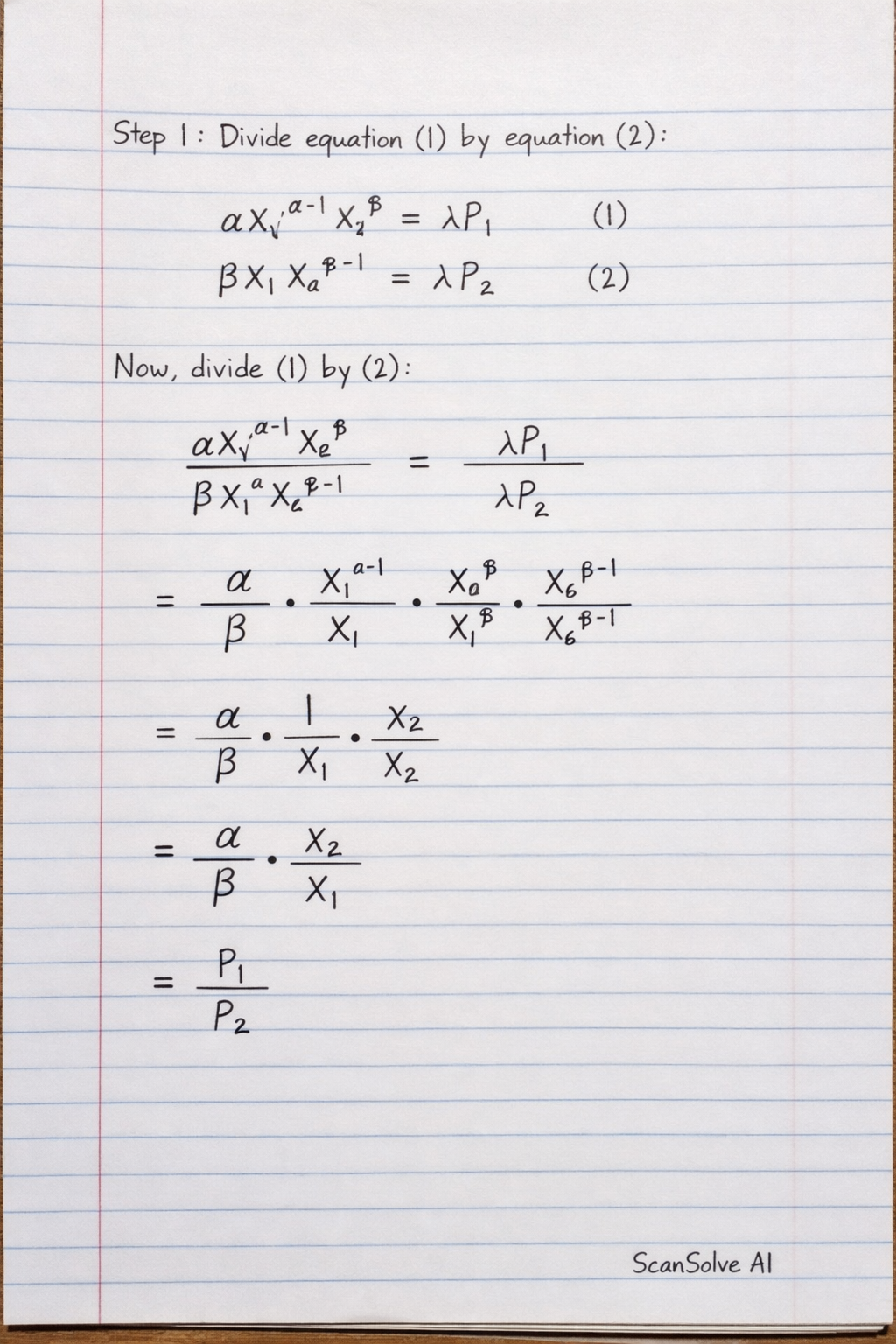
We read your photo as:

Calculer les dérivées partielles de la fonction par rapport à Xᵢ, i=1,2

Mathematics

ScanSolve AI Answer

Answer

X1=αRP1(α+β)X_1 = \frac{\alpha R}{P_1 (\alpha + \beta)}

X2=βRP2(α+β)X_2 = \frac{\beta R}{P_2 (\alpha + \beta)}

Step-by-step solution

7 steps

The image shows steps to solve a system of equations, likely from an optimization problem using the Lagrange multiplier method. The goal is to find expressions for X1X_1 and X2X_2.

The student's work starts by dividing equation (1) by equation (2) and then simplifying. Let's follow the steps and complete the solution.

  1. Divide equation (1) by equation (2).

    The given equations (1) and (2) are:

    αX1α−1X2β=λP1(1)\alpha X_1^{\alpha-1} X_2^\beta = \lambda P_1 \quad (1) βX1αX2β−1=λP2(2)\beta X_1^\alpha X_2^{\beta-1} = \lambda P_2 \quad (2)

    Dividing (1) by (2):

    αX1α−1X2ββX1αX2β−1=λP1λP2\frac{\alpha X_1^{\alpha-1} X_2^\beta}{\beta X_1^\alpha X_2^{\beta-1}} = \frac{\lambda P_1}{\lambda P_2} αβ⋅X1α−1X1α⋅X2βX2β−1=P1P2\frac{\alpha}{\beta} \cdot \frac{X_1^{\alpha-1}}{X_1^\alpha} \cdot \frac{X_2^\beta}{X_2^{\beta-1}} = \frac{P_1}{P_2}
  2. Simplify the expression.

    Using exponent rules am/an=am−na^m/a^n = a^{m-n}:

    αβ⋅X1α−1−α⋅X2β−(β−1)=P1P2\frac{\alpha}{\beta} \cdot X_1^{\alpha-1-\alpha} \cdot X_2^{\beta-(\beta-1)} = \frac{P_1}{P_2} αβ⋅X1−1⋅X21=P1P2\frac{\alpha}{\beta} \cdot X_1^{-1} \cdot X_2^1 = \frac{P_1}{P_2} αβ⋅X2X1=P1P2\frac{\alpha}{\beta} \cdot \frac{X_2}{X_1} = \frac{P_1}{P_2}
  3. Solve for X2X_2 in terms of X1X_1.

    X2=βα⋅P1P2⋅X1(4)X_2 = \frac{\beta}{\alpha} \cdot \frac{P_1}{P_2} \cdot X_1 \quad (4)

    This matches the student's derived equation (4).

  4. Substitute X2X_2 from equation (4) into equation (3).

    Equation (3) is given as:

    P1X1+P2X2=R(3)P_1 X_1 + P_2 X_2 = R \quad (3)

    Substitute the expression for X2X_2 from Step 3:

    P1X1+P2(βαP1P2X1)=RP_1 X_1 + P_2 \left( \frac{\beta}{\alpha} \frac{P_1}{P_2} X_1 \right) = R
  5. Simplify and solve for X1X_1.

    P1X1+βαP1X1=RP_1 X_1 + \frac{\beta}{\alpha} P_1 X_1 = R

    Factor out P1X1P_1 X_1:

    P1X1(1+βα)=RP_1 X_1 \left( 1 + \frac{\beta}{\alpha} \right) = R P1X1(α+βα)=RP_1 X_1 \left( \frac{\alpha + \beta}{\alpha} \right) = R X1=RαP1(α+β)X_1 = \frac{R \alpha}{P_1 (\alpha + \beta)}

    So, the expression for X1X_1 is:

    X1=αRP1(α+β)\boxed{X_1 = \frac{\alpha R}{P_1 (\alpha + \beta)}}
  6. Substitute the expression for X1X_1 back into equation (4) to find X2X_2.

    X2=βαP1P2X1X_2 = \frac{\beta}{\alpha} \frac{P_1}{P_2} X_1 X2=βαP1P2(αRP1(α+β))X_2 = \frac{\beta}{\alpha} \frac{P_1}{P_2} \left( \frac{\alpha R}{P_1 (\alpha + \beta)} \right)
  7. Simplify the expression for X2X_2.

    X2=βαP1P2αRP1(α+β)X_2 = \frac{\beta}{\alpha} \frac{P_1}{P_2} \frac{\alpha R}{P_1 (\alpha + \beta)}

    Cancel out α\alpha and P1P_1:

    X2=βRP2(α+β)X_2 = \frac{\beta R}{P_2 (\alpha + \beta)}

    So, the expression for X2X_2 is:

    X2=βRP2(α+β)\boxed{X_2 = \frac{\beta R}{P_2 (\alpha + \beta)}}
Was this helpful?

Try one yourself

A new problem that tests the same skill.

Still stuck on this one?

Ask a follow-up, and the answer starts from this question.

Got a different question?Ask your own question
Handwritten step-by-step solution preview

Handwritten Step-by-Step Solution

Get this as a handwritten image on WhatsApp — like a tutor wrote it for you.

Try on WhatsApp