
We read your photo as:
Classify numbers as Natural, Whole, Integers, Rational, Irrational and identify set elements belonging to these categories.
ScanSolve AI Answer
Answer
Question 1: Classify the following numbers.
- Natural Numbers (N):
- Whole Numbers (W):
- Integers (Z):
- Rational Numbers (Q): Can be written as (terminating or repeating decimals).
- Irrational Numbers (Q'): Cannot be written as (non-terminating, non-repeating decimals).
Here are the classifications for each number:
- 1: N, W, Z, Q
- 0: W, Z, Q
- 2.435435435...: This is a repeating decimal. Q
- 100: N, W, Z, Q
- : This appears to be a typo in the question, likely intended as a repeating decimal or a fraction. Assuming it's a repeating decimal like 0.1200120012..., it would be Q. If it's literally 1 divided by a very long number, it's still a fraction, so Q.
- : This is a non-perfect square root. Q'
- 4.75: This is a terminating decimal. Q
- : Z, Q
- : This is a non-terminating, non-repeating decimal. Q'
- 0.5: This is a terminating decimal. Q
Question 2: Find out which of the following elements of the set are:
First, simplify the elements of set M:
- a) Natural numbers: Numbers in N are positive integers.
- Natural numbers:
- b) Integers: Numbers in Z are whole numbers and their negatives.
- Integers:
- c) Rational numbers: Numbers in Q can be expressed as a fraction.
- Rational numbers:
- d) Irrational numbers: Numbers in Q' cannot be expressed as a fraction.
- Irrational numbers:
- e) Real numbers: All numbers listed are real numbers.
- Real numbers:
Question 3: Classify the following numbers: and 7.
- : Integer, Rational
- 0: Whole number, Integer, Rational
- : Irrational
- : Rational
- 7: Natural number, Whole number, Integer, Rational
Question 4: Illustrate the content in the hunter's bag using a Venn diagram. Relate these within the real number system.
The hunter's bag contains a python and a bottle of water. The python contains a hawk, which contains a chicken, which contains a grain of corn.
Venn Diagram for Contents:
Let B = Hunter's Bag, P = Python, W = Bottle of Water, H = Hawk, C = Chicken, G = Grain of Corn.
\begin{tikzpicture}
    \draw (0,0) circle (3cm) node[above right] {B (Hunter's Bag)};
    \draw (-1,0) circle (1.5cm) node[above right] {P (Python)};
    \draw (1.5,0.5) circle (0.5cm) node[above right] {W (Bottle of Water)};
    \draw (-1,0) circle (1cm) node[above right] {H (Hawk)};
    \draw (-1,0) circle (0.5cm) node[above right] {C (Chicken)};
    \node at (-1,0) {G (Grain of Corn)};
\end{tikzpicture}
Relation to the Real Number System:
Each distinct item (grain of corn, chicken, hawk, python, bottle of water) represents a count of 1. The number 1 is a natural number, a whole number, an integer, a rational number, and a real number.
Question 5: Convert the following decimals into fractions.
- a) 0.5
- b) 0.62
- c) 1.6
- d) 2.31
Try one yourself
A new problem that tests the same skill.
Still stuck on this one?
Ask a follow-up, and the answer starts from this question.
More Mathematics Questions
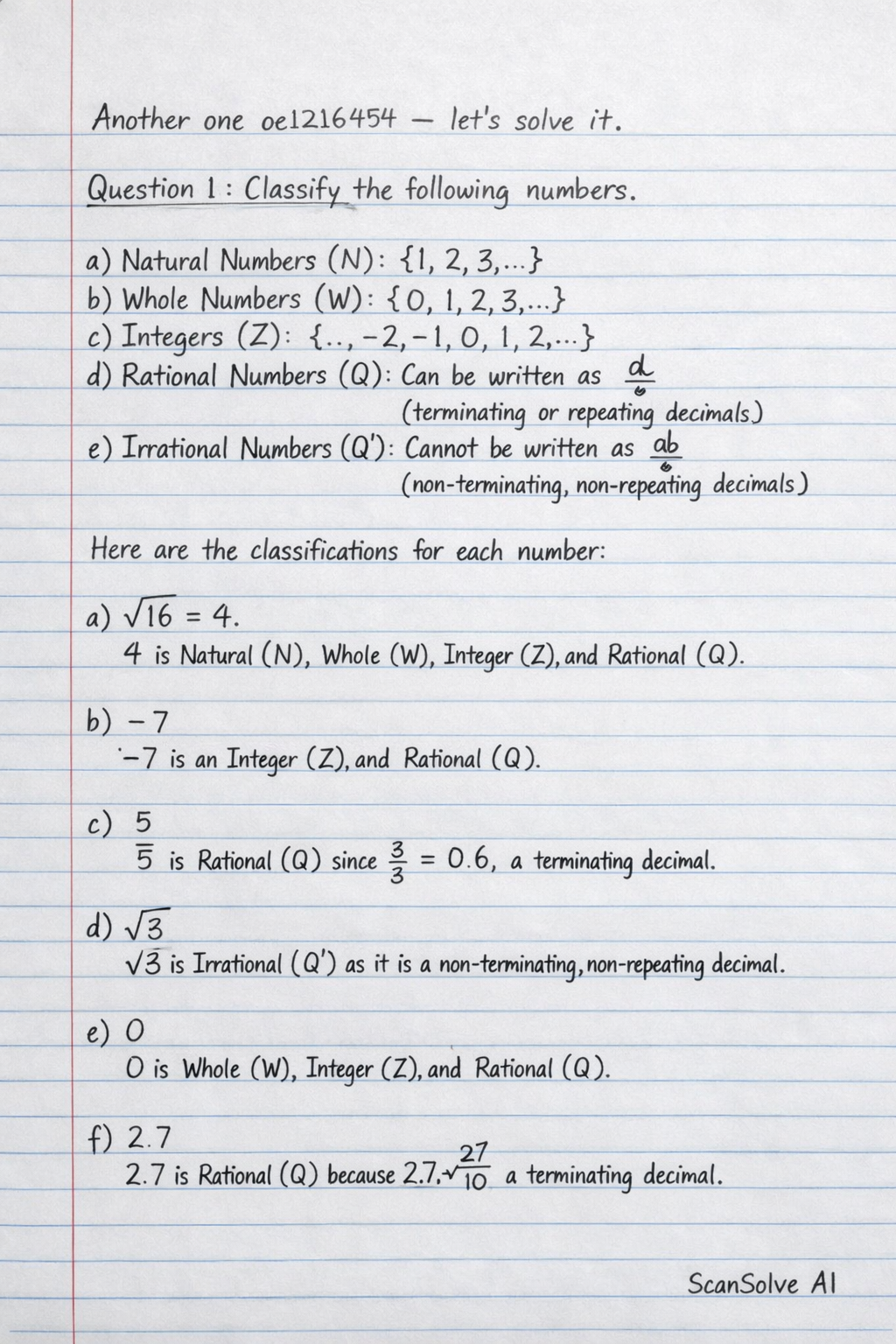
Handwritten Step-by-Step Solution
Get this as a handwritten image on WhatsApp — like a tutor wrote it for you.
Try on WhatsApp