

This mathematics problem involves applying core mathematical principles and formulas. Below you will find a complete step-by-step solution with detailed explanations for each step, helping you understand not just the answer but the method behind it.
ScanSolve AI Answer
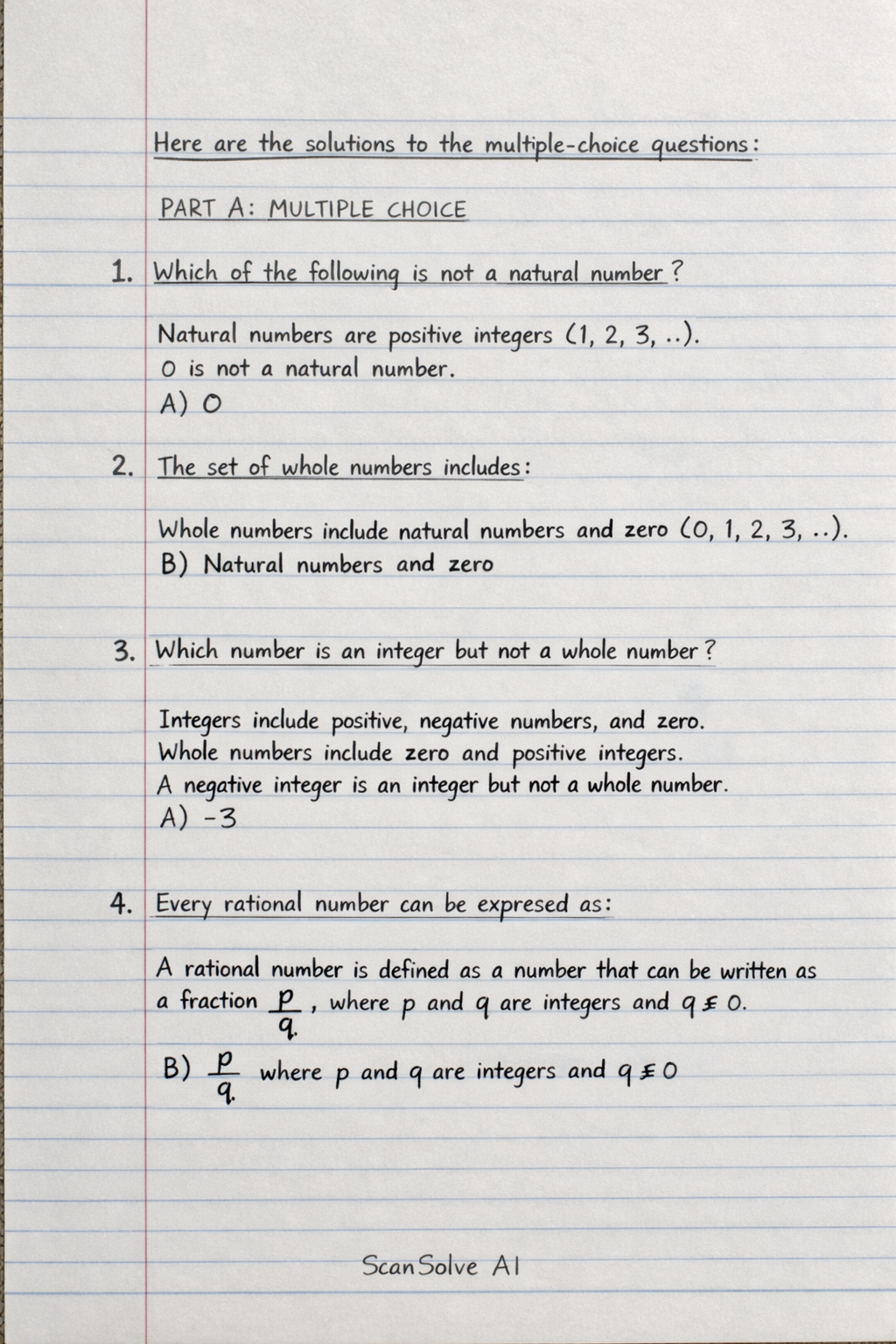
Here are the solutions to the multiple-choice questions: PART A: MULTIPLE CHOICE 1. Which of the following is not a natural number? Natural numbers are positive integers (1, 2, 3, ...). 0 is not a natural number. A) 0 2. The set of whole numbers includes: Whole numbers include natural numbers and zero (0, 1, 2, 3, ...). B) Natural numbers and zero 3. Which number is an integer but not a whole number? Integers include positive, negative numbers, and zero. Whole numbers include zero and positive integers. A negative integer is an integer but not a whole number. A) -3 4. Every rational number can be expressed as: A rational number is defined as a number that can be written as a fraction (p)/(q), where p and q are integers and q ≠ 0. B) p/q where p and q are integers and q ≠ 0 5. Which of the following is an irrational number? Irrational numbers cannot be expressed as a simple fraction and have non-repeating, non-terminating decimal expansions. A) (3)/(5) is rational. B) sqrt(4) = 2, which is rational. C) is an irrational number. D) -8 is rational. C) 6. A prime number is a natural number greater than 1 that: A prime number has exactly two distinct positive factors: 1 and itself. A) Has exactly two factors 7. Which of the following is a composite number? A composite number is a natural number greater than 1 that has more than two factors. A) 7 (factors: 1, 7) - Prime B) 11 (factors: 1, 11) - Prime C) 15 (factors: 1, 3, 5, 15) - Composite D) 17 (factors: 1, 17) - Prime C) 15 8. The factors of 24 include: The factors of 24 are the numbers that divide 24 evenly: 1, 2, 3, 4, 6, 8, 12, 24. A) 1, 2, 3, 4, 6, 8, 12, 24 9. The first five multiples of 6 are: Multiples of 6 are found by multiplying 6 by consecutive natural numbers: 6 × 1 = 6 6 × 2 = 12 6 × 3 = 18 6 × 4 = 24 6 × 5 = 30 A) 6, 12, 18, 24, 30 10. 1 is: A prime number has exactly two factors. A composite number has more than two factors. The number 1 has only one factor (itself), so it is neither prime nor composite. C) Neither prime nor composite 3 done, 2 left today. You're making progress.