
We read your photo as:
List and explain the following number concepts: natural numbers, whole numbers, integers, rational numbers, irrational numbers, prime numbers, composite numbers, multiples, and factors. Provide exampl
ScanSolve AI Answer
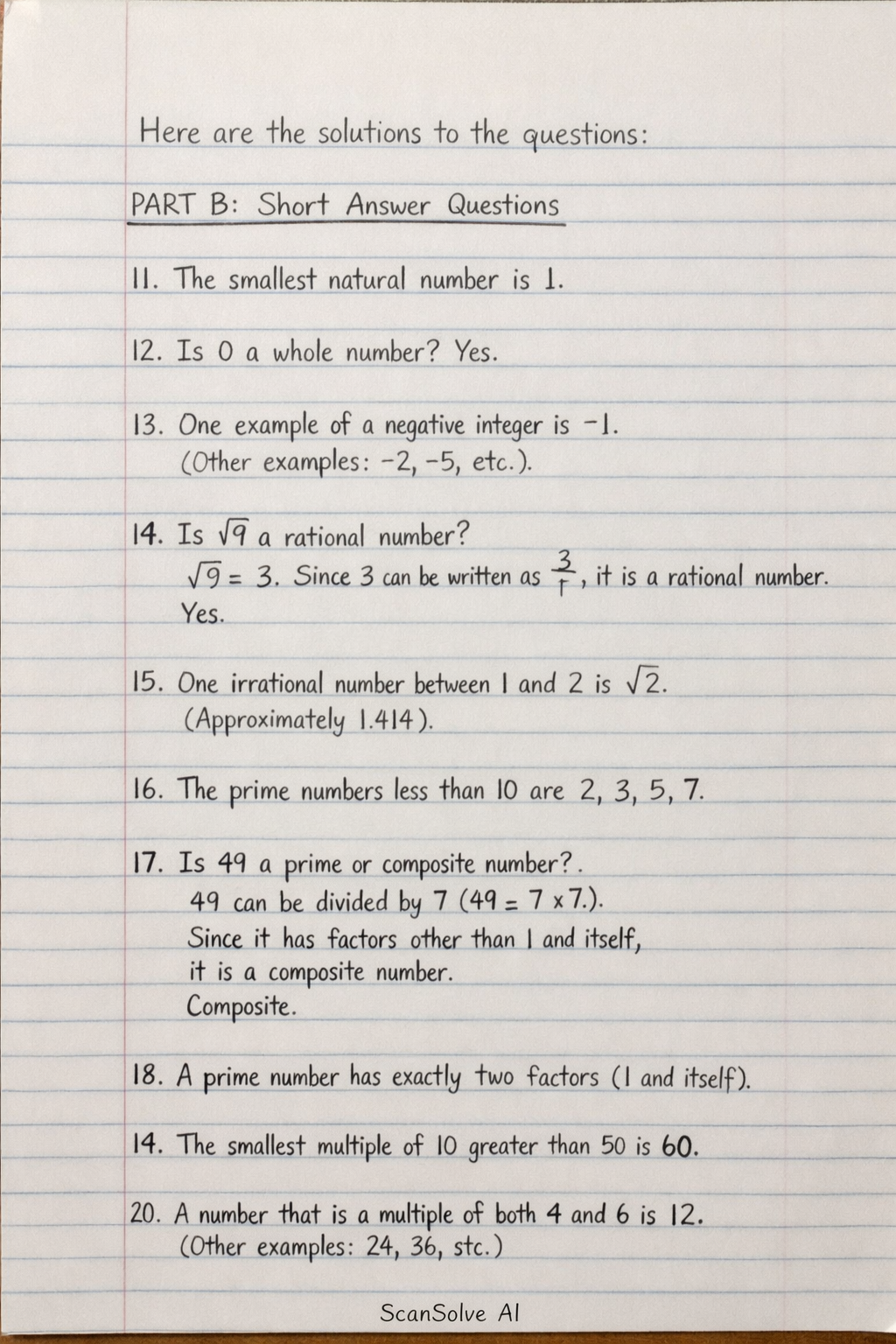
Here are the solutions to the questions:
PART B: Short Answer Questions
-
The smallest natural number is 1.
-
Is 0 a whole number? Yes.
-
One example of a negative integer is -1. (Other examples include -2, -5, etc.)
-
Is a rational number? . Since 3 can be written as , it is a rational number. Yes.
-
One irrational number between 1 and 2 is . (Approximately 1.414)
-
The prime numbers less than 10 are 2, 3, 5, 7.
-
Is 49 a prime or composite number? 49 can be divided by 7 (). Since it has factors other than 1 and itself, it is a composite number. Composite.
-
A prime number has exactly two factors (1 and itself).
-
The smallest multiple of 10 greater than 50 is 60.
-
A number that is a multiple of both 4 and 6 is 12. (Other examples include 24, 36, etc.)
PART C: Calculations and Explanations
-
To list all the factors of 36, we find all pairs of numbers that multiply to 36: The factors of 36 are 1, 2, 3, 4, 6, 9, 12, 18, 36.
-
To write the prime factorization of 180, we can use the division method:
The prime factorization of 180 is . Using exponents, this is .
-
From the list: 4, 9, 11, 15, 23, 25, 29 a) Identify all prime numbers. Prime numbers are numbers greater than 1 that have only two factors: 1 and themselves. The prime numbers are 11, 23, 29.
b) Identify all composite numbers.
Composite numbers are numbers greater than 1 that have more than two factors.
The composite numbers are 4, 9, 15, 25. -
a) Explain why 0 is a rational number. Write it as a fraction p/q. A rational number is any number that can be expressed as a fraction , where and are integers and is not zero. Zero can be written as (or , , etc.), where 0 is an integer and 1 is a non-zero integer. Therefore, 0 is a rational number. As a fraction : .
-
a) What is the smallest positive number that is a multiple of both 8 and 12? This is the Least Common Multiple (LCM) of 8 and 12. The smallest positive number that is a multiple of both 8 and 12 is 24.
b) Show how you found it (e.g., method used).
Method: Listing multiples
Multiples of 8: 8, 16, 24, 32, ...
Multiples of 12: 12, 24, 36, ...
The smallest common multiple is 24.
Still stuck on this one?
Ask a follow-up, and the answer starts from this question.
More Mathematics Questions
Handwritten Step-by-Step Solution
Get this as a handwritten image on WhatsApp — like a tutor wrote it for you.
Try on WhatsApp