
We read your photo as:
Consider the input numbers: 3, 5, 7, 9, 11. Rule: 2x. Represent your answers using a flow diagram. Write down the rule for the following input and output values. Input values: 2, 4, 6, 8, 10 Output va
ScanSolve AI Answer
Step-by-step solution
5 stepsHere are the solutions to Question 3.
Question 3
3.1.1
Consider the input numbers: 3, 5, 7, 9, 11.
Rule: $2x$.
Apply the rule $2x$ to each input number.
- For :
- For :
- For :
- For :
- For :
The output numbers are .
3.1.2
Represent your answers using a flow diagram.3.2
Write down the rule for the following input and output values.Input values: 2, 4, 6, 8, 10
Output values: 3, 15, 35, 63, 99Analyze the relationship between input and output values.
- For input 2, output 3:
- For input 4, output 15:
- For input 6, output 35:
- For input 8, output 63:
- For input 10, output 99:
The rule is .
3.3
What kind of outputs will be obtained by applying the rule to all negative integers?Consider examples of negative integers and apply the rule.
- If , output is .
- If , output is .
- If , output is .
The outputs will be .
3.4
What kind of outputs will be obtained by applying the rule to natural numbers smaller than 5?Identify natural numbers smaller than 5.
Natural numbers are positive integers (1, 2, 3, ...). So, natural numbers smaller than 5 are 1, 2, 3, 4.
Apply the rule to each of these numbers.
- For :
- For :
- For :
- For :
The outputs will be .
Still stuck on this one?
Ask a follow-up, and the answer starts from this question.
More Mathematics Questions
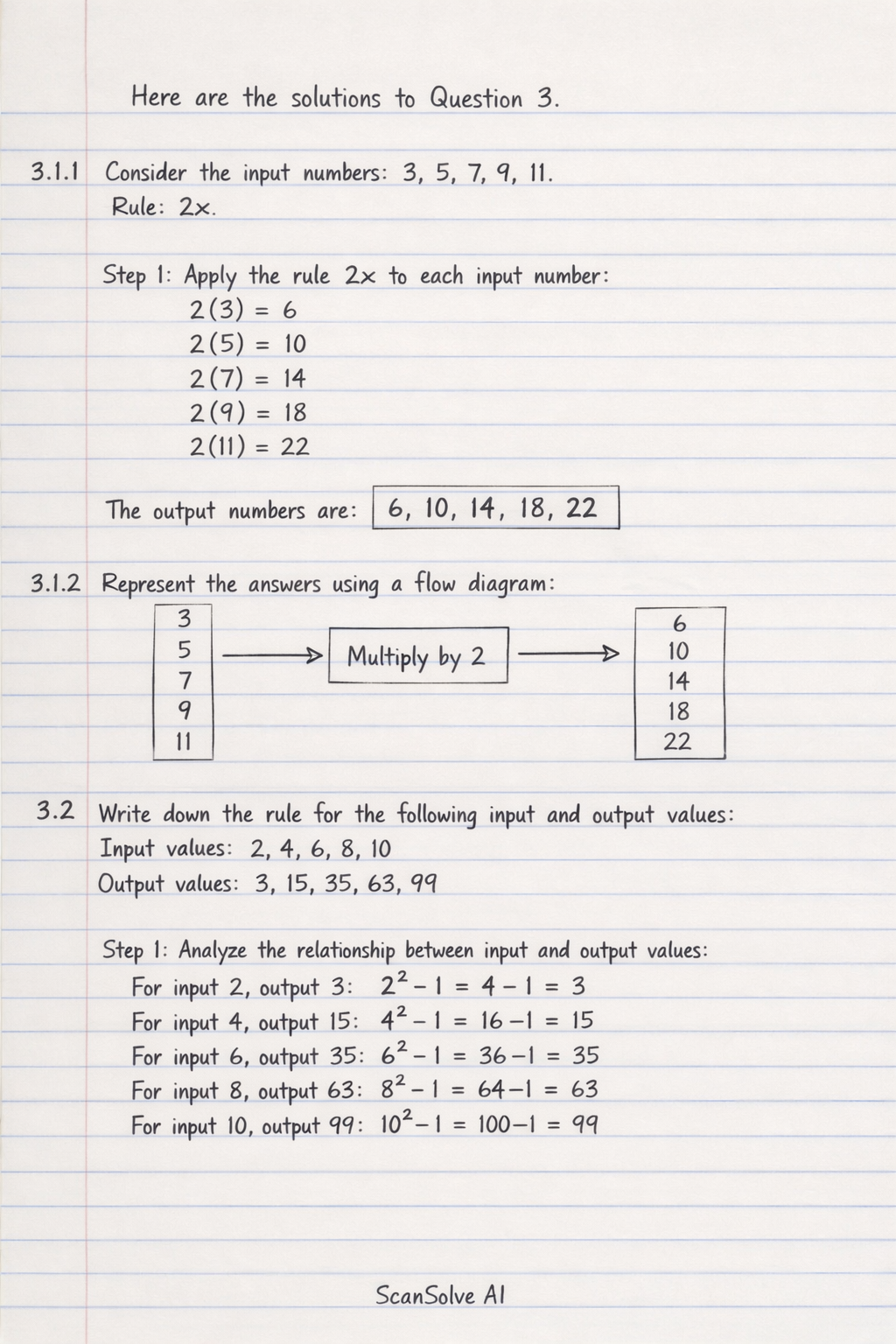
Handwritten Step-by-Step Solution
Get this as a handwritten image on WhatsApp — like a tutor wrote it for you.
Try on WhatsApp