

This mathematics problem involves applying core mathematical principles and formulas. Below you will find a complete step-by-step solution with detailed explanations for each step, helping you understand not just the answer but the method behind it.
ScanSolve AI Answer
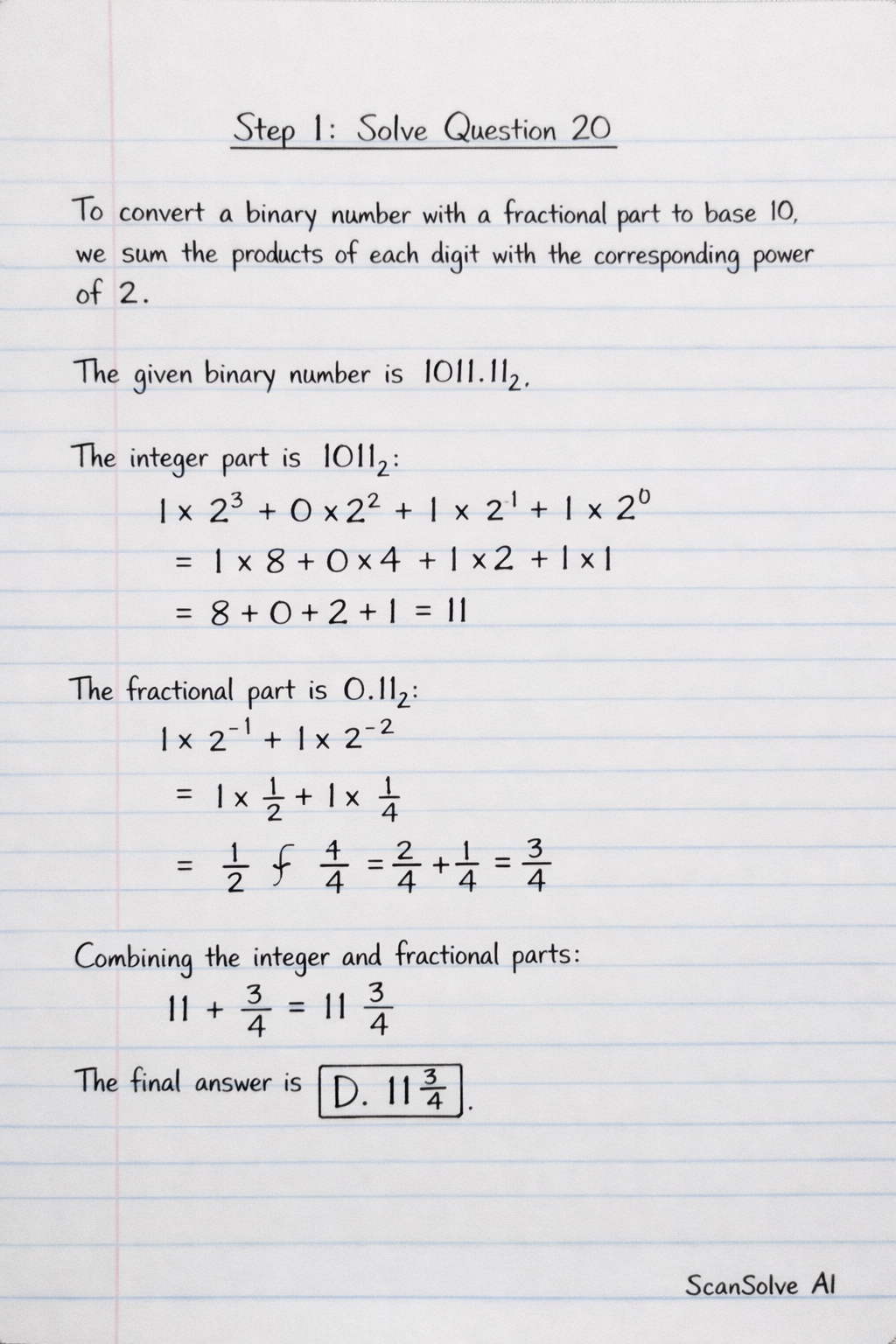
Step 1: Solve Question 20 To convert a binary number with a fractional part to base 10, we sum the products of each digit with the corresponding power of 2. The given binary number is 1011.11_2. The integer part is 1011_2: 1 × 2^3 + 0 × 2^2 + 1 × 2^1 + 1 × 2^0 = 1 × 8 + 0 × 4 + 1 × 2 + 1 × 1 = 8 + 0 + 2 + 1 = 11 The fractional part is 0.11_2: 1 × 2^-1 + 1 × 2^-2 = 1 × (1)/(2) + 1 × (1)/(4) = (1)/(2) + (1)/(4) = (2)/(4) + (1)/(4) = (3)/(4) Combining the integer and fractional parts: 11 + (3)/(4) = 11(3)/(4) The final answer is D. 11(3)/(4). Step 2: Solve Question 21 Given that O is the center of the circle and AB // CD. Also, ABO = 45^. Since OA and OB are radii, OAB is an isosceles triangle with OA = OB. Therefore, OAB = ABO = 45^. The sum of angles in OAB is 180^: AOB = 180^ - ( OAB + ABO) AOB = 180^ - (45^ + 45^) AOB = 180^ - 90^ = 90^ Since AB // CD, the chords AB and CD are parallel. In a circle, parallel chords are equidistant from the center. This implies that the lengths of the chords are equal, so AB = CD. If two chords are equal in length, they subtend equal angles at the center. Therefore, COD = AOB = 90^. In OCD, OC and OD are radii, so OC = OD. This means OCD is an isosceles triangle. Thus, OCD = ODC. The sum of angles in OCD is 180^: OCD + ODC + COD = 180^ 2 OCD + 90^ = 180^ 2 OCD = 180^ - 90^ 2 OCD = 90^ OCD = (90^)/(2) OCD = 45^ The final answer is A. 45^. Step 3: Solve Question 22 Given matrices X = 4 & -11 \\ -8 & 5 and Y = -5 & 2 \\ 0 & 6 . We need to evaluate 4X - 3Y. First, calculate 4X: 4X = 4 4 & -11 \\ -8 & 5 = 4 × 4 & 4 × (-11) \\ 4 × (-8) & 4 × 5 = 16 & -44 \\ -32 & 20 Next, calculate 3Y: 3Y = 3 -5 & 2 \\ 0 & 6 = 3 × (-5) & 3 × 2 \\ 3 × 0 & 3 × 6 = -15 & 6 \\ 0 & 18 Now, subtract 3Y from 4X: 4X - 3Y = 16 & -44 \\ -32 & 20 - -15 & 6 \\ 0 & 18 = 16 - (-15) & -44 - 6 \\ -32 - 0 & 20 - 18 = 16 + 15 & -50 \\ -32 & 2 = 31 & -50 \\ -32 & 2 The final answer is A. 31 & -50 \\ -32 & 2 . Step 4: Solve Question 23 We need to solve the simultaneous equations: 1) 2x + y = 4 2) 3x - y = 1 Add equation (1) and equation (2) to eliminate y: (2x + y) + (3x - y) = 4 + 1 5x = 5 Divide by 5: x = 1 Substitute x=1 into equation (1): 2(1) + y = 4 2 + y = 4 Subtract 2 from both sides: y = 4 - 2 y = 2 The solution is x=1 and y=2. The final answer is C. x=1, y=2. Step 5: Solve Question 24 We need to solve the equation _2 2 + _x 8 = 4. First, evaluate _2 2. Since 2^1 = 2, _2 2 = 1. Substitute this value into the equation: 1 + _x 8 = 4 Subtract 1 from both sides: _x 8 = 3 Convert the logarithmic equation to its exponential form. If _b a = c, then b^c = a. x^3 = 8 Take the cube root of both sides: x = [3]8 x = 2 The final answer is B. 2. Step 6: Solve Question 25 The aircraft flies from Q (25^ N, 38^ E) to R (72^ S, 38^ E). Since both points are on the same longitude (38^ E), the flight is along a line of longitude. The difference in latitude, , is the sum of the absolute values of the latitudes because one is North and the other is South: = 25^ + 72^ = 97^ To use the arc length formula s = R, we must convert to radians: = 97^ × ()/(180^) radians Given R = 6,400 km and = (22)/(7). Substitute these values into the formula: s = 6400 × (97)/(180) × (22)/(7) s = (6400 × 97 × 22)/(180 × 7) s = (13657600)/(1260) s = (1365760)/(126) s = (682880)/(63) s ≈ 10839.365 km Rounding to the nearest kilometer: s ≈ 10839 km The final answer is D. 10,839. Step 7: Solve Question 26 We need to express the product of 0.016 and 3.54 in standard form. First, calculate the product: 0.016 × 3.54 = 0.05664 Now, express 0.05664 in standard form (a × 10^n, where 1 |a| < 10). Move the decimal point two places to the right to get 5.664. Since we moved the decimal point two places to the right, the exponent of 10 will be -2. 0.05664 = 5.664 × 10^-2 The final answer is E. 5.664 × 10^-2. 3 done, 2 left today. You're making progress.