
We read your photo as:
Convert fractions to decimals using division and by changing the denominator to a power of ten.
ScanSolve AI Answer
Step-by-step solution
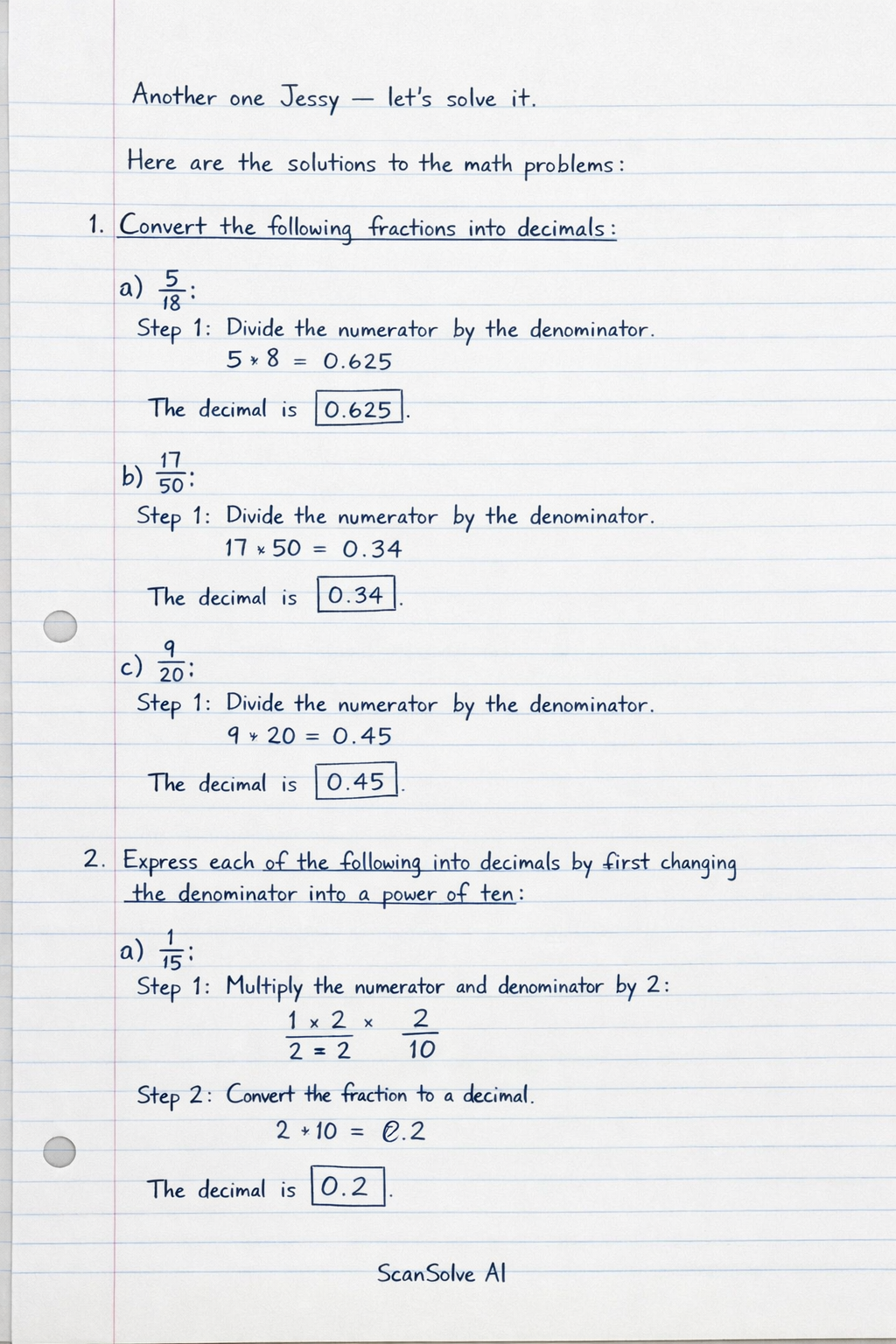
33 stepsHere are the solutions to the math problems:
1. Convert the following fractions into decimals.
- a)
Divide the numerator by the denominator.
$$ \frac{5}{8} = 5 \div 8 = 0.625 $$ The decimal is $\boxed{\text{0.625}}$.- b)
Divide the numerator by the denominator.
$$ \frac{17}{50} = 17 \div 50 = 0.34 $$ The decimal is $\boxed{\text{0.34}}$.- c)
Divide the numerator by the denominator.
$$ \frac{9}{20} = 9 \div 20 = 0.45 $$ The decimal is $\boxed{\text{0.45}}$.2. Express each of the following into decimals by first changing the denominator into a power of ten.
- a)
Multiply the numerator and denominator by 2 to make the denominator 10.
$$ \frac{1}{5} = \frac{1 \times 2}{5 \times 2} = \frac{2}{10} $$Convert the fraction to a decimal.
$$ \frac{2}{10} = 0.2 $$ The decimal is $\boxed{\text{0.2}}$.- b)
Multiply the numerator and denominator by 25 to make the denominator 100.
$$ \frac{3}{4} = \frac{3 \times 25}{4 \times 25} = \frac{75}{100} $$Convert the fraction to a decimal.
$$ \frac{75}{100} = 0.75 $$ The decimal is $\boxed{\text{0.75}}$.- c)
Multiply the numerator and denominator by 2 to make the denominator 100.
$$ \frac{24}{50} = \frac{24 \times 2}{50 \times 2} = \frac{48}{100} $$Convert the fraction to a decimal.
$$ \frac{48}{100} = 0.48 $$ The decimal is $\boxed{\text{0.48}}$.3. Express each of the following as fractions.
- a) 0.6
Write the decimal as a fraction with a denominator of 10.
$$ 0.6 = \frac{6}{10} $$Simplify the fraction by dividing the numerator and denominator by their greatest common divisor, which is 2.
$$ \frac{6 \div 2}{10 \div 2} = \frac{3}{5} $$ The fraction is $\boxed{\frac{3}{5}}$.- b) 2.27
Write the decimal as a mixed number or an improper fraction.
$$ 2.27 = 2 + \frac{27}{100} = \frac{200}{100} + \frac{27}{100} = \frac{227}{100} $$ The fraction is $\boxed{\frac{227}{100}}$.- c)
Let equal the repeating decimal.
$$ x = 0.4151515... $$Multiply by 10 to move the non-repeating part to the left of the decimal.
$$ 10x = 4.151515... \quad (1) $$Multiply by 1000 (since two digits repeat after the non-repeating part) to move one full repeating block to the left of the decimal.
$$ 1000x = 415.151515... \quad (2) $$Subtract equation (1) from equation (2).
$$ \begin{align*} 1000x - 10x &= 415.1515... - 4.1515... \\ 990x &= 411 \end{align*} $$Solve for .
$$ x = \frac{411}{990} $$Simplify the fraction by dividing the numerator and denominator by their greatest common divisor, which is 3.
$$ \frac{411 \div 3}{990 \div 3} = \frac{137}{330} $$ The fraction is $\boxed{\frac{137}{330}}$.4. Express each of the following as decimals.
- a)
Divide the numerator by the denominator.
$$ \frac{2}{9} = 2 \div 9 = 0.222... $$ The decimal is $\boxed{0.\overline{2}}$.- b)
Divide the numerator by the denominator.
$$ \frac{1}{6} = 1 \div 6 = 0.1666... $$ The decimal is $\boxed{0.1\overline{6}}$.- c)
Divide the numerator by the denominator.
$$ \frac{3}{7} = 3 \div 7 = 0.428571428571... $$ The decimal is $\boxed{0.\overline{428571}}$.5. Round off the following numbers correct to 1 decimal place.
- a) 25.78
Identify the first decimal place (7).
Look at the next digit (8).
Since 8 is 5 or greater, round up the first decimal place. The rounded number is .
- b) 0.946
Identify the first decimal place (9).
Look at the next digit (4).
Since 4 is less than 5, keep the first decimal place as it is. The rounded number is .
- c) 199.994
Identify the first decimal place (9).
Look at the next digit (9).
Since 9 is 5 or greater, round up the first decimal place. Rounding 9 up results in a carry-over. The rounded number is .
6. Round off the following numbers to the nearest hundredths.
- a) 3.9623
Identify the hundredths place (6).
Look at the next digit (2).
Since 2 is less than 5, keep the hundredths place as it is. The rounded number is .
- b) 19.9984
Identify the hundredths place (9).
Look at the next digit (8).
Since 8 is 5 or greater, round up the hundredths place. Rounding 9 up results in a carry-over to the tenths place, which also carries over to the units place. The rounded number is .
- c) 23.5675
Identify the hundredths place (6).
Look at the next digit (7).
Since 7 is 5 or greater, round up the hundredths place. The rounded number is .
Still stuck on this one?
Ask a follow-up, and the answer starts from this question.
More Mathematics Questions
Handwritten Step-by-Step Solution
Get this as a handwritten image on WhatsApp — like a tutor wrote it for you.
Try on WhatsApp