We read your photo as:

Find the coordinates of N, given A(6; -2), B(2; 15), C(-4; 3), and M is the midpoint of AB and MN || BC.

Mathematics

ScanSolve AI Answer

Step-by-step solution

5 steps
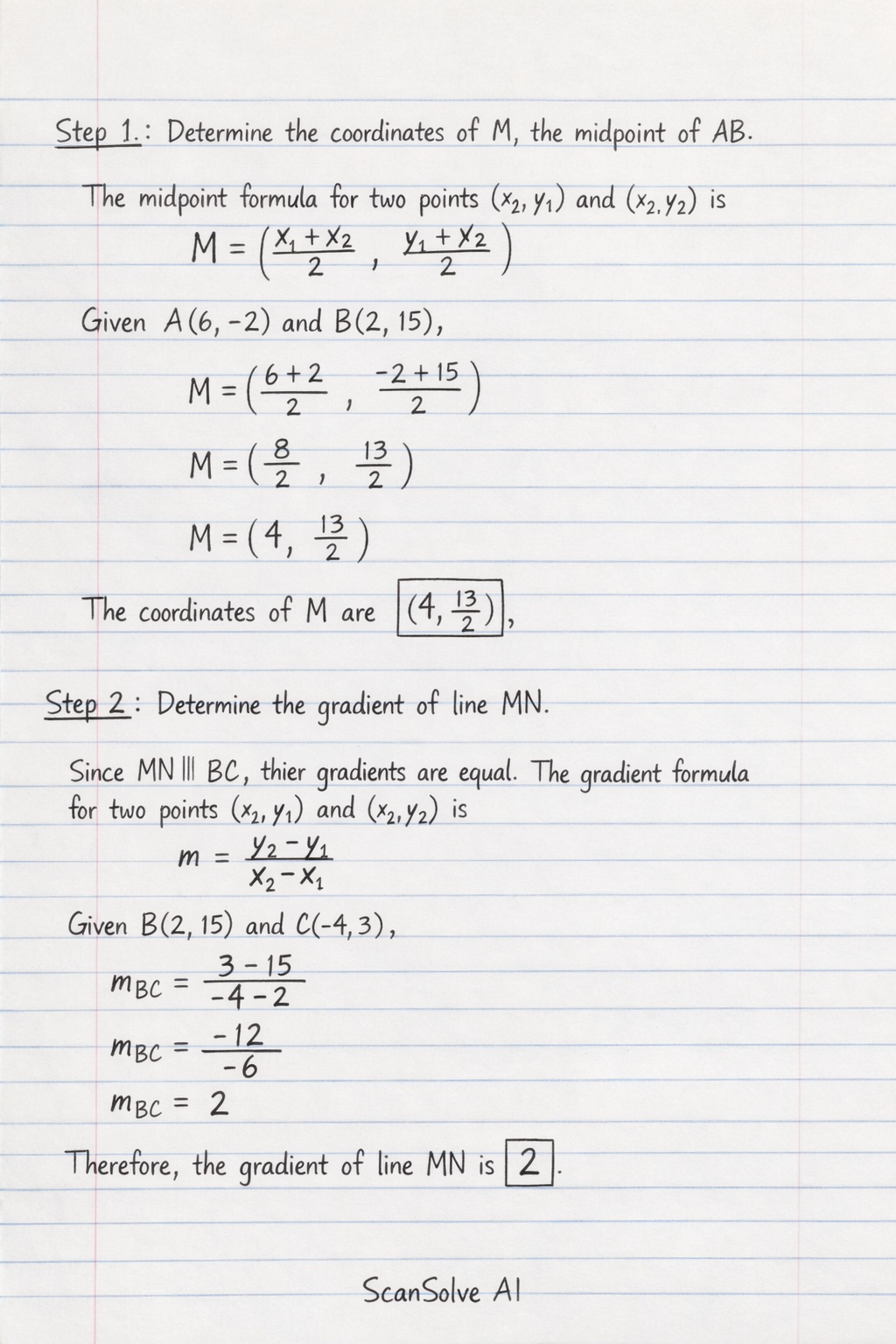
  1. Determine the coordinates of M, the midpoint of AB.

    The midpoint formula for two points (x1,y1)(x_1, y_1) and (x2,y2)(x_2, y_2) is M=(x1+x22,y1+y22)M = \left(\frac{x_1+x_2}{2}, \frac{y_1+y_2}{2}\right).
    Given A(6;−2)A(6; -2) and B(2;15)B(2; 15).

    M=(6+22,−2+152)M = \left(\frac{6+2}{2}, \frac{-2+15}{2}\right) M=(82,132)M = \left(\frac{8}{2}, \frac{13}{2}\right) M=(4,132)M = \left(4, \frac{13}{2}\right)

    The coordinates of M are (4,132)\boxed{\left(4, \frac{13}{2}\right)}.

  2. Determine the gradient of line MN.

    Since MN∥BCMN \parallel BC, their gradients are equal. The gradient formula for two points (x1,y1)(x_1, y_1) and (x2,y2)(x_2, y_2) is m=y2−y1x2−x1m = \frac{y_2-y_1}{x_2-x_1}.
    Given B(2;15)B(2; 15) and C(−4;3)C(-4; 3).

    mBC=3−15−4−2m_{BC} = \frac{3-15}{-4-2} mBC=−12−6m_{BC} = \frac{-12}{-6} mBC=2m_{BC} = 2

    Therefore, the gradient of line MN is 2\boxed{2}.

  3. Determine the equation of line MN in the form y=mx+cy = mx+c.

    We have the gradient mMN=2m_{MN} = 2 (from Step 2) and point M(4,132)M\left(4, \frac{13}{2}\right) (from Step 1).
    Using the point-slope form y−y1=m(x−x1)y - y_1 = m(x - x_1):

    y−132=2(x−4)y - \frac{13}{2} = 2(x - 4) y−132=2x−8y - \frac{13}{2} = 2x - 8 y=2x−8+132y = 2x - 8 + \frac{13}{2} y=2x−162+132y = 2x - \frac{16}{2} + \frac{13}{2} y=2x−32y = 2x - \frac{3}{2}

    The equation of line MN is y=2x−32\boxed{y = 2x - \frac{3}{2}}.

  4. Calculate, with reasons, the coordinates of point N.

    Given that MM is the midpoint of ABAB and MN∥BCMN \parallel BC.
    By the Midpoint Theorem (or its converse), if a line passes through the midpoint of one side of a triangle and is parallel to another side, then it bisects the third side.
    Therefore, NN is the midpoint of ACAC.
    Given A(6;−2)A(6; -2) and C(−4;3)C(-4; 3).

    N=(6+(−4)2,−2+32)N = \left(\frac{6+(-4)}{2}, \frac{-2+3}{2}\right) N=(22,12)N = \left(\frac{2}{2}, \frac{1}{2}\right) N=(1,12)N = \left(1, \frac{1}{2}\right)

    The coordinates of N are (1,12)\boxed{\left(1, \frac{1}{2}\right)}.

  5. If ABCD (in that order) is a parallelogram, determine the coordinates of point D.

    In a parallelogram, the diagonals bisect each other. This means the midpoint of ACAC is the same as the midpoint of BDBD.
    From Step 4, the midpoint of ACAC is N(1,12)N\left(1, \frac{1}{2}\right).
    Let D=(xD,yD)D = (x_D, y_D). The midpoint of BDBD is (xB+xD2,yB+yD2)\left(\frac{x_B+x_D}{2}, \frac{y_B+y_D}{2}\right).
    Given B(2;15)B(2; 15).
    Equating the midpoints:

    2+xD2=1  ⟹  2+xD=2  ⟹  xD=0\frac{2+x_D}{2} = 1 \implies 2+x_D = 2 \implies x_D = 0 15+yD2=12  ⟹  15+yD=1  ⟹  yD=1−15  ⟹  yD=−14\frac{15+y_D}{2} = \frac{1}{2} \implies 15+y_D = 1 \implies y_D = 1-15 \implies y_D = -14

    The coordinates of D are (0,−14)\boxed{(0, -14)}.

Was this helpful?

Still stuck on this one?

Ask a follow-up, and the answer starts from this question.

Got a different question?Ask your own question
Handwritten step-by-step solution preview

Handwritten Step-by-Step Solution

Get this as a handwritten image on WhatsApp — like a tutor wrote it for you.

Try on WhatsApp