
We read your photo as:
Déterminer l'équation réduite de la droite () passant par le point C(3; 2) et perpendiculaire à la droite (AB) d'équation y = 2x − 4.
ScanSolve AI Answer
Answer
Use the left and right arrow keys to trace the curve, up and down to jump between key points, and plus and minus to zoom.
| Point | x | y |
|---|---|---|
| y-intercept | 0 | −4 |
| x-intercept | 2 | 0 |
Step-by-step solution
2 stepsDéterminons (Determine )
On a l'équation de la droite : .
Le coefficient directeur de la droite est .
La droite est perpendiculaire à la droite .
Alors, le produit de leurs coefficients directeurs est : .
Donc, .
Alors, .
D'où : .Déterminons (Determine )
On a : .
La droite passe par le point .
Alors, on substitue les coordonnées du point dans l'équation de :
.
C'est-à-dire : .
C'est-à-dire : .
Alors : .
Alors : .
D'où, l'équation réduite de la droite est :The reduced equation of line is:
Try one yourself
A new problem that tests the same skill.
Still stuck on this one?
Ask a follow-up, and the answer starts from this question.
More Mathematics Questions
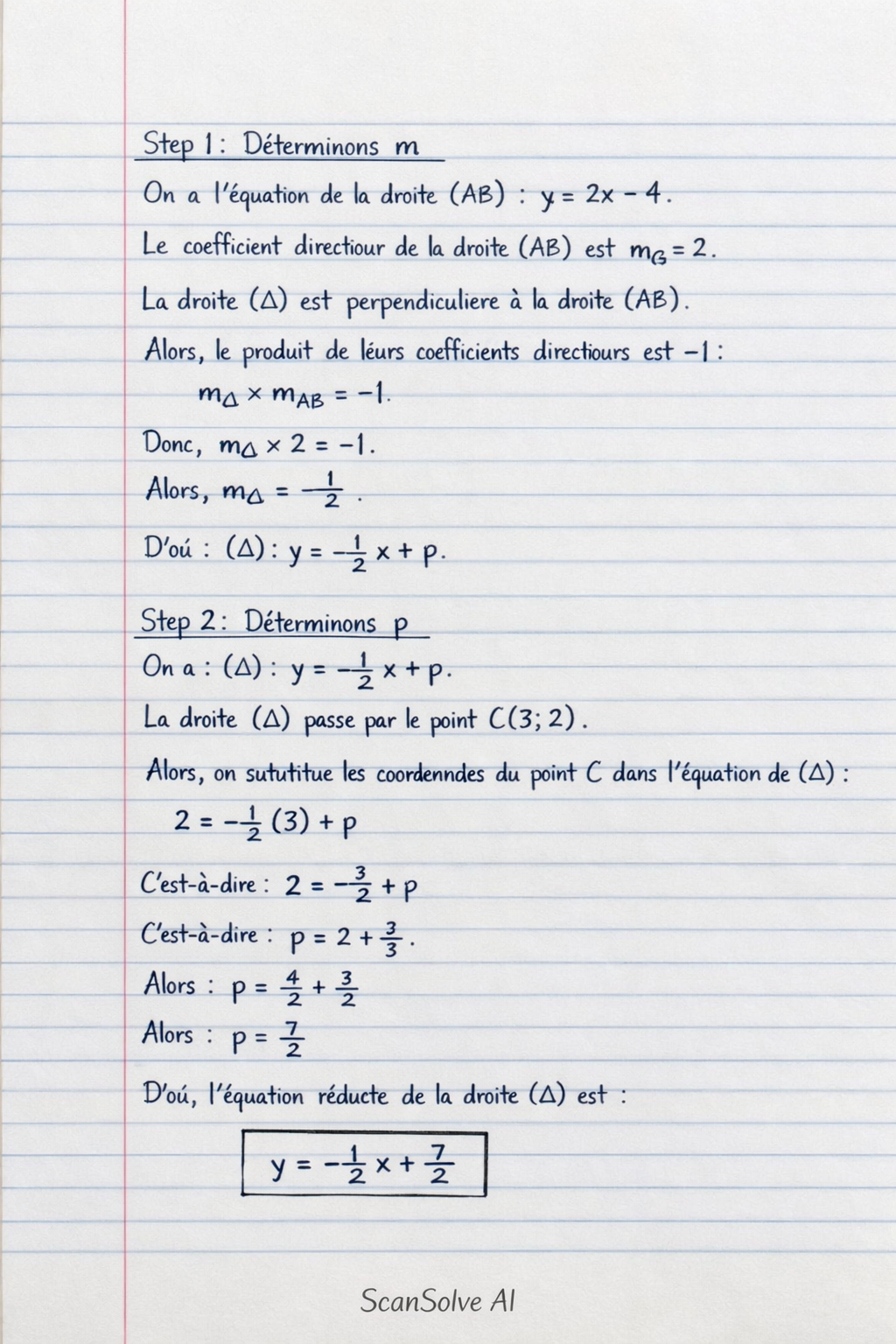
Handwritten Step-by-Step Solution
Get this as a handwritten image on WhatsApp — like a tutor wrote it for you.
Try on WhatsApp