We read your photo as:

Determine the derivative of the following: 1.1 f(x) = 5x³ − 4x² + 3x − 8 1.2 y = 3/x² - 4sqrt(x) + 3(x + 2)

Mathematics

ScanSolve AI Answer

Answers

4 parts
1.1

f′(x)=15x2−8x+3f'(x) = 15x^2 - 8x + 3

1.2

dydx=−6x3−2x+3\frac{dy}{dx} = -\frac{6}{x^3} - \frac{2}{\sqrt{x}} + 3

2.1

y=−10x+11y = -10x + 11

2.2

The graph is increasing at x=−5 because g′(−5)>0\text{The graph is increasing at } x = -5 \text{ because } g'(-5) > 0

(−310,−4920)\left(-\frac{3}{10}, -\frac{49}{20}\right)

p′(x)=10xp'(x) = 10x

Step-by-step solution

20 steps

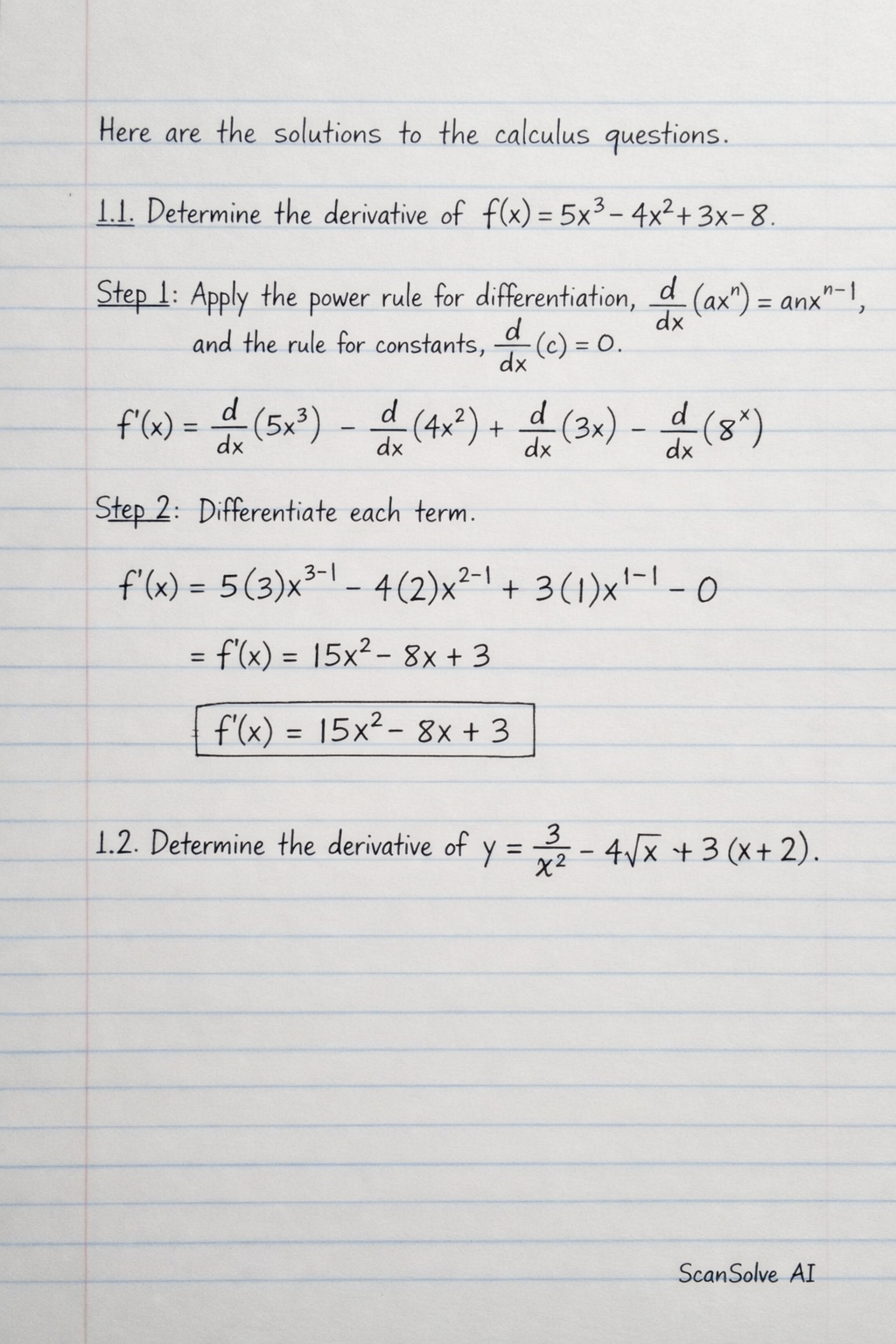
Here are the solutions to the calculus questions.

Part 1.1· 2 steps

Determine the derivative of f(x)=5x3−4x2+3x−8f(x) = 5x^3 - 4x^2 + 3x - 8.

  1. Apply the power rule for differentiation, ddx(axn)=anxn−1\frac{d}{dx}(ax^n) = anx^{n-1}, and the rule for constants, ddx(c)=0\frac{d}{dx}(c) = 0.

    f′(x)=ddx(5x3)−ddx(4x2)+ddx(3x)−ddx(8)f'(x) = \frac{d}{dx}(5x^3) - \frac{d}{dx}(4x^2) + \frac{d}{dx}(3x) - \frac{d}{dx}(8)
  2. Differentiate each term.

    f′(x)=5(3)x3−1−4(2)x2−1+3(1)x1−1−0f'(x) = 5(3)x^{3-1} - 4(2)x^{2-1} + 3(1)x^{1-1} - 0 f′(x)=15x2−8x+3f'(x) = 15x^2 - 8x + 3 f′(x)=15x2−8x+3\boxed{f'(x) = 15x^2 - 8x + 3}

Part 1.2

dydx=−6x3−2x+3\frac{dy}{dx} = -\frac{6}{x^3} - \frac{2}{\sqrt{x}} + 3

Determine the derivative of y=3x2−4x+3(x+2)y = \frac{3}{x^2} - 4\sqrt{x} + 3(x + 2).

  1. Rewrite the terms in the form axnax^n.

    y=3x−2−4x12+3x+6y = 3x^{-2} - 4x^{\frac{1}{2}} + 3x + 6
  2. Apply the power rule for differentiation to each term.

    dydx=ddx(3x−2)−ddx(4x12)+ddx(3x)+ddx(6)\frac{dy}{dx} = \frac{d}{dx}(3x^{-2}) - \frac{d}{dx}(4x^{\frac{1}{2}}) + \frac{d}{dx}(3x) + \frac{d}{dx}(6) dydx=3(−2)x−2−1−4(12)x12−1+3(1)x1−1+0\frac{dy}{dx} = 3(-2)x^{-2-1} - 4\left(\frac{1}{2}\right)x^{\frac{1}{2}-1} + 3(1)x^{1-1} + 0
  3. Simplify the expression.

    dydx=−6x−3−2x−12+3\frac{dy}{dx} = -6x^{-3} - 2x^{-\frac{1}{2}} + 3 dydx=−6x3−2x+3\frac{dy}{dx} = -\frac{6}{x^3} - \frac{2}{\sqrt{x}} + 3 dydx=−6x3−2x+3\boxed{\frac{dy}{dx} = -\frac{6}{x^3} - \frac{2}{\sqrt{x}} + 3}

Part 2.1

y=−10x+11y = -10x + 11

Determine the equation of the tangent passing through x=2x = 2 for g(x)=−3x2+2x−1g(x) = -3x^2 + 2x - 1.

  1. Find the y-coordinate of the point of tangency.

    Substitute x=2x = 2 into g(x)g(x):

    g(2)=−3(2)2+2(2)−1g(2) = -3(2)^2 + 2(2) - 1 g(2)=−3(4)+4−1g(2) = -3(4) + 4 - 1 g(2)=−12+4−1g(2) = -12 + 4 - 1 g(2)=−9g(2) = -9

    The point of tangency is (2,−9)(2, -9).

  2. Find the derivative of g(x)g(x) to get the gradient function.

    g′(x)=ddx(−3x2+2x−1)g'(x) = \frac{d}{dx}(-3x^2 + 2x - 1) g′(x)=−3(2)x2−1+2(1)x1−1−0g'(x) = -3(2)x^{2-1} + 2(1)x^{1-1} - 0 g′(x)=−6x+2g'(x) = -6x + 2
  3. Calculate the gradient of the tangent at x=2x = 2.

    Substitute x=2x = 2 into g′(x)g'(x):

    m=g′(2)=−6(2)+2m = g'(2) = -6(2) + 2 m=−12+2m = -12 + 2 m=−10m = -10
  4. Use the point-slope form y−y1=m(x−x1)y - y_1 = m(x - x_1) to find the equation of the tangent.

    Using (x1,y1)=(2,−9)(x_1, y_1) = (2, -9) and m=−10m = -10:

    y−(−9)=−10(x−2)y - (-9) = -10(x - 2) y+9=−10x+20y + 9 = -10x + 20 y=−10x+20−9y = -10x + 20 - 9 y=−10x+11y = -10x + 11 y=−10x+11\boxed{y = -10x + 11}

Part 2.2

The graph is increasing at x=−5 because g′(−5)>0\text{The graph is increasing at } x = -5 \text{ because } g'(-5) > 0

Is the graph of g(x)=−3x2+2x−1g(x) = -3x^2 + 2x - 1 increasing or decreasing at x=−5x = -5? Give a reason for your answer.

  1. Use the derivative g′(x)=−6x+2g'(x) = -6x + 2 (from 2.1).

  2. Evaluate the derivative at x=−5x = -5.

    g′(−5)=−6(−5)+2g'(-5) = -6(-5) + 2 g′(−5)=30+2g'(-5) = 30 + 2 g′(−5)=32g'(-5) = 32
  3. Determine if the graph is increasing or decreasing.

    Since g′(−5)=32>0g'(-5) = 32 > 0, the graph is increasing at x=−5x = -5.

    The graph is increasing at x=−5 because g′(−5)>0.\boxed{\text{The graph is increasing at } x = -5 \text{ because } g'(-5) > 0.}

    3. Determine the coordinate(s) of the stationary point(s) of h(x)=5x2+3x−2h(x) = 5x^2 + 3x - 2.

  4. Find the derivative of h(x)h(x).

    h′(x)=ddx(5x2+3x−2)h'(x) = \frac{d}{dx}(5x^2 + 3x - 2) h′(x)=5(2)x2−1+3(1)x1−1−0h'(x) = 5(2)x^{2-1} + 3(1)x^{1-1} - 0 h′(x)=10x+3h'(x) = 10x + 3
  5. Set the derivative equal to zero to find the x-coordinate(s) of the stationary point(s).

    10x+3=010x + 3 = 0 10x=−310x = -3 x=−310x = -\frac{3}{10}
  6. Substitute the x-coordinate back into the original function h(x)h(x) to find the y-coordinate.

    h(−310)=5(−310)2+3(−310)−2h\left(-\frac{3}{10}\right) = 5\left(-\frac{3}{10}\right)^2 + 3\left(-\frac{3}{10}\right) - 2 h(−310)=5(9100)−910−2h\left(-\frac{3}{10}\right) = 5\left(\frac{9}{100}\right) - \frac{9}{10} - 2 h(−310)=45100−90100−200100h\left(-\frac{3}{10}\right) = \frac{45}{100} - \frac{90}{100} - \frac{200}{100} h(−310)=45−90−200100h\left(-\frac{3}{10}\right) = \frac{45 - 90 - 200}{100} h(−310)=−245100h\left(-\frac{3}{10}\right) = \frac{-245}{100} h(−310)=−4920h\left(-\frac{3}{10}\right) = -\frac{49}{20}

    The coordinate of the stationary point is (−310,−4920)\left(-\frac{3}{10}, -\frac{49}{20}\right).

    (−310,−4920)\boxed{\left(-\frac{3}{10}, -\frac{49}{20}\right)}

    4. Given p(x)=5x2p(x) = 5x^2. Using first principles determine p′(x)p'(x).

  7. Write down the definition of the derivative from first principles.

    p′(x)=lim⁡h→0p(x+h)−p(x)hp'(x) = \lim_{h \to 0} \frac{p(x+h) - p(x)}{h}
  8. Substitute p(x+h)p(x+h) and p(x)p(x) into the formula.

    p(x+h)=5(x+h)2=5(x2+2xh+h2)=5x2+10xh+5h2p(x+h) = 5(x+h)^2 = 5(x^2 + 2xh + h^2) = 5x^2 + 10xh + 5h^2 p′(x)=lim⁡h→0(5x2+10xh+5h2)−5x2hp'(x) = \lim_{h \to 0} \frac{(5x^2 + 10xh + 5h^2) - 5x^2}{h}
  9. Simplify the numerator.

    p′(x)=lim⁡h→010xh+5h2hp'(x) = \lim_{h \to 0} \frac{10xh + 5h^2}{h}
  10. Factor out hh from the numerator and cancel it with the denominator.

    p′(x)=lim⁡h→0h(10x+5h)hp'(x) = \lim_{h \to 0} \frac{h(10x + 5h)}{h} p′(x)=lim⁡h→0(10x+5h)p'(x) = \lim_{h \to 0} (10x + 5h)
  11. Apply the limit as h→0h \to 0.

    p′(x)=10x+5(0)p'(x) = 10x + 5(0) p′(x)=10xp'(x) = 10x p′(x)=10x\boxed{p'(x) = 10x}
Was this helpful?

Try one yourself

A new problem that tests the same skill.

Still stuck on this one?

Ask a follow-up, and the answer starts from this question.

Got a different question?Ask your own question
Handwritten step-by-step solution preview

Handwritten Step-by-Step Solution

Get this as a handwritten image on WhatsApp — like a tutor wrote it for you.

Try on WhatsApp