
We read your photo as:
Find the derivative of y = (log x)^(log x), assuming log x means ln x.
ScanSolve AI Answer
Answer
Use the left and right arrow keys to trace the curve, up and down to jump between key points, and plus and minus to zoom.
| Point | x | y |
|---|---|---|
| Minimum | 2.33 | 0.69 |
Step-by-step solution
4 stepsTake the natural logarithm of both sides.
Given .
Taking the natural logarithm on both sides:Use the logarithm property .
Note that typically refers to in general contexts, but in calculus, it often implies (natural logarithm). However, given the explicit use of in the solution, it's safer to assume means or . If it were , the derivative would involve an extra factor of . Let's proceed assuming .
So, the equation becomes:Differentiate both sides with respect to using the chain rule and product rule.
The derivative of with respect to is .
For the right side, use the product rule where and .Using the chain rule for , let . Then .
Now apply the product rule:
Equate the derivatives and solve for .
Multiply both sides by :
Substitute back into the equation:
The final answer is .
Try one yourself
A new problem that tests the same skill.
Still stuck on this one?
Ask a follow-up, and the answer starts from this question.
More Mathematics Questions
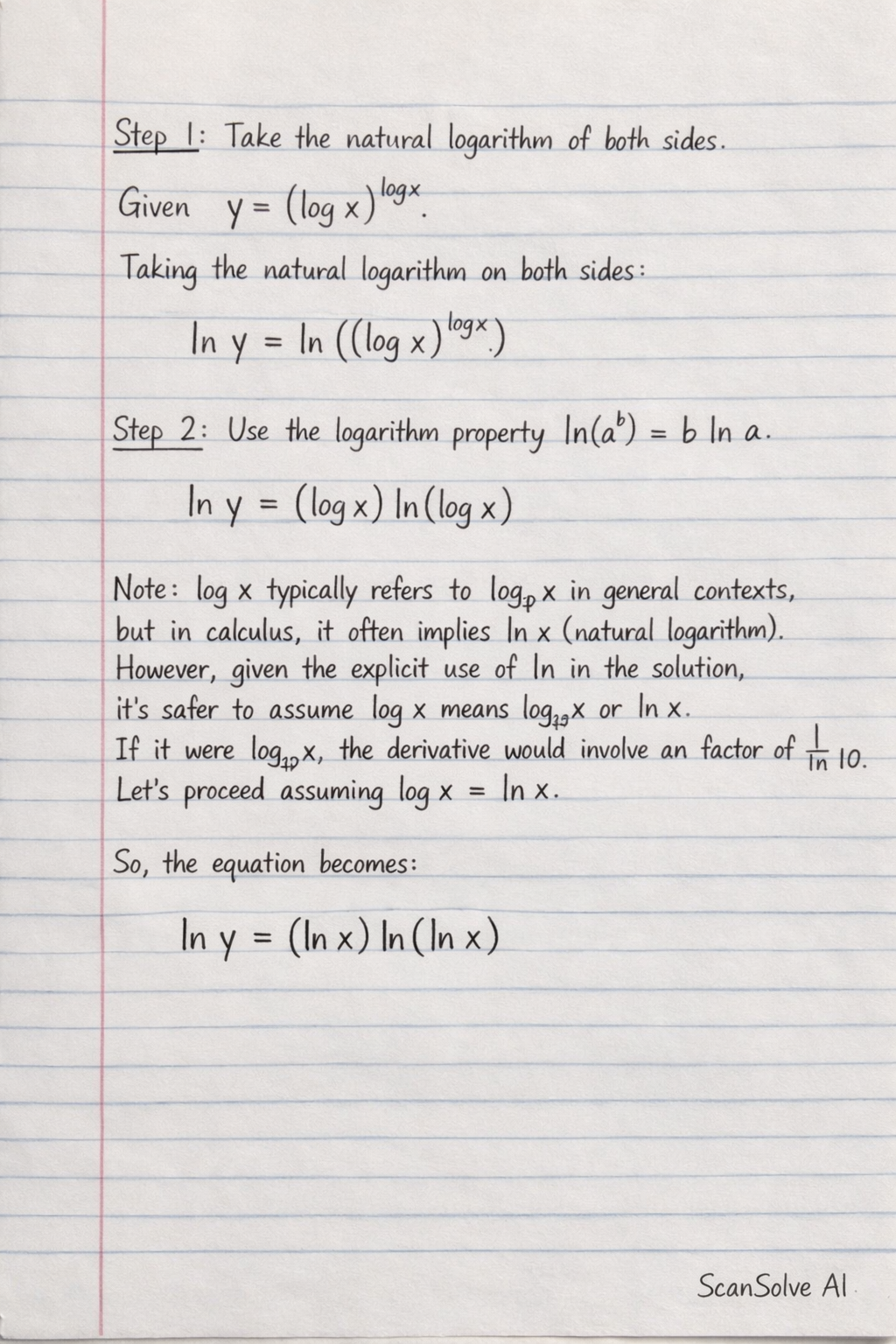
Handwritten Step-by-Step Solution
Get this as a handwritten image on WhatsApp — like a tutor wrote it for you.
Try on WhatsApp