
We read your photo as:
Differentiate the following functions: 1. y = x3 + x 2. y = x2 x 3. y = (x2 + x)/(x)
ScanSolve AI Answer
Step-by-step solution
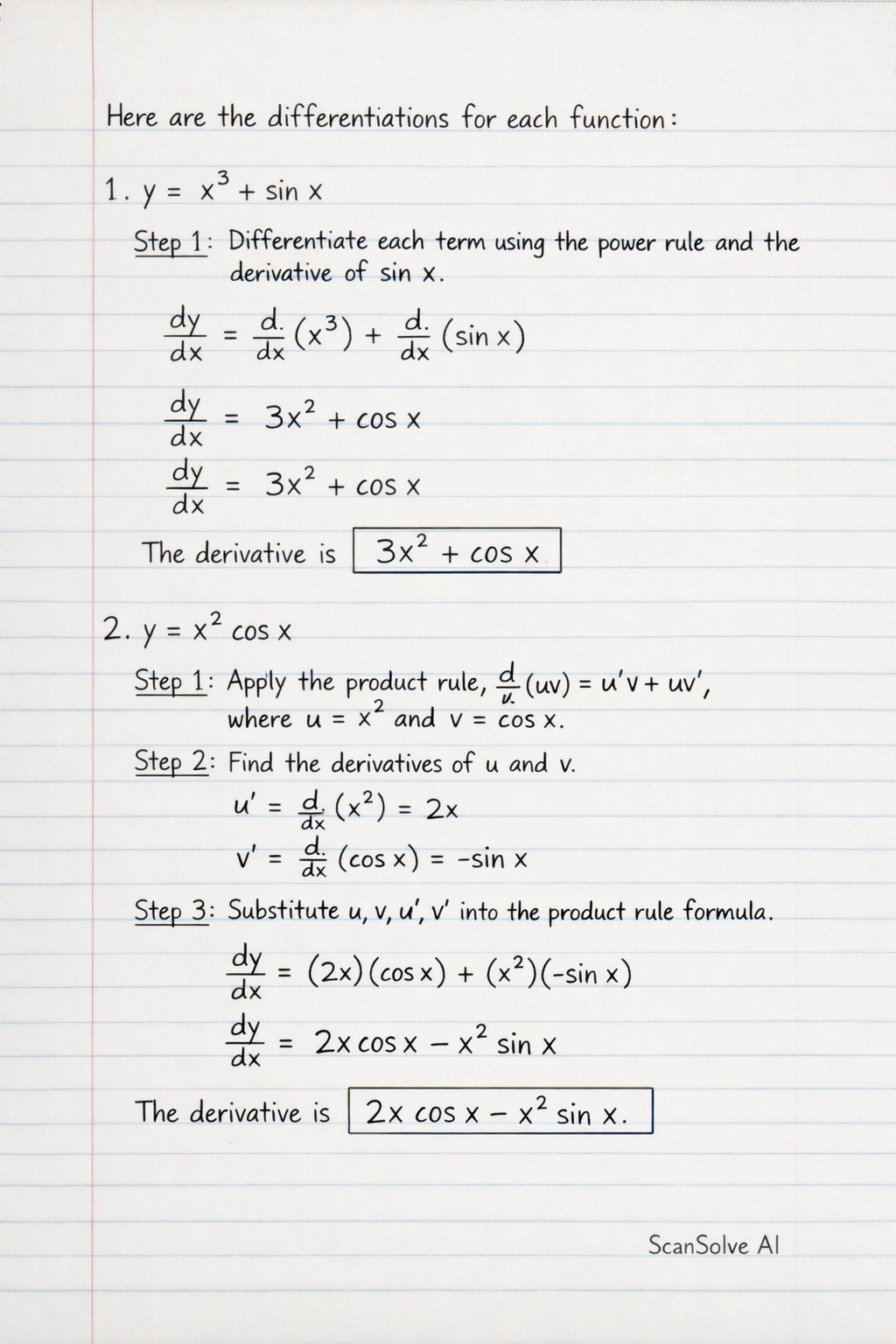
25 stepsHere are the differentiations for each function:
Differentiate each term using the power rule and the derivative of .
$$ \frac{dy}{dx} = \frac{d}{dx}(x^3) + \frac{d}{dx}(\sin x) $$ $$ \frac{dy}{dx} = 3x^{3-1} + \cos x $$ $$ \frac{dy}{dx} = 3x^2 + \cos x $$ The derivative is $\boxed{3x^2 + \cos x}$.2.
Apply the product rule, , where and .
Find the derivatives of and .
$u' = \frac{d}{dx}(x^2) = 2x$ $v' = \frac{d}{dx}(\cos x) = -\sin x$Substitute $u, v, u', v'$ into the product rule formula.
$$ \frac{dy}{dx} = (2x)(\cos x) + (x^2)(-\sin x) $$ $$ \frac{dy}{dx} = 2x \cos x - x^2 \sin x $$ The derivative is $\boxed{2x \cos x - x^2 \sin x}$.3.
Apply the quotient rule, , where and .
Find the derivatives of and .
$u' = \frac{d}{dx}(x^2 + \sin x) = 2x + \cos x$ $v' = \frac{d}{dx}(x) = 1$Substitute $u, v, u', v'$ into the quotient rule formula.
$$ \frac{dy}{dx} = \frac{(2x + \cos x)(x) - (x^2 + \sin x)(1)}{x^2} $$Simplify the expression.
$$ \frac{dy}{dx} = \frac{2x^2 + x \cos x - x^2 - \sin x}{x^2} $$ $$ \frac{dy}{dx} = \frac{x^2 + x \cos x - \sin x}{x^2} $$ The derivative is $\boxed{\frac{x^2 + x \cos x - \sin x}{x^2}}$.4.
Apply the product rule, , where and .
Find the derivatives of and .
$u' = \frac{d}{dx}(x^2 + 1) = 2x$ $v' = \frac{d}{dx}(\sin x) = \cos x$Substitute $u, v, u', v'$ into the product rule formula.
$$ \frac{dy}{dx} = (2x)(\sin x) + (x^2 + 1)(\cos x) $$ $$ \frac{dy}{dx} = 2x \sin x + (x^2 + 1) \cos x $$ The derivative is $\boxed{2x \sin x + (x^2 + 1) \cos x}$.5.
Apply the product rule, , where and .
Find the derivatives of and .
$u' = \frac{d}{dx}(x^3) = 3x^2$ $v' = \frac{d}{dx}(\tan x) = \sec^2 x$Substitute $u, v, u', v'$ into the product rule formula.
$$ \frac{dy}{dx} = (3x^2)(\tan x) + (x^3)(\sec^2 x) $$ $$ \frac{dy}{dx} = 3x^2 \tan x + x^3 \sec^2 x $$ The derivative is $\boxed{3x^2 \tan x + x^3 \sec^2 x}$.6.
Apply the quotient rule, , where and .
Find the derivatives of and .
$u' = \frac{d}{dx}(\cos x) = -\sin x$ $v' = \frac{d}{dx}(x^2) = 2x$Substitute $u, v, u', v'$ into the quotient rule formula.
$$ \frac{dy}{dx} = \frac{(-\sin x)(x^2) - (\cos x)(2x)}{(x^2)^2} $$Simplify the expression.
$$ \frac{dy}{dx} = \frac{-x^2 \sin x - 2x \cos x}{x^4} $$ $$ \frac{dy}{dx} = \frac{-x(x \sin x + 2 \cos x)}{x^4} $$ $$ \frac{dy}{dx} = \frac{-(x \sin x + 2 \cos x)}{x^3} $$ The derivative is $\boxed{\frac{-(x \sin x + 2 \cos x)}{x^3}}$.7.
Differentiate each term.
For , apply the product rule.
For and :
Differentiate .
$$ \frac{d}{dx}(x^2) = 2x $$Combine the derivatives.
$$ \frac{dy}{dx} = (\sin x + x \cos x) + 2x $$ $$ \frac{dy}{dx} = \sin x + x \cos x + 2x $$ The derivative is $\boxed{\sin x + x \cos x + 2x}$.8.
Apply the product rule, , where and .
Find the derivatives of and .
$u' = \frac{d}{dx}(x^2 + x) = 2x + 1$ $v' = \frac{d}{dx}(\cos x) = -\sin x$Substitute $u, v, u', v'$ into the product rule formula.
$$ \frac{dy}{dx} = (2x + 1)(\cos x) + (x^2 + x)(-\sin x) $$ $$ \frac{dy}{dx} = (2x + 1) \cos x - (x^2 + x) \sin x $$ The derivative is $\boxed{(2x + 1) \cos x - (x^2 + x) \sin x}$.9.
Apply the quotient rule,
Still stuck on this one?
Ask a follow-up, and the answer starts from this question.
More Mathematics Questions
Handwritten Step-by-Step Solution
Get this as a handwritten image on WhatsApp — like a tutor wrote it for you.
Try on WhatsApp